Setting up a Wholly Foreign-Owned Enterprise (WFOE) is usually the first step for foreign AI and tech companies entering China. But the process is more complex — and the decisions you make at setup matter more — than most foreign founders expect.
Get the structure right and everything that follows — hiring, licensing, financing, compliance — builds on a solid foundation. Get it wrong and you may need to restructure later, costing months of time and significant money.
This guide walks you through everything a foreign AI or tech company needs to know about WFOE setup in China in 2026: the structure options, the key decisions, the timeline, the costs, and the common mistakes to avoid.
Why a WFOE — and when you might not need one
A WFOE is a limited liability company in China that is 100% owned by foreign investors. It is the most common entry structure for foreign tech and AI companies because it gives you full control, lets you operate independently, and can generate revenue legally in China.
But a WFOE is not always the right first step. You may not need one (yet) if:
- Your product is purely cross-border. If you sell a SaaS product that is hosted outside China and you do not have employees or operations on the ground, you may be able to serve Chinese customers without a local entity — at least initially.
- You are still in market exploration. If you are not sure whether China is a priority market yet, you can start with market research and customer development before committing to an entity.
- You are entering through a partner. If you go to market through a local distributor or reseller, they may handle the regulatory side while you provide the product.
On the other hand, you do need a Chinese entity if:
- You need ICP filing or an ICP licence for your website or app
- Your product requires algorithm filing or generative AI registration
- You handle personal information of Chinese users on a significant scale
- You have employees working in China
- You need to invoice Chinese customers in RMB
- You want to access government grants, R&D subsidies, or tech park benefits
If you are not sure whether you need a WFOE yet, see our China Entry Readiness Checklist or read Do foreign companies need a Chinese entity to sell AI products in China?
The four big decisions at setup
Most of what matters about your WFOE is decided before you file a single form. These are the four decisions that will shape your China operation for years.
1. Entity structure: what type of WFOE?
There are several types of WFOE, and the type determines what you can do:
- Consulting / Service WFOE — The simplest and fastest to set up. Covers consulting, technical services, R&D, and software development. Many AI companies start here.
- Trading WFOE — For buying and selling goods. If you are a software company selling licences, a service WFOE usually suffices; if you sell hardware, you may need a trading WFOE.
- Manufacturing WFOE — For producing goods. Most AI software companies do not need this.
For AI and tech companies, a technology consulting / service WFOE is usually the right starting point. You can always expand the business scope later as you add products or services.
2. Registered capital: how much, and when to pay it in
Registered capital (注册资本) is the amount shareholders commit to contribute to the company. It is not a fee — it is your company’s stated capital base.
Key things to know:
- No legal minimum for most industries (since the 2014 Company Law reform). You could technically set it at RMB 1, but that would be a bad idea.
- It does not need to be paid in upfront. You specify a contribution schedule in the articles of association — typically over 10–30 years.
- It affects liability. Shareholders are liable up to the amount of registered capital. Set it too high and you carry unnecessary personal risk; set it too low and customers, partners, and regulators may not take you seriously.
- It affects licensing eligibility. Some licences (including ICP and EDI licences) have minimum registered capital requirements.
For AI and tech startups entering China, RMB 1–5 million is the most common range. We usually recommend RMB 2–3 million as a starting point — enough to be credible, not so much that it creates unnecessary risk. You can increase it later if needed.
3. Business scope: what you can do
The business scope (经营范围) is the list of activities your company is legally authorised to conduct. It is printed on your business licence.
Getting the business scope right is important. If you try to do something outside your scope, you could face penalties or be unable to issue invoices for that activity. Adding to the scope later is possible but takes time.
For AI companies, a typical business scope might include:
- Technology development, technical consulting, technical services
- Software development and sales
- Data processing services
- Artificial intelligence application software development
- Computer hardware and software sales
The exact wording matters — some categories are straightforward, others are restricted or require pre-approval. We help you design a scope that covers what you do now and what you reasonably expect to do later.
4. Location: where to register
Where you register your WFOE affects everything — tax rates, available subsidies, regulatory speed, talent pool, and cost. For AI companies, the main options are:
| City | District | Why AI companies choose it |
|---|---|---|
| Shenzhen | Nanshan Hi-Tech Park | China’s tech capital, deepest AI talent pool, most supportive policies for tech startups, fast registration |
| Shenzhen | Qianhai | Special economic zone with preferential tax rates (15% corporate income tax for qualifying companies) |
| Shanghai | Pudong / Zhangjiang | Strong for enterprise software, fintech, and multinational companies; deeper legal and financial services |
| Beijing | Haidian / Zhongguancun | Best for government relations, foundation model companies, and state-owned enterprise clients |
| Hangzhou | Binjiang | Strong for e-commerce AI and consumer AI; Alibaba ecosystem |
For most foreign AI and tech companies, Shenzhen Nanshan is the default choice. It has the most efficient registration process, the most tech-friendly policies, and the deepest pool of AI engineers.
The WFOE setup process step by step
Here is what the process actually looks like, from start to finish:
Step 1: Pre-establishment planning (weeks 1–2)
Before you file anything, you need to make the four big decisions above and prepare the documents. This is the most important step — rushing it leads to rework later.
What you need to prepare:
- Proposed company name (in Chinese)
- Registered address proof
- Shareholder documents (incorporation certificate, passport of legal representative)
- Proposed business scope
- Registered capital amount and contribution schedule
- Articles of association
- Appointment of legal representative, directors, supervisors
Step 2: Name approval (weeks 2–3)
You submit your proposed company name to the local Administration for Market Regulation (AMR). The name must follow the format: [City] [Name] [Industry] Co., Ltd.
Name approval usually takes 3–5 working days if the name is available and meets the rules. Common reasons for rejection: the name is too similar to an existing company, it contains restricted words, or it does not clearly state the industry.
Step 3: Business licence application (weeks 3–6)
With an approved name, you submit the full set of incorporation documents to the AMR. This includes the articles of association, shareholder information, appointment of officers, and registered address proof.
If everything is in order, you receive the business licence (营业执照) in about 5–10 working days. This is the official birth certificate of your company.
Step 4: Post-licence registrations (weeks 6–8)
Getting the business licence is not the end. There are several mandatory registrations:
- Seal carving — Official company seals (company seal, legal representative seal, financial seal, invoice seal)
- Bank account opening — Opening a basic RMB bank account
- Tax registration — Registering with the tax bureau, including VAT and corporate income tax
- Social insurance and housing fund registration — Mandatory if you plan to hire employees
- Foreign exchange registration — With SAFE (State Administration of Foreign Exchange), for cross-border transactions
- Customs registration — If you plan to import or export goods
Step 5: Additional licences (weeks 8–14+)
For AI companies, the business licence is the starting point, not the end. You will likely need additional licences depending on your product:
- ICP filing (10–20 working days) — Basic website registration
- ICP licence (60–90 working days) — If you charge for information services
- EDI licence — If you operate a platform or marketplace
- Algorithm filing / generative AI registration — If your product uses AI algorithms or generative AI
See our ICP filing vs ICP licence guide and algorithm filing guide for more on these.
Realistic timeline and costs
Timeline
| Stage | Time |
|---|---|
| Planning and document preparation | 1–2 weeks |
| Name approval | 3–5 working days |
| Business licence application | 5–10 working days |
| Post-licence registrations (seals, bank, tax, etc.) | 2–3 weeks |
| Total for basic WFOE | 6–8 weeks |
| + ICP filing | + 2–3 weeks |
| + ICP licence | + 2–3 months |
| + Algorithm filing | + 1–3 months |
| Total for AI product launch-ready | 3–6 months |
This assumes you have all documents ready and no surprises. If you need to gather foreign shareholder documents, get them notarised and apostilled, or make decisions about structure, add more time.
Costs
Setup costs for a WFOE vary depending on location, industry, and whether you use a service provider. Here is a rough breakdown:
| Item | Cost (approximate) |
|---|---|
| Government fees | ~RMB 0–1,000 (most fees waived for tech companies) |
| Registered address | RMB 5,000–20,000/year (if you do not have a physical office) |
| Legal / professional fees | RMB 15,000–50,000+ depending on complexity |
| Total one-time setup | RMB 20,000–70,000+ |
| Ongoing maintenance (accounting, tax filing) | RMB 500–2,000/month |
| Office rent (Shenzhen Nanshan) | RMB 5,000–20,000+/month depending on size |
For a more detailed breakdown, see How much does it cost to set up and operate an AI company in China?
Common mistakes foreign companies make
1. Choosing the wrong entity type
Some companies set up a representative office first, thinking it is cheaper and simpler, then discover they cannot actually do business through it and have to start over with a WFOE. If you are serious about the China market, start with a WFOE.
2. Setting registered capital too low or too high
Set it too low and you will struggle with credibility, licensing, and customer trust. Set it too high and you carry unnecessary liability and may face pressure to actually contribute the capital. RMB 2–3 million is a sensible starting point for most AI startups.
3. Getting the business scope wrong
A common mistake: copying your US or EU company’s description word-for-word into the Chinese business scope. China’s business scope uses specific, regulated categories. If your scope is too vague or uses the wrong categories, you may not be able to do business you intended — or you may be operating outside your registered scope, which is illegal.
4. Choosing the wrong registered address
Your registered address determines which district and which tax bureau you fall under — and that affects which policies and subsidies you can access. Many companies choose based on cost alone and miss out on thousands or even hundreds of thousands in R&D grants and tax incentives.
5. Not planning for licences
The business licence is just the beginning. For AI companies, the licence that actually matters is usually the ICP licence or algorithm filing — and those have their own requirements, timelines, and costs. Build all of this into your launch plan from the start, not as an afterthought.
6. Appointing the wrong legal representative
The legal representative (法定代表人) has significant legal authority in China — they can bind the company, sign contracts, and open bank accounts. Choose carefully. It should be someone you trust completely who understands the responsibility.
Special considerations for AI companies
AI companies face additional structural decisions that most other companies do not:
Training data and intellectual property. Where will your model weights and training data be held? If data is stored in China, you need to think about data security classification and cross-border data transfer rules. If the model is developed in China, who owns it — the China entity or the parent? These questions should be answered at setup, not after the model is trained.
Algorithm filing timeline. If your product requires algorithm filing, the filing can only be done by a Chinese entity. This means you need the WFOE set up before you can start the filing process — and the filing itself takes 1–3 months. Build this into your product launch timeline.
Talent and equity incentives. China’s AI talent market is competitive. You will need an equity incentive plan that works under Chinese law and tax rules to attract and retain the best people. It is easier to set this up at the beginning than to add it later.
VIE or not? For some restricted industries (like value-added telecom services), foreign companies cannot hold equity directly, and a VIE (Variable Interest Entity) structure is used. Most AI software companies do not need a VIE — but if your product falls into a restricted category, you may need one. Get advice early.
How Geason helps
We help foreign AI and tech companies set up WFOEs in China that are structured correctly from day one. Our approach:
- Structure first, filing second. We start by understanding your business model, product roadmap, and financing plans — then recommend the right structure, location, and business scope.
- Licence-aware setup. We do not just set up the company and leave. We design the structure so that you can get the licences you need (ICP, EDI, algorithm filing) without restructuring later.
- One team, end-to-end. Entity setup, employment, contracts, data compliance, algorithm filing — the same team handles all of it. You do not have to coordinate three different service providers.
- English, always. We communicate with you in English, explain everything clearly, and make sure your global legal team understands what is happening and why.
Learn more about our incorporation and entity structure services.
Next steps
If you are considering setting up a WFOE in China, the next step is a structured assessment:
- Determine whether you actually need a WFOE for your current stage and business model
- Choose the right structure, location, and registered capital
- Map out the licences you will need and their timelines
- Build a realistic timeline and budget for setup and launch
We offer a free initial consultation where we walk through your specific situation and give you clear recommendations — no pitch, no pressure.
Related resources
- China Entry Readiness Checklist — 25-point interactive checklist
- How long does it take to set up an AI company in China?
- How much does it cost to set up and operate an AI company in China?
- Do foreign companies need a Chinese entity to sell AI products in China?
- Glossary: China Entry Basics
The Real Cost of Entering China: Beyond Setup Fees
When budgeting for China entry, foreign companies often focus on the setup fees — business license, registered capital, legal fees — and underestimate the ongoing operational costs. The setup cost is real, but it is typically the smallest part of the total cost of being in China.
The major ongoing costs fall into several categories. First, people: salaries, benefits, social insurance (which adds about 30-40% on top of base salary), and housing fund contributions. Second, office and infrastructure: rent in Shenzhen or Shanghai is comparable to major Western cities, plus IT infrastructure and compliance systems. Third, compliance: annual audit, tax filing, regulatory filings, and legal advisory. Fourth, taxes: corporate income tax (25% standard rate, though high-tech enterprises qualify for 15%), VAT (6-13% depending on activity), and withholding tax on profit repatriation.
There are also less obvious costs. The opportunity cost of management time spent on China operations is significant. The cost of mistakes — a misfiled tax return, an employment dispute, a compliance gap — can be high. And the cost of doing business slowly — taking longer to hire, longer to get approvals, longer to reach profitability — adds up.
The companies that succeed in China are the ones that budget for the full picture, not just the setup fees. They plan for at least 18-24 months of operating runway before expecting the China entity to be self-sustaining.
Working with Chinese Partners and Distributors
Many foreign companies entering China consider working with a local partner or distributor as a way to accelerate market entry and reduce risk. Partners can provide local market knowledge, existing customer relationships, and regulatory expertise. But partnerships also come with challenges — and they rarely work out as well as expected without careful structuring and management.
The most common types of partners are: distributors (who buy your product and resell it), agents (who sell on your behalf for a commission), strategic partners (who invest in deeper collaboration), and licensing partners (who license your technology and sell their own products based on it). Each type has different implications for control, revenue share, and risk.
Key success factors for partnerships include: clear expectations from the beginning (what each side is responsible for, what the targets are, how success is measured), strong contracts (with clear terms for exclusivity, territory, pricing, IP protection, and termination), active management (partnerships need attention — they do not run themselves), and an exit strategy (what happens if it does not work out? How do you end the relationship cleanly?).
The biggest mistake companies make is treating the partnership as a shortcut that means they do not need to build their own China capability. In practice, even with a strong partner, you still need your own team on the ground to manage the relationship, protect your interests, and ensure you are learning about the market directly.
Common China Entry Mistakes and How to Avoid Them
After working with dozens of foreign companies entering the China market, we have seen the same mistakes repeated many times. Here are the most common ones — and how to avoid them.
Mistake 1: Underestimating the time and cost. Many companies budget for setup fees but not for the first 1-2 years of operating losses. China entry is an investment, and you need adequate runway.
Mistake 2: Putting the wrong person in charge. The first China hire — usually the country manager or GM — is the most important decision you will make. A bad hire can set you back a year or more. Take the time to find the right person, even if it means the process takes longer.
Mistake 3: Treating compliance as an afterthought. Some companies launch first and figure out compliance later. This is risky in China, where enforcement is increasing and penalties can be significant. Building compliance in from the start is cheaper and less stressful than fixing it later.
Mistake 4: Not protecting IP early enough. Register your trademarks, copyrights, and patents before you come. China is first-to-file, and if someone else registers your brand before you do, it is expensive and time-consuming to fix.
Mistake 5: Trying to do everything yourself. You need local advisors who know the market, the regulations, and the culture. A good lawyer, accountant, and recruiter are worth their fees many times over. The key is finding the right advisors who understand your industry and your stage of growth.
Hiring Your First China Employees: Key Considerations
Your first employees in China will shape the culture, direction and trajectory of your China operation. Getting the hiring right — especially for the country lead role — is one of the most important factors in China entry success.
The China country lead needs a rare combination of skills: deep understanding of the local market, ability to work with foreign headquarters, technical credibility in your industry, and the leadership skills to build a team from scratch. Finding someone who has all four is challenging, and many companies underestimate how long this search takes.
Employment law in China also differs from what many foreign companies are used to. Employment contracts are mandatory, probation periods have strict limits, and termination is more regulated — ‘at will’ employment does not exist. Social insurance (pension, medical, unemployment, work injury, maternity) and the housing fund are mandatory contributions that add significantly to total compensation cost.
For AI companies specifically, there is also the question of where to locate. Shenzhen is the natural choice for hardware and AI companies — it has the deepest talent pool, the strongest supply chain, and the most supportive policy environment. But competition for top AI talent is intense, and salaries have risen rapidly. Budget accordingly.
Related guides in this series
- China AI Regulation 2026: The Complete Guide for Foreign Companies
- Do I Need a Chinese Entity? When to Set Up and When to Stay Cross-Border
- ICP Filing, ICP Licence & EDI Licence: A Guide for Foreign Companies in China (2026)
Related Articles
- Trading WFOE in China: Setup, Costs and Compliance for Import/Export Companies
- Do I Need a Chinese Entity? When to Set Up and When to Stay Cross-Border
- China Product Certification: CCC, CQC, SRRC and More — A Complete Guide for Foreign Hardware Companies
- ICP Filing, ICP Licence & EDI Licence: A Guide for Foreign Companies in China (2026)
FAQ
Q1: What industries are restricted for foreign investment in China?
A1: China publishes a Foreign Investment Negative List that specifies industries where foreign investment is prohibited or restricted. Prohibited sectors include certain news media, compulsory education institutions, and some rare earth mining. Restricted sectors where foreign ownership is limited include telecommunications, education, healthcare, financial services, and agriculture. The negative list is periodically updated, generally becoming more open over time. Industries not on the negative list receive national treatment, meaning foreign investors enjoy the same treatment as domestic investors.
Q2: What is the minimum registered capital for a WFOE?
A2: China abolished the statutory minimum registered capital requirement for most industries in 2014 under the注册资本认缴登记制 (subscription system). However, companies must still specify a registered capital amount and contribution timeline in their articles of association. The practical registered capital amount should reflect the actual operational needs of the business and the industry norms. Some regulated industries still have minimum capital requirements, such as banking, insurance, securities, and certain types of consulting businesses.
Q3: What is the difference between a WFOE and a joint venture in China?
A3: A WFOE (Wholly Foreign-Owned Enterprise) is a limited liability company entirely owned by foreign investors, offering full control over operations but requiring the foreign investor to handle all aspects of market entry independently. A joint venture involves partnering with a Chinese shareholder, which can provide market access, local expertise, and government relationships but requires sharing control and profits. The choice depends on the industry (some sectors require joint ventures under the negative list), the level of local market knowledge needed, and the desired degree of operational control.
Q4: How long does it typically take to set up a WFOE in China?
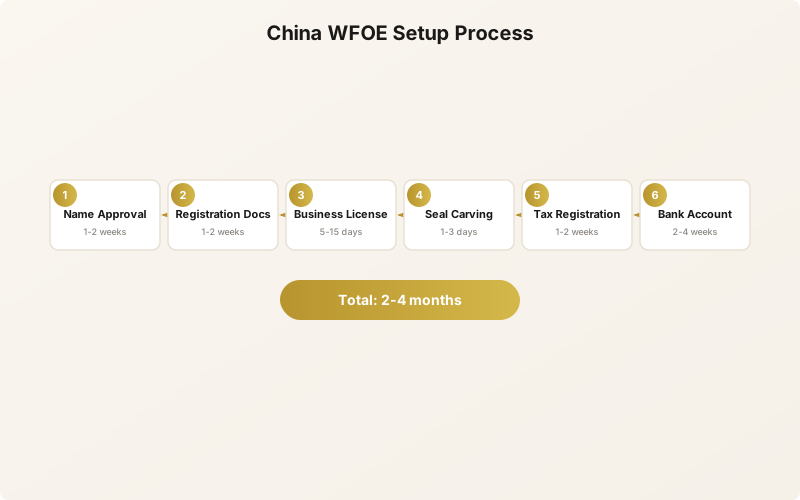
A4: The WFOE setup process typically takes 2-4 months from start to finish, depending on the industry and location. The timeline includes: name approval (1-2 weeks), preparing registration documents (1-2 weeks), business license application (5-15 business days), seal carving (1-3 days), tax registration (1-2 weeks), bank account opening (2-4 weeks), and any special industry licenses (variable timeline). Certain restricted industries may require additional approvals that can significantly extend the timeline.
Q5: Can a foreign company hire employees in China without a local entity?
A5: Foreign companies cannot directly hire employees in China without establishing a legal entity. The common alternatives include using a PEO (Professional Employer Organization) or staffing agency for temporary or initial staffing needs, engaging independent contractors (though this carries misclassification risks), or establishing a representative office (which is limited to non-commercial activities like market research and liaison work). For ongoing business operations, establishing a WFOE or joint venture is the proper way to hire local employees directly and issue employment contracts.
Frequently Asked Questions↑ Back to article
How long does it take to set up a WFOE in China?
A standard WFOE setup takes roughly 2–3 months from document preparation to final registration. For AI and tech companies, additional licences (ICP, algorithm filing) can add 1–3 more months. The timeline varies by location and industry.
How much registered capital does a WFOE need?
There is no legal minimum for most industries, but registered capital matters for credibility, licensing eligibility, and liability. For AI and tech companies, RMB 1–5 million is common. The capital does not need to be paid in all at once — it is contributed over the company's operating term.
Can a foreign company sell AI products in China without a WFOE?
It depends on the product and business model. Some services can be provided cross-border without a local entity. But if you need ICP filing, algorithm registration, handle Chinese user personal information, or have employees in China, you typically need a domestic entity.
What is the difference between a WFOE and a representative office?
A WFOE is a full legal entity that can generate revenue, sign contracts, hire employees, and hold assets. A representative office (RO) can only do market research and liaison work — it cannot generate revenue or sign commercial contracts. Most serious market entries use a WFOE.
Where should I register my WFOE — Shenzhen, Shanghai, or Beijing?
For AI and tech companies, Shenzhen (especially Nanshan district) is often the best choice — it has the most supportive policies for tech companies, the deepest AI talent pool, and the most efficient registration process. Shanghai is strong for fintech and enterprise software; Beijing for government relations and foundation model companies.
What are common mistakes foreign companies make when setting up a WFOE?
The most common mistakes include choosing the wrong entity type (setting up a representative office first when they need a WFOE), setting registered capital too low or too high (which affects credibility, licensing eligibility, and liability), getting the business scope wrong by copying foreign company descriptions instead of using proper Chinese regulatory categories, choosing the wrong registered address based solely on cost and missing out on district-specific policies and subsidies, not planning for additional licenses (the business license is just the start), and appointing the wrong legal representative who has significant authority to bind the company. Avoiding these mistakes saves months of time and significant restructuring costs.
What special considerations do AI companies face for WFOE setup in China?
AI companies face additional structural decisions that most other companies do not. Training data and IP location matters — if data and model weights are stored in China, you must comply with data security classification and cross-border data transfer rules, and ownership of models developed in China must be clearly defined. Algorithm filing can only be done by a Chinese entity, so you need the WFOE set up before starting the filing process, which takes 1-3 additional months. Talent competition is intense — equity incentive plans that work under Chinese law are essential for attracting and retaining AI talent. Finally, some AI product categories may require VIE structures if they fall into restricted industries, though most AI software companies do not need one.