Key Takeaways
- A trading WFOE is the right structure when you need to buy/sell goods in China, issue local VAT invoices, and control import/export operations — but it requires significant setup and ongoing compliance.
- Registered capital of RMB 500K–2M (USD 70K–280K) is typical, despite China having no legal minimum.
- The full setup process takes 3–5 months with 10+ registration steps.
- Total setup costs range from USD 5,000–20,000 in fees, plus capital and office lease.
- Alternatives like Chinese trading companies or cross-border e-commerce may suit low-volume operations.
1. Introduction
For foreign hardware and tech companies selling into or sourcing from China, the question of whether to establish a local trading entity is rarely simple. China is both the world’s factory floor and a top consumer market, yet setting up a local company involves legal complexity, ongoing costs, and long-term commitment.
Many foreign companies begin without a local entity — working with Chinese trading partners, sourcing agents, or cross-border e-commerce. This works for market testing or low-volume purchases. But as you scale, limitations emerge: you cannot issue VAT invoices (fapiao), you have limited control over pricing and distribution, and you cannot directly employ staff or hold local assets.
A trading Wholly Foreign-Owned Enterprise (WFOE) bridges this gap. It gives you a fully-owned Chinese legal entity authorized to import, export, buy, sell, and distribute goods within China. It can issue VAT invoices, hire employees directly, and transact in RMB.
This guide covers what a trading WFOE is, when it makes sense, how to set one up, costs, compliance obligations, and alternatives.
2. What Is a Trading WFOE?
A trading WFOE is a limited liability company registered in China, 100% owned by a foreign investor, with a business license authorizing commercial activities involving physical goods.
What It Can and Cannot Do
A trading WFOE can import/export directly, buy and sell domestically (wholesale, retail, distribution), issue VAT invoices, hire employees, open RMB and foreign currency accounts, hold IP in China, and provide related services like installation or after-sales support (if in scope).
It cannot manufacture goods (requires a manufacturing WFOE), trade restricted categories without special licenses, or operate outside its approved business scope.
Trading WFOE vs. Other WFOE Types
Consulting/service WFOEs are limited to services and advisory — they cannot trade physical goods. Manufacturing WFOEs produce goods but require factory facilities and environmental approvals. Trading WFOEs sit in the middle: higher capital than consulting WFOEs but simpler than manufacturing, with setup timelines of 3–5 months vs. 2–3 months for consulting and 4–8+ months for manufacturing.
3. When to Set Up a Trading WFOE
A trading WFOE makes sense when strategic and financial benefits outweigh setup and compliance costs. Key scenarios:
High import/export volume. When annual trade reaches several million USD, controlling your own customs clearance, VAT recovery, and foreign exchange saves money and reduces risk.
Need for local billing. Chinese customers — especially SOEs and large domestic firms — require VAT invoices (fapiao) to process payments and claim input credits. Without a local entity, this is a dealbreaker for B2B sales.
Tax optimization. A trading WFOE can recover import VAT as input credit. Transfer pricing between overseas parent and Chinese entity can be structured for tax efficiency, subject to arm’s-length rules.
Customer trust and market access. A local entity signals commitment and eases relationship-building. Some government tenders are only open to locally registered companies.
Supply chain control. Direct control over procurement, QC, inventory, and logistics. Consolidate shipments, manage warehousing, negotiate with factories in RMB.
Local after-sales support. Essential for hardware companies — employ technicians and hold spare parts inventory locally.
Alternatives work better when testing the market with low volumes, selling cross-border only, sourcing occasionally, or providing services rather than goods.
4. Setup Process Step by Step
Setting up a trading WFOE involves a structured sequence of registrations. Total timeline: 3–5 months.
Step 1: Name Pre-Approval (1–2 weeks). Submit 3–5 proposed names to the AMR. Format: [City] [Trade Name] Trading Co., Ltd.
Step 2: Prepare Incorporation Documents (2–4 weeks). Many documents need notarization and consular authentication in your home country: parent company certificate of incorporation (notarized/apostilled), bank reference letter, passport copies of directors/legal rep, address proof, articles of association, business plan.
Step 3: Business License Application (2–4 weeks). Submit documents to AMR with a scope including “import and export of goods” and product categories. Receive a unified social credit code license.
Step 4: Seal Carving (1 week). Carve official seals (company, legal rep, financial, invoice, contract) and register with public security.
Step 5: Bank Account Opening (1–2 weeks). Open a basic RMB account plus foreign currency capital and settlement accounts.
Step 6: Tax Registration (1–2 weeks). Register with STA and apply for general taxpayer status (essential for VAT invoices and input credits).
Step 7: Import-Export Operator Filing (1–2 weeks). File with Commerce Bureau for the Foreign Trade Operator Registration Certificate.
Step 8: Customs Registration (1–2 weeks). Register with GAC for a customs code required for all declarations.
Step 9: e-Port IC Card (1–2 weeks). Required for online customs declaration and duty payment.
Step 10: Foreign Exchange Registration (1–2 weeks). Register with SAFE for foreign exchange verification and settlement rights.
Step 11: Inspection, Quarantine, and Special Licenses. Product-dependent filings for food, cosmetics, electronics, CCC-regulated products. Regulated goods (medical devices, hazardous chemicals, telecom) need additional licenses adding weeks or months.
5. Registered Capital Requirements
China eliminated statutory minimum registered capital for most industries in 2014, switching from paid-in to subscribed capital. Shareholders specify an amount and timeline in the articles of association, without full upfront deposit.
However, trading WFOEs face practical requirements well above zero.
Typical Ranges
| Scenario | Registered Capital | USD Equivalent |
|---|---|---|
| Basic trading (narrow scope) | RMB 500K – 1M | ~$70K – $140K |
| Standard import/export | RMB 1M – 2M | ~$140K – $280K |
| Broad product scope | RMB 2M – 5M | ~$280K – $700K |
Authorities expect capital to cover 6–12 months of operating expenses. Amount depends on scope breadth, general taxpayer applications, and local district thresholds.
Under the subscribed system, the contribution period is typically 10–30 years. Inject 20–30% in the first year to fund operations and show genuine activity.
Common Misconceptions
- “RMB 1 capital is enough”: Legally possible, practically impossible — applications face rejection or scrutiny.
- “Capital must be fully paid upfront”: No, phased contributions are allowed.
- “More is always better”: Higher capital means higher stamp duty (0.025%) and liability. Choose what you need.
6. Key Licenses and Registrations
A trading WFOE requires more than just a business license:
Business License with Trading Scope. Foundational document. Scope must include “import and export of goods” (货物进出口) and product categories.
Foreign Trade Operator Registration Certificate. From Commerce Bureau — confirms foreign trade eligibility.
Customs Registration Certificate. From GAC — assigns a 10-digit customs code.
e-Port IC Card. Digital identity for electronic customs declaration and online duty payment.
Inspection and Quarantine Filing. Required for food, cosmetics, electronics, and CCC-regulated products.
Foreign Exchange (SAFE) Registration. Enables foreign currency payments, export proceeds receipt, and currency settlement.
Tax Registration and General Taxpayer Status. Critical — only general taxpayers issue special VAT invoices that B2B customers need for input credits. Small-scale status is usually insufficient.
7. Costs of Setting Up and Running
Setup Costs
| Category | Cost Range (USD) | Notes |
|---|---|---|
| Agency / professional fees | $3,000 – $15,000 | Varies by firm, scope, city |
| Government fees | $200 – $1,000 | Seals, registration, e-port |
| Document legalization | $500 – $2,000 | Notarization, apostille, translation |
| Registered capital | $70,000 – $280,000+ | Equity, not an expense |
| Office lease (deposit + initial) | $2,000 – $10,000+ | Required for address |
Total setup cost (excl. capital): $5,000 – $20,000+
Ongoing Costs
| Category | Cost (USD) | Notes |
|---|---|---|
| Accounting | $300 – $1,000 / month | Varies by volume |
| Annual audit | $1,000 – $3,000 / year | Required |
| Office rent | $1,000 – $5,000+ / month | Tier-1 cities more |
| Staff salaries | $2,000 – $8,000 / month/person | Min: legal rep, finance |
| Social insurance & housing fund | ~40% of salary | Mandatory |
Key Tax Rates
- CIT: 25% on profits. 15% for qualified high-tech enterprises.
- VAT: 13% for most goods (general taxpayer rate). Import VAT recoverable as input credit.
- Stamp Duty: 0.03% on sales contracts, 0.025% on capital.
- Customs Duties: Vary by HS code, 0% to 50%+.
- Withholding Tax: 10% on dividends (reduced under tax treaties to 5–10%).
8. Compliance Requirements
Operating a trading WFOE carries substantial ongoing obligations. Non-compliance can result in fines, license suspension, or criminal liability.
Annual Reporting. Submit to AMR by June 30 each year with financial and operational info. Failure leads to “abnormal” status and potential revocation.
Tax Filing. General taxpayers file monthly VAT returns, quarterly CIT prepayments, and annual CIT reconciliation (汇算清缴) due May 31. Late penalties start at RMB 200/day.
Customs Compliance. Declarations must be accurate and timely. Misclassification, undervaluation, or missing docs cause penalties, delays, or smuggling allegations. Regular internal audits recommended.
Foreign Exchange Compliance. Cross-border payments must be documented and match customs declarations. Related-party transactions need arm’s-length pricing with contemporaneous documentation.
Labor Compliance. Written contracts, minimum wage, social insurance/housing fund, and working hour rules are mandatory. Labor disputes are common and costly.
Common Pitfalls. Understating revenue/overstating expenses, incorrect HS codes, mixing personal and company funds, missing transfer pricing docs, and failing to update registrations.
9. Alternatives to a Trading WFOE
Chinese Trading Company. Import/export firms act as buyer/seller of record, handling customs, VAT, and forex. Fast setup (plug-and-play), but charge 2–5% commission and you cede control over relationships and pricing.
Sourcing Agent. Manages suppliers, QC, and logistics for China sourcing. Low cost and flexible, but limited value-added and no domestic sales capability.
Cross-Border E-Commerce. Platforms like Tmall Global or JD Worldwide use bonded warehouses — sell to Chinese consumers without a local entity. Good for B2C, less for B2B hardware.
Representative Office (RO). Low-cost presence for marketing, liaison, research. But ROs cannot make profit, issue invoices, or sign contracts. Many start with an RO and upgrade.
Local Distributor. Immediate market access with minimal upfront investment. Trade-off: less control over pricing, brand, and customer data.
10. Choosing a Service Provider
Virtually all foreign companies use a professional services firm for WFOE setup. The process involves multiple agencies, Chinese documentation, and nuanced regulations hard to navigate remotely.
What to Look For
- Trading WFOE experience. Many firms specialize in consulting WFOEs but lack import/export expertise. Ask for industry references.
- Multi-disciplinary capabilities. Incorporation plus accounting, tax, HR, customs — ideally one provider.
- English capability. Clear communication and bilingual docs.
- Local presence. Regulations vary by city.
- Transparent fees. Avoid lowball quotes with hidden charges.
Setup fees: USD 3,000–15,000. Ongoing accounting is monthly retainer.
Red Flags and Questions
Beware prices far below market, unrealistic timelines, no physical office, or reluctance to give references. Ask: How many trading WFOEs did you set up here last year? Do you handle customs in-house? Total first-year cost? Can you provide hardware/tech references?
11. Common Mistakes to Avoid
Underestimating registered capital. Setting it too low causes problems with general taxpayer status, scope expansion, and reviews. Start with 6–12 months of expenses.
Not planning for general taxpayer status. Many start as small-scale taxpayers for simplicity, then find customers need special VAT invoices. Plan for general taxpayer from day one for B2B.
Ignoring customs compliance. China’s customs uses advanced analytics and risk targeting. Even one misclassified product triggers audits and penalties. Invest in proper classification.
Choosing the wrong business scope. Too narrow means frequent amendments; too broad raises red flags. Work with advisors for an accurate yet flexible scope.
Lacking transfer pricing documentation. Related-party transactions need contemporaneous arm’s-length documentation. Tax authorities actively audit these, with severe penalties for non-compliance.
12. Key Takeaways
A trading WFOE gives foreign hardware and tech companies full control over import/export, domestic sales, and supply chain in China — but requires 3–5 months of setup, USD 5K–20K in costs, and ongoing compliance.
Before proceeding, assess whether: your China trade volume justifies the complexity, customers require local VAT invoicing, you need direct control over pricing and distribution, and you are prepared for reporting obligations.
If yes, a trading WFOE is likely right. If testing the market or at lower volumes, start with a trading partner, distributor, or cross-border e-commerce — and upgrade later.
Work with experienced advisors who know both the regulations and your industry. The right partner saves months of delay, thousands in costs, and the frustration of navigating China’s bureaucracy from abroad.
Working with Chinese Partners and Distributors
Many foreign companies entering China consider working with a local partner or distributor as a way to accelerate market entry and reduce risk. Partners can provide local market knowledge, existing customer relationships, and regulatory expertise. But partnerships also come with challenges — and they rarely work out as well as expected without careful structuring and management.
The most common types of partners are: distributors (who buy your product and resell it), agents (who sell on your behalf for a commission), strategic partners (who invest in deeper collaboration), and licensing partners (who license your technology and sell their own products based on it). Each type has different implications for control, revenue share, and risk.
Key success factors for partnerships include: clear expectations from the beginning (what each side is responsible for, what the targets are, how success is measured), strong contracts (with clear terms for exclusivity, territory, pricing, IP protection, and termination), active management (partnerships need attention — they do not run themselves), and an exit strategy (what happens if it does not work out? How do you end the relationship cleanly?).
The biggest mistake companies make is treating the partnership as a shortcut that means they do not need to build their own China capability. In practice, even with a strong partner, you still need your own team on the ground to manage the relationship, protect your interests, and ensure you are learning about the market directly.
Visa, Work Permits, and Relocation for Foreign Staff
If you are sending foreign employees to China to build your operation, you need to navigate the visa and work permit system. The process has become more streamlined in recent years but still requires careful planning and documentation.
The standard path for foreign workers in China is: first, obtain a work permit notification from the local foreign experts bureau (or equivalent), then apply for a Z visa (work visa) at a Chinese embassy or consulate in your home country, travel to China, then complete the work permit and residence permit process after arrival. The whole process typically takes 2-4 months from start to finish.
Eligibility for a work permit is based on a points system that considers factors like education, work experience, salary, age, and Chinese language ability. There are three tiers (A, B, C) with different requirements and benefits. Tier A (high-end talent) gets the fastest processing and the most benefits; Tier C (unskilled workers) is restricted. For AI and tech professionals, most qualify for Tier A or B.
There are also special programmes for high-end talent — like the Shenzhen Peacock Plan — that provide faster processing, preferential treatment, and sometimes financial incentives. If you qualify, these programmes are worth pursuing as they can significantly speed up the process and reduce the administrative burden.
Relocation support — housing, schooling for children, healthcare access, cultural adaptation — is also important. Employees who are well-supported in their relocation are more productive and more likely to stay long-term. Budgeting for this support is an investment, not a cost.
Shenzhen vs. Shanghai vs. Beijing: Where to Locate
Where you establish your China entity matters — for talent access, supply chain proximity, policy environment, and cost. The three main options for tech and AI companies are Shenzhen, Shanghai, and Beijing — each with different strengths and cultures.
Shenzhen is the hardware and manufacturing capital of China, with the deepest supply chain ecosystem in the world. It has a young, entrepreneurial culture, strong government support for tech and AI companies, and a pragmatic regulatory environment. For AI hardware, robotics, or any company that works closely with manufacturing, Shenzhen is usually the first choice. Salaries and rent are lower than Beijing or Shanghai, and the pace of business is faster.
Shanghai is China’s financial and commercial capital, with the largest concentration of multinational companies. It has a more international business environment, strong legal and financial services, and excellent global connectivity. For SaaS, enterprise software, or companies focused on serving multinational clients in China, Shanghai is a strong choice. It is also the most ‘international’ of the three cities, which can make it easier for expat employees.
Beijing has the deepest AI research talent pool, with top universities and research institutions, plus the headquarters of many of China’s largest internet companies. It is also where most national regulators are based, which can be an advantage for companies with heavy regulatory engagement. The downside is higher cost, more bureaucracy, and a slower, more relationship-driven business culture.
The right choice depends on your industry, your talent needs, your supply chain requirements, and your personal preference. Many companies start with one city and expand to others as they grow.
Protecting Your IP Before You Enter China
Intellectual property protection is often the number one concern for foreign AI and tech companies entering China. And with good reason — IP disputes are common, and the consequences can be severe. But many companies make the mistake of thinking about IP protection only after they have started operations, when the most important steps should happen before entry.
The first principle of China IP strategy is: register everything before you come. Patents, trademarks, software copyright — each needs to be registered in China to be enforceable there. China follows a first-to-file system, which means whoever files first gets the rights, regardless of who invented it first. If you wait until after you enter, you may find that someone else has already filed for your brand name or key technology.
Second, structure your contracts carefully. Your employment contracts should have clear IP assignment clauses, confidentiality provisions, and non-compete obligations (though non-competes are limited in scope and duration under Chinese law). Your supplier contracts should specify who owns the tooling, the designs, and any improvements made during the manufacturing relationship.
Third, build internal IP protection systems. Access controls, compartmentalisation of sensitive information, employee training, and regular audits all contribute to a defensible IP position. And if the worst happens — infringement or misappropriation — you need a plan for how to respond, whether through administrative channels, civil litigation, or criminal complaint.
Entity Structure Decision Tree: WFOE, JV, RO or No Entity?
One of the first and most important decisions when entering China is choosing the right legal entity structure. The options — and the tradeoffs between them — are often more nuanced than foreign companies expect.
A wholly foreign-owned enterprise (WFOE) is the most common choice for foreign tech and AI companies. It gives you full control, allows you to hire employees directly, issue RMB invoices, and conduct a wide range of business activities. The tradeoff is higher setup cost, more compliance obligations, and a longer setup timeline (typically 2-4 months).
A representative office (RO) is simpler and cheaper to set up, but it can only perform liaison activities — market research, contact facilitation, quality control oversight. It cannot generate revenue, sign contracts, or hire employees directly. ROs are suitable for the initial exploration phase but quickly become limiting as you grow.
A joint venture (JV) — partnering with a Chinese company — offers local market access and shared risk, but at the cost of control. For AI companies specifically, JVs also raise IP protection concerns that need careful contractual structuring.
Finally, some companies start without a China entity at all, serving the market cross-border through a Hong Kong or Singapore entity. This avoids China entity setup entirely but limits what you can do locally and may not work for products that require domestic licensing or filing.
FAQ
Q1: What is the minimum registered capital for a WFOE?
A1: China abolished the statutory minimum registered capital requirement for most industries in 2014 under the注册资本认缴登记制 (subscription system). However, companies must still specify a registered capital amount and contribution timeline in their articles of association. The practical registered capital amount should reflect the actual operational needs of the business and the industry norms. Some regulated industries still have minimum capital requirements, such as banking, insurance, securities, and certain types of consulting businesses.
Q2: What is the difference between a WFOE and a joint venture in China?
A2: A WFOE (Wholly Foreign-Owned Enterprise) is a limited liability company entirely owned by foreign investors, offering full control over operations but requiring the foreign investor to handle all aspects of market entry independently. A joint venture involves partnering with a Chinese shareholder, which can provide market access, local expertise, and government relationships but requires sharing control and profits. The choice depends on the industry (some sectors require joint ventures under the negative list), the level of local market knowledge needed, and the desired degree of operational control.
Q3: How long does it typically take to set up a WFOE in China?
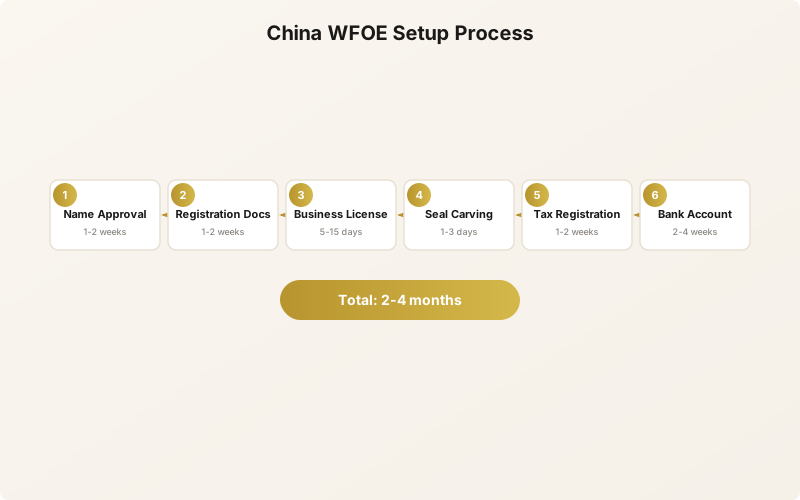
A3: The WFOE setup process typically takes 2-4 months from start to finish, depending on the industry and location. The timeline includes: name approval (1-2 weeks), preparing registration documents (1-2 weeks), business license application (5-15 business days), seal carving (1-3 days), tax registration (1-2 weeks), bank account opening (2-4 weeks), and any special industry licenses (variable timeline). Certain restricted industries may require additional approvals that can significantly extend the timeline.
Q4: What industries are restricted for foreign investment in China?
A4: China publishes a Foreign Investment Negative List that specifies industries where foreign investment is prohibited or restricted. Prohibited sectors include certain news media, compulsory education institutions, and some rare earth mining. Restricted sectors where foreign ownership is limited include telecommunications, education, healthcare, financial services, and agriculture. The negative list is periodically updated, generally becoming more open over time. Industries not on the negative list receive national treatment, meaning foreign investors enjoy the same treatment as domestic investors.
Q5: Can a foreign company hire employees in China without a local entity?
A5: Foreign companies cannot directly hire employees in China without establishing a legal entity. The common alternatives include using a PEO (Professional Employer Organization) or staffing agency for temporary or initial staffing needs, engaging independent contractors (though this carries misclassification risks), or establishing a representative office (which is limited to non-commercial activities like market research and liaison work). For ongoing business operations, establishing a WFOE or joint venture is the proper way to hire local employees directly and issue employment contracts.
Further Reading
- China Customs Clearance & Import/Export: A Practical Guide — Customs and import/export procedures
- China Product Certification: CCC, CQC, SRRC and More — Product certification for selling in China
- Supply Chain Risk Management in China — Supply chain risk management
- Payment Terms in China Manufacturing — Payment terms and foreign exchange
Next Steps
For a company at the entity and licensing stage, the usual order is to decide whether a Chinese entity is needed, settle its structure and business scope, then map the licences, employment documents and contracts that follow. The guides below cover that sequence.
Two service lines most often relevant at this stage:
- How do I set up a Chinese entity for my AI company?
- Which licences does a foreign AI company need to operate in China?
To discuss scope, timeline and fees for your own matter, Contact Us About Your China Entry. The initial consultation is free; the form prepares an email in your own mail application.
Related guides in this series
- China AI Regulation 2026: The Complete Guide for Foreign Companies
- Do I Need a Chinese Entity? When to Set Up and When to Stay Cross-Border
- WFOE Setup in China: A Complete Guide for Foreign AI & Tech Companies (2026)
Frequently Asked Questions↑ Back to article
What is the difference between a trading WFOE and a consulting WFOE?
A trading WFOE is licensed to buy and sell physical goods, engage in import/export activities, and distribute products within China. A consulting WFOE is limited to providing services, advisory, and intellectual property licensing — it cannot trade physical products or engage in import/export of goods. Trading WFOEs also have higher registered capital requirements and face more extensive compliance requirements, including customs registration and foreign exchange filing.
How much registered capital do I need for a trading WFOE?
While China legally allows subscribed capital with no statutory minimum for most industries, trading WFOEs in practice require registered capital of RMB 500,000 to RMB 2,000,000 (approximately USD 70,000 to USD 280,000) to satisfy government review and operational needs. The exact amount depends on your business scope, projected revenue, and whether you apply for general taxpayer status. Many authorities expect capital sufficient to cover 6-12 months of operating expenses.
How long does it take to set up a trading WFOE in China?
The full setup process for a trading WFOE typically takes 3-5 months from document preparation to full operational status. The core business license registration takes about 4-6 weeks, but additional registrations — including import-export filing, customs registration, e-port card, and foreign exchange registration — add another 6-10 weeks. Timelines vary by city and depend on document preparation completeness.
Can a foreign company import/export to China without a local entity?
Yes, but with limitations. Foreign companies can work with Chinese trading companies or sourcing agents who handle import/export on their behalf. They can also sell through cross-border e-commerce platforms. However, without a local entity, you cannot issue local VAT invoices (fapiao), cannot directly engage in domestic distribution, and have limited control over pricing, customer relationships, and supply chain operations. A trading WFOE is necessary when you need full operational control and the ability to transact domestically.
What are the tax implications of a trading WFOE?
Trading WFOEs are subject to several taxes in China: Corporate Income Tax at 25% (reduced to 15% for qualified high-tech enterprises), VAT at 13% for most goods (with import VAT recoverable through the credit system), and stamp duty (typically 0.03-0.05% on contracts). Additionally, customs duties apply to imported goods at rates varying by product category. Trading WFOEs must register as general taxpayers to issue VAT invoices and claim input tax credits, which is essential for most import/export businesses.
What are the key compliance requirements for a trading WFOE in China?
Trading WFOEs face more compliance requirements than consulting WFOEs due to the physical goods and cross-border transactions involved. Key requirements include customs registration and compliance with import/export regulations, foreign exchange registration and SAFE compliance for cross-border payments, VAT registration as a general taxpayer with proper invoicing and filing, annual audit and corporate income tax filing, social insurance and housing fund contributions for employees, and various industry-specific licenses depending on the product category. Trading WFOEs must also maintain proper accounting records, contract documentation, and customs declaration files for audit purposes.
What are the alternatives to setting up a trading WFOE in China?
Alternatives to a trading WFOE include working with Chinese trading companies or sourcing agents who handle import/export on your behalf, which is simple but gives you less control and adds margin cost; cross-border e-commerce platforms for direct-to-consumer sales, which work for retail products but not B2B; representative offices, which can only do market research and liaison work, not actual trading; and joint ventures with Chinese partners, which provide local market access but require sharing control and profits. The right alternative depends on your stage, volume, and need for control. Many companies start with a trading partner and transition to a trading WFOE as their China business grows.