Key Takeaways
- Speed is the biggest advantage. Chinese prototype shops can turn around 3D-printed parts in 24-48 hours and CNC parts in 3-5 days, a pace that is 2-3x faster than Western counterparts.
- Cost savings are substantial. Expect to pay 50-70% less than you would in the US or Europe for comparable prototype quality across most technologies.
- Shenzhen is the global capital of prototyping. The density of suppliers, material availability, and specialization means almost any prototype can be fabricated within a 50-kilometer radius.
- Iteration is everything. Plan for 3-5 major prototype rounds. Each iteration should have a clear testing objective — mechanical, electronic, cosmetic, or user-focused.
- File quality determines outcome quality. Spend the time to prepare clean CAD files with proper tolerances, clear drawings, and complete BOMs. Poor files cause rework, delays, and unexpected costs.
- Prototype shops and production factories are different. The shop that makes your 5th prototype may not be the right partner for your 5,000-piece production run. Plan the transition carefully.
1. Introduction: Why Prototyping in China Is a Superpower for Hardware Startups
For hardware startups, speed is survival. The faster you can go from a CAD file to a physical part you can hold, test, and iterate on, the sooner you can validate your product, impress investors, and get to market. China — and specifically the Pearl River Delta centered around Shenzhen and Dongguan — offers the fastest, most diverse, and most cost-effective prototyping ecosystem on the planet.
The advantages are well-known but worth stating clearly. First, speed: a startup in San Francisco or Berlin might wait 1-2 weeks for a single CNC prototype. In Shenzhen, that same part can be in your hand in 3-5 days, and 3D-printed parts can arrive the next day. Second, cost: prototyping in China is typically 50-70% cheaper than in Western countries, which means a startup’s R&D budget stretches 2-3x further. Third, proximity to manufacturing: when your prototype is ready to scale, the factories that can produce it at volume are literally down the street from the prototype shop. The handoff is faster, the learning curve is gentler, and the supply chain is already proven.
But there is a learning curve. Working with Chinese prototype factories requires understanding their capabilities, their processes, and their communication norms. This guide covers everything a hardware startup founder, product manager, or engineer needs to know to prototype effectively in China — from choosing the right technology to managing iteration loops to making the jump to mass production.
2. Prototyping Technologies Available in China
China’s prototyping ecosystem covers the full spectrum of manufacturing technologies. Understanding what each one does — and when to use it — is the first step to effective prototyping.
3D Printing
China has the largest installed base of industrial 3D printers in the world. The major technologies available:
- FDM (Fused Deposition Modeling): The most basic and cheapest 3D printing method. Best for quick form-and-fit checks, jigs and fixtures, and low-cost concept models. Materials include PLA, ABS, PETG, and various engineering filaments. Cost: $5-50 per part. Lead time: 1-3 days.
- SLA (Stereolithography): Uses UV-cured resin to produce high-resolution, smooth-surfaced parts. Excellent for appearance models, fine details, and master patterns for vacuum casting. Materials: standard resin, tough resin, transparent resin, high-temperature resin. Cost: $20-150 per part. Lead time: 1-3 days.
- SLS (Selective Laser Sintering): Uses a laser to sinter nylon powder. Produces strong, functional plastic parts without support structures. Ideal for complex geometries, living hinges, and snap fits. Materials: PA12, PA12-GF, TPU. Cost: $30-200 per part. Lead time: 2-5 days.
- MJF (Multi Jet Fusion): HP’s technology produces nylon parts with excellent mechanical properties, fine detail, and consistent quality. Often preferred over SLS for functional prototypes that need predictable strength. Materials: PA12, PA11, TPU. Cost: $40-250 per part. Lead time: 2-5 days.
- Metal 3D Printing (SLM/DMLS): Laser-sintered metal parts in stainless steel, aluminum, titanium, and tool steel. Used for functional metal prototypes, conformal cooling channels, and low-volume production metal parts. Cost: $100-2,000+ per part. Lead time: 5-15 days.
CNC Machining
CNC (Computer Numerical Control) machining is the workhorse of functional prototyping. It produces parts by cutting away material from a solid block, resulting in accurate, strong, production-representative parts.
In China, prototype CNC shops specialize in one-off and low-volume machined parts with fast turnaround. They differ from production CNC shops in that they prioritize speed over per-unit cost optimization, use more flexible scheduling, and are set up to handle frequent design changes.
Key facts about CNC prototyping in China:
- Materials: Almost any machinable material — aluminum (6061, 7075), stainless steel (304, 316), brass, copper, ABS, PC, acrylic, POM, PEEK, and more.
- Tolerances: Typically ±0.05mm to ±0.1mm for general parts, ±0.01mm to ±0.02mm for precision work.
- Surface finishes: As-machined, bead-blasted, anodized (various colors), powder-coated, polished, brushed, and more.
- Cost range: $50-500 per part for aluminum, $100-1,000+ for stainless steel or complex geometries.
- Lead time: 3-7 days for most parts, 7-14 days for complex multi-axis work.
Vacuum Casting / Urethane Casting
Vacuum casting (also called urethane casting or polyurethane casting) is a bridge technology between 3D printing and injection molding. It uses a silicone mold cast from a master pattern (usually 3D-printed SLA or CNC-machined) to produce 10-100 copies of a part in polyurethane resin.
When to use vacuum casting:
- You need 10-100 copies of a plastic part (too many for 3D printing, too few for injection molding)
- You need parts with production-like surface finishes and material properties
- You need rubber-like or soft-touch parts (TPU-like resins)
- You want to test multiple material durometers or colors without investing in tooling
Quality and capabilities: Modern vacuum casting shops in China can produce parts with surface quality nearly indistinguishable from injection molding. Resins can simulate ABS, PP, PC, rubber, and clear materials. Shore hardness ranges from 20A to 90D.
Cost: $30-150 per part, with a mold cost of $200-800 depending on part size and complexity. The mold typically lasts 15-25 shots before needing replacement.
Lead time: 5-10 days from approved master pattern.
Sheet Metal Prototyping
Sheet metal prototypes are made using laser cutting, CNC bending, welding, and finishing operations. China has extensive sheet metal prototyping capacity, particularly for enclosures, brackets, chassis, and structural components.
- Laser cutting: 2D profiles cut from sheet stock. Fast and accurate.
- CNC bending: Press-brake forming for bends, flanges, and channels.
- Welding: TIG, MIG, and spot welding for assembled prototypes.
- Finishes: Powder coating, anodizing, brushing, polishing, silk-screening.
Cost: $30-300 per part depending on size, material, and number of bends/operations. Lead time: 3-7 days.
PCB Prototype & PCBA
China dominates the global PCB prototyping market. Companies like PCBWay, JLCPCB, and Seeed Studio have built global brands on 24-72 hour PCB fabrication turnarounds.
- PCB fabrication: 2-6 layer boards in 24-72 hours. 8-16 layer boards in 5-10 days. Standard materials: FR-4 with 1oz copper.
- SMT assembly: Most prototype PCB houses offer SMT assembly for prototype quantities (1-50 boards). Turnaround: 3-10 days after PCB fabrication.
- Components: Shenzhen’s electronic component markets (Huaqiangbei) mean almost any component is available same-day or next-day, though specialized or long-lead components still need to be sourced.
- Cost: Bare PCBs from $10-50 for 2-4 layer, 10x10cm boards. PCBA adds $50-500+ depending on component count and complexity.
Comparison Table: Which Technology for Which Stage?
| Technology | Best For | Quantity Range | Typical Lead Time | Cost Range (per part) |
|---|---|---|---|---|
| FDM 3D Print | Concept models, fit checks, jigs | 1-5 | 1-3 days | $5-50 |
| SLA 3D Print | Appearance models, master patterns | 1-10 | 1-3 days | $20-150 |
| SLS/MJF 3D Print | Functional plastic prototypes | 1-20 | 2-5 days | $30-250 |
| CNC Machining | High-accuracy functional parts | 1-50 | 3-7 days | $50-500 |
| Vacuum Casting | Small-batch production-like parts | 10-100 | 5-10 days | $30-150 |
| Sheet Metal | Enclosures, brackets, chassis | 1-50 | 3-7 days | $30-300 |
| PCB / PCBA | Electronic prototypes | 1-50 boards | 3-10 days | $20-500 |
3. China’s Prototyping Ecosystem
China’s prototyping industry is not monolithic. It is concentrated in specific regions and includes different types of suppliers, each with different strengths.
Key Regions
Shenzhen / Dongguan (Guangdong Province): The undisputed capital of hardware prototyping. The density of suppliers is unmatched — you can walk into an office building in Huaqiangbei and find 10 prototype shops on different floors. Everything from 3D printing to CNC to PCB assembly is available within a 50km radius. The primary advantage is speed: parts that would take a week elsewhere can be done in 2-3 days because all the supply chain pieces are local.
Suzhou / Shanghai (Jiangsu Province): Known for higher precision and cleaner operations. Suzhou is a preferred location for medical device, automotive, and aerospace prototypes where quality systems and documentation matter more than raw speed. Factories here tend to be better organized, have stronger English capabilities, and follow more structured processes — but they also charge 20-40% more than Shenzhen equivalents.
Ningbo / Wenzhou (Zhejiang Province): Strong in casting, forging, and mold-making prototypes. Good if your product involves investment casting, die casting, or other metal forming processes that need prototype tooling.
Factory Types
Dedicated prototype shops: These companies exist solely to make prototypes. They have flexible scheduling, a wide range of equipment, and teams that specialize in handling frequent design changes. Their speed is unmatched, but they typically cannot handle production volumes. Most are small operations (5-50 people).
Production factories with prototype departments: Many mid-sized and large production factories have in-house prototype teams. The advantage here is that the same engineers who will design your production tooling can work on your prototypes, ensuring a smoother transition. The downside is longer lead times and less flexibility — production orders often take priority over prototype work.
Online platforms: Services like Xometry, PCBWay, and RapidDirect offer online quoting and ordering. They are convenient for simple parts and quick quotes, but they add a layer of abstraction between you and the actual factory making your parts. For complex or critical prototypes, a direct factory relationship is usually better.
The Shenzhen Speed Advantage
What makes Shenzhen prototypes so fast? It is not that Chinese workers work harder — though many shops do operate 12-16 hour days, six or seven days a week. The real advantage is ecosystem density. If a CNC shop needs a specific end mill, it can get it in 30 minutes from a nearby supplier. If a 3D printing service runs out of resin, there is a warehouse 10 minutes away. If a prototype needs anodizing, the anodizing shop is in the same industrial park. This proximity eliminates shipping delays between process steps, which is the primary bottleneck in Western prototyping.
4. The Sampling Process with Chinese Factories
Working with a Chinese prototype factory follows a predictable process. Understanding each step helps you set realistic expectations and avoid delays.
Step 1: Design Files Submission. You send your CAD files (STEP/IGES for mechanical, Gerber/BOM for electronics) along with any drawings, specifications, and requirements. The more detail you provide upfront, the more accurate the quote and the fewer surprises later.
Step 2: DFM Review. The factory reviews your design for manufacturability. They will flag issues like thin walls that may warp, features that are too small to machine, tolerances that are unrealistic, and design choices that will add unnecessary cost. Good prototype shops provide DFM feedback as part of the quoting process at no charge.
Step 3: Quotation. The factory sends a quote with price, lead time, and any assumptions or recommendations. Quotes are typically free and arrive within 24-48 hours for standard parts. For complex assemblies or unusual requirements, it may take longer.
Step 4: PO and Payment. Once you approve the quote, you issue a purchase order and arrange payment. Most prototype shops require 100% payment upfront for first-time customers. After a relationship is established, some may offer net-7 or net-15 terms. Payment methods include bank transfer (T/T), PayPal, Western Union, and increasingly, credit card.
Step 5: Prototype Fabrication. The factory makes your parts. During this phase, they may send photos or short videos of the parts in progress, though this varies by shop. Do not expect daily updates — most shops only reach out if there is a problem or question.
Step 6: First Sample Production. For multi-part or complex projects, some factories will produce one sample first and send photos for your approval before making the rest. This catches issues early and avoids wasting materials on incorrect parts.
Step 7: Inspection and Shipping. When the parts are complete, the factory performs basic inspection (dimensional checks, visual inspection) and then ships. Shipping options include express (DHL, FedEx, UPS — 3-5 days), air freight (5-7 days), and sea freight (25-35 days, rarely used for prototypes).
Step 8: Inspection and Testing. You receive the parts and perform your own inspection and testing. Document everything — measure critical dimensions, test functionality, check cosmetics, and take photos of any issues.
Step 9: Feedback and Revision. You send feedback to the factory with specific, documented changes. The factory provides a revised quote and lead time for the next iteration.
Step 10: Final Sample Approval. After enough iterations, you approve a final sample — sometimes called a “golden sample” — that serves as the reference standard for production.
Typical timeline per iteration: For a moderately complex mechanical + electronic product, plan on 2-4 weeks per full iteration. Simple mechanical-only prototypes can iterate in 1-2 weeks.
5. Design File Preparation
The quality of your design files directly impacts the quality of your prototypes and the accuracy of your quotes. Chinese factories deal with files from customers all over the world, and they have seen every file mistake imaginable. But that does not mean you should send sloppy work — good files get better quotes, faster turnaround, and fewer defects.
What Files You Need to Provide
For mechanical parts:
- 3D CAD files in STEP (.stp) or IGES (.igs) format. STEP is preferred.
- 2D drawings (.pdf or .dwg) with critical dimensions, tolerances, surface finish requirements, and material specifications.
- An exploded view or assembly drawing if there are multiple parts.
- A bill of materials (BOM) listing each part, material, and quantity.
For electronics:
- Gerber files (RS-274-X format) for PCB fabrication.
- Drill file and board outline.
- BOM with component part numbers, values, packages, and quantities.
- Pick-and-place (centroid) file for SMT assembly.
- Schematic PDF for reference.
Common File Issues from Startups
- Missing tolerances: If you do not specify tolerances, the factory will use whatever is convenient, which may not meet your requirements. Always specify critical tolerances on your drawings.
- Inconsistent units: Mixing mm and inches, or forgetting to specify units at all, leads to parts that are 25.4x too big or too small.
- Bad geometry: Non-manifold edges, overlapping surfaces, and missing faces cause problems for both 3D printing and CNC. Run a geometry check in your CAD software before exporting.
- Incomplete BOMs: Missing component values, wrong package sizes, or obsolete part numbers slow down PCB assembly and cause substitution errors.
- Unclear surface finish requirements: “Make it look nice” is not a specification. Specify anodizing type and color, bead blast media size, powder coat color code, or polish level.
IP Protection Considerations
IP protection during prototyping is a common concern. Here is what you can do:
- Only share what is needed: You do not need to send your entire product CAD file if you are only prototyping one component.
- Use NDA agreements: Reputable prototype shops will sign NDAs. Have one ready in both English and Chinese.
- Watermark your files: Embed your company name and confidential markings in CAD files and drawings.
- Split prototyping across vendors: If your product has a particularly sensitive mechanism, consider having different components made by different shops so no single supplier has the complete design.
- File for patents before sharing: If you have patentable technology, file before sending designs to any external party, Chinese or otherwise.
6. Cost and Pricing
Prototype pricing in China is remarkably affordable compared to Western countries, but it is important to understand what drives cost and what hidden expenses to watch for.
Cost Ranges by Technology
| Technology | Low End | Mid Range | High End | Notes |
|---|---|---|---|---|
| FDM 3D Print | $5 | $15-30 | $50+ | PLA/ABS, small to medium parts |
| SLA 3D Print | $20 | $50-100 | $150+ | Standard resin, size-dependent |
| SLS/MJF Nylon | $30 | $80-150 | $250+ | PA12, functional parts |
| CNC Aluminum | $50 | $150-300 | $500+ | 6061 aluminum, moderate complexity |
| CNC Stainless Steel | $100 | $250-500 | $1,000+ | 304/316, slower machining |
| Vacuum Casting | $30/part | $60-100/part | $150+/part | + $200-800 mold cost |
| Sheet Metal | $30 | $80-150 | $300+ | Steel/aluminum, bending + welding |
| PCB (2-4 layer) | $10 | $30-80 | $200+ | Bare board, 10x10cm |
| PCBA | $50 | $150-300 | $500+ | Assembly + components |
Factors Affecting Prototype Cost
- Complexity: More features, tighter tolerances, and complex geometries increase programming time and machining time.
- Material: Exotic materials (titanium, PEEK, medical-grade plastics) cost more and take longer to machine.
- Tolerance: Tighter tolerances require more careful machining, more measurement time, and higher scrap rates.
- Surface finish: Additional finishing operations (anodizing, polishing, painting, silk-screening) add cost.
- Quantity: While there is some volume discount for prototypes, it is not as dramatic as production pricing. The first part is expensive because of programming and setup; additional copies cost less but not proportionally so.
- Urgency: Rush fees of 30-100% are common for expedited prototypes.
NRE vs. Per-Unit Cost
For technologies that involve tooling (vacuum casting, sheet metal with custom dies, injection molding prototypes), you will see separate charges for non-recurring engineering (NRE) and per-unit cost. Make sure you understand which is which when comparing quotes. A lower per-unit price with a higher NRE may or may not be a better deal depending on your quantity.
How Chinese Pricing Compares
As a general rule, Chinese prototype pricing is 50-70% lower than US or European pricing for comparable quality. For example, a CNC aluminum part that costs $200 in the US might cost $60-100 in China. A vacuum casting run of 50 parts that costs $5,000 in Germany might cost $1,500-2,500 in Shenzhen.
Hidden Costs to Watch For
- Shipping: Express shipping from China can add $50-200 depending on package size and weight.
- Import duties and taxes: Depending on your country, you may owe customs duties and VAT/GST on imported prototypes.
- Revision costs: Design changes mid-project almost always incur additional charges.
- Material substitutions: If your specified material is not available, the factory may offer a substitute — sometimes at a premium.
- Inspection: Third-party inspection services add cost but can save you from expensive mistakes.
7. Lead Times
Typical Lead Times by Technology
| Technology | Standard | Expedited | Notes |
|---|---|---|---|
| FDM 3D Print | 1-3 days | 24 hours | Same-day possible for simple parts |
| SLA 3D Print | 1-3 days | 24 hours | Post-processing adds time |
| SLS/MJF 3D Print | 2-5 days | 48 hours | Cooling + post-processing required |
| CNC Machining (plastic) | 3-5 days | 48 hours | Single-setup parts |
| CNC Machining (metal) | 3-7 days | 2-3 days | Aluminum fastest, steel slower |
| Vacuum Casting | 5-10 days | 3-5 days | Master pattern + mold + casting |
| Sheet Metal | 3-7 days | 2-3 days | Simple bends fastest |
| PCB Fabrication (2-4 layer) | 2-5 days | 24 hours | Many shops offer 24hr service |
| PCBA | 3-10 days | 2-3 days | Depends on component availability |
| Full product assembly | 2-4 weeks | 1-2 weeks | Mechanical + electronic + enclosure |
Why Chinese Prototypes Are Faster
- Supply chain proximity: Materials, tooling, and secondary processes are all within hours or minutes, not days.
- Longer working hours: Many Chinese factories operate 12-hour shifts, six days a week. Some run 24/7 for prototype work.
- Specialization: Shenzhen has thousands of small shops that do one thing extremely fast — one shop only does SLA printing, another only does CNC aluminum, another only does anodizing.
- Flexible prioritization: Prototype shops are accustomed to shifting schedules to accommodate rush orders.
How to Further Expedite
- Pay for priority: Most shops offer expedited service for a 30-50% premium. It is almost always worth it for startups.
- Use local couriers: Within the Pearl River Delta, same-city courier services can deliver parts in hours. If you have a representative on the ground, they can pick up parts directly.
- Simplify designs: Removing unnecessary features, using standard tolerances, and choosing readily available materials all speed up production.
- Order early in the week: Because many factories work Monday-Saturday, submitting files on Monday morning maximizes the available working days before the weekend.
Realistic Expectations vs. Marketing Claims
Many prototype shops advertise “24-hour turnaround,” but this almost always refers to the fabrication time only. It does not include quoting, file preparation, DFM review, shipping, or potential delays from questions or issues. Add 1-3 days of buffer on top of quoted lead times for realistic planning.
8. What to Test in Prototypes
A prototype without a testing plan is just an expensive paperweight. Each iteration should have a clear set of testing objectives.
Mechanical Testing
- Fit check: Do mating parts assemble correctly? Are there interferences? Do fasteners line up?
- Form verification: Does it look and feel right? Are proportions correct?
- Functional testing: Do moving parts move as intended? Do hinges, latches, and sliders work smoothly?
- Stress testing: Apply expected loads and forces. Does anything bend, break, or deform permanently?
- Drop test: Drop the product from expected heights onto expected surfaces. What breaks? What survives?
- Environmental testing: Temperature cycling, humidity exposure, water resistance (IP rating) testing.
Electronic Testing
- Functional test: Does the device do what it is supposed to do?
- Power consumption: Measure current draw in active, standby, and sleep modes. Is it within budget?
- Heat dissipation: Run the device at full load. How hot do components get? Is thermal management adequate?
- Signal integrity: For RF, high-speed digital, or analog circuits, verify signal quality, noise levels, and EMI.
- Battery life: How long does the battery last under real-world conditions?
User Testing
- Ergonomics: Is it comfortable to hold, wear, or use? Do controls fall naturally under fingers?
- Usability: Can users figure out how to use it without reading a manual?
- Cosmetic review: Do people like how it looks? Is the finish quality acceptable?
- Size and weight feedback: Is it too big? Too heavy? Too light?
Certification Pre-Checks
- Design for compliance: Review your design against relevant standards (FCC, CE, RoHS, FDA, etc.) before you finalize it. Changing a design to pass EMC testing after tooling is cut is expensive.
- Material compliance: Verify that the materials you are prototyping with can meet regulatory requirements for your target markets.
Types of Samples
- Appearance sample (A-sample): Looks right but may not work. Used for marketing photos, investor demos, and cosmetic validation.
- Engineering sample (E-sample / EVT sample): Works but may not look production-ready. Used for functional testing, electronics validation, and design verification.
- Production sample (P-sample / DVT sample): Made with production tools, materials, and processes. Used for final validation, certification testing, and pilot production.
9. Iterating Fast
The whole point of prototyping in China is to iterate quickly. But speed depends as much on how you manage the iteration process as it does on the factory’s capabilities.
How Many Iterations Are Normal?
Most hardware products go through 3-5 major iterations before production readiness:
- Iteration 1 (Proof of concept): Does the basic idea work? Often crude, 3D-printed, with hand-soldered electronics.
- Iteration 2 (Engineering validation): Closer to final design, tests all major functions. Reveals integration issues.
- Iteration 3 (Design validation): Production-intent materials and processes. Used for certification and reliability testing.
- Iteration 4-5 (Optimization): Cosmetic refinement, DFM optimization, cost reduction.
Budget for more iterations than you think you need. Almost every startup underestimates the number of rounds required.
How to Give Effective Feedback
The quality of your feedback directly impacts how quickly and accurately the factory can make changes.
- Use annotated drawings: Mark up 2D drawings or screenshots with specific dimensions, locations, and descriptions of changes. “Increase wall thickness to 2mm in the area circled in red” is much better than “make it stronger.”
- Send photos and videos: Show the problem. A 30-second video of a mechanism jamming is worth 1,000 words of description.
- Write a structured change log: List each change with a reference number, description, priority, and rationale. This gives the factory a clear checklist to work from.
- Prioritize changes: Not every change is equally important. Mark changes as “must have,” “should have,” and “nice to have” so the factory knows what to focus on.
- Confirm understanding: After sending feedback, ask the factory to confirm they understand each change and to provide a revised quote and timeline.
Common Iteration Mistakes
- Changing everything at once: If you modify 20 things in one iteration, you will not know which change caused a new problem. Make changes incrementally when possible.
- Skipping the written record: Verbal feedback on a call is forgotten. Always follow up calls with written confirmation of decisions and changes.
- Treating the factory like an employee: They are a partner, not a subordinate. Respect their expertise and listen to their DFM suggestions — they have made thousands of parts and know what works.
- Micromanaging from overseas: Trust but verify. Specify what you want, inspect what you get, but do not try to control every minute of the process.
Communication Best Practices
- Use written communication as the primary channel. Email, WeChat, or WhatsApp messages create a record that both sides can reference.
- Schedule regular video calls for complex discussions, but always follow up with a written summary.
- Be mindful of time zones. China Standard Time is UTC+8, which is 12-16 hours ahead of US time and 6-8 hours ahead of European time.
- Keep language simple and direct. Avoid idioms, slang, and complex sentence structures. Your counterpart may be reading in a second language.
- Use bullet points and numbered lists. They are easier to understand and translate than paragraphs of text.
10. From Prototype to Production
At some point, you need to stop iterating and start producing. The transition from prototype to production is where many hardware startups stumble.
When to Switch from Prototype Shop to Production Factory
The prototype shop that made your 5th prototype is probably not the right partner for your 5,000 or 50,000 piece production run. Dedicated prototype shops are set up for speed and flexibility, not for consistent quality at volume or cost optimization.
Switch to a production factory when:
- Your design is stable and you have approved a golden sample
- You are ready to invest in production tooling (injection molds, stamping dies, etc.)
- You need consistent quality across hundreds or thousands of units
- You want to optimize per-unit cost
The Handoff Process
- Transfer all design files — CAD models, drawings, BOMs, specifications, test reports, and the approved golden sample.
- Conduct a DFM review with the production factory. They will likely have suggestions for improving manufacturability that the prototype shop did not mention.
- Negotiate pricing and terms for production volumes. Production pricing is very different from prototype pricing — per-unit costs drop dramatically, but there are NRE and tooling costs.
- Plan the pilot run. Start with a small production batch (50-500 units) to validate the production process before scaling up.
Tooling Preparation
- DFM for mass production: Prototype designs often need modification for efficient mass production. This includes adding draft angles to plastic parts, optimizing wall thickness, standardizing fasteners, and simplifying assembly.
- Tolerance stack-up analysis: A prototype might work because each part happens to be at nominal dimension. In production, parts vary within tolerance. You need to analyze how tolerances accumulate to ensure your product works across the full range of variation.
- Tooling design and fabrication: Injection molds typically cost $2,000-20,000+ and take 3-6 weeks to make. Stamping dies cost $1,000-10,000+ and take 2-4 weeks.
Common Pitfalls in the Prototype-to-Production Transition
- The prototype works, but production does not: This is the #1 problem. Prototypes are often hand-finished, carefully assembled, and made from carefully selected materials. Production parts are made with automated processes, looser tolerances, and commodity materials. Design for production reality, not prototype perfection.
- Underestimating tooling lead times: Mold making always takes longer than quoted. Add 50% buffer to any tooling timeline you receive.
- Skipping the pilot run: It is tempting to go straight from prototype to full production to save time and money. Resist the urge. Pilot runs catch problems that prototypes cannot reveal.
- Assuming the prototype factory can scale: Many prototype shops have no production capability and will outsource production to someone else, adding cost and removing your direct control.
11. Quality Control for Prototypes
Prototype quality varies enormously. What you receive depends on the factory’s standards, how well you communicated your requirements, and sometimes just luck.
What to Inspect When You Receive Samples
- Dimensional inspection: Measure critical dimensions with calipers, micrometers, or a coordinate measuring machine (CMM). Compare against your drawing specifications.
- Cosmetic inspection: Check for scratches, blemishes, uneven finishes, color mismatches, sink marks, and other visual defects.
- Functional testing: Assemble the parts and test every function. Does everything work as intended? Are there unexpected friction points, binding, or play?
- Material verification: If material is critical, verify it. Simple checks include weight, magnet test (for stainless steel), or surface hardness. For critical applications, send samples to a testing lab.
- Documentation review: Check that the factory provided any requested inspection reports, material certificates, or test data.
Using Third-Party Inspection Services
For critical prototypes or when you cannot travel to China, third-party inspection companies can check your parts before they ship. Companies like SGS, Bureau Veritas, and many smaller local firms offer prototype inspection services for $200-500 per day. This catches issues before parts are shipped internationally, saving time and shipping costs.
When to Fly to China for Sample Review
There is no substitute for being there in person. Consider traveling to China for sample review when:
- You are approving a final production-intent prototype
- The prototype is for a high-value or high-risk product
- You need to review and approve multiple iterations in quick succession
- Communication has been difficult and you suspect things are getting lost in translation
- You want to build a closer relationship with the factory
A 3-5 day trip to Shenzhen can easily save 2-3 months of back-and-forth shipping and iteration.
Common Prototype Quality Issues and Solutions
| Issue | Cause | Solution |
|---|---|---|
| Dimensions off by 0.1-0.5mm | Programming error, tool deflection, loose tolerances | Specify critical dimensions on drawing, ask for first-article inspection |
| Rough surface finish | Tool marks, insufficient finishing, cheap material | Specify finish requirements clearly, request finish samples |
| Parts do not fit together | Tolerance stack-up, CAD file issues, scaling errors | Check your CAD for interference, verify scale, add clearance |
| Wrong material | Factory substituted cheaper material | Specify material by grade/standard, request material certs |
| Cosmetic defects | Poor quality control, rushed production | Define cosmetic standards, ask for photos before shipping |
12. Key Takeaways
Prototyping in China is one of the most powerful tools available to hardware startups today. The combination of speed, cost, and ecosystem diversity is unmatched anywhere else in the world. But to get the most out of it, you need to approach it strategically.
Invest in file preparation. Clean CAD files, clear drawings, and complete specifications are the foundation of good prototypes. The time you spend preparing files pays for itself in fewer iterations and better quality.
Choose the right technology for each stage. Do not CNC machine parts that could be 3D printed. Do not 3D print parts that need vacuum casting. Match the prototyping method to your testing objectives.
Plan for iteration. You will need more iterations than you think. Budget time and money for 3-5 major rounds. Each iteration should have clear testing goals.
Communicate clearly. Written, structured, specific feedback is the key to fast, accurate revisions. Follow up verbal discussions with written confirmations.
Think about production from day one. Design decisions made in the first prototype have consequences for production cost, quality, and lead time. Keep DFM principles in mind even during early prototyping.
Know when to switch gears. Prototype shops and production factories serve different purposes. Make the transition deliberately, with a clear handoff process and a pilot run.
For hardware startups, China is not just a place to manufacture — it is a place to invent faster. The ability to go from idea to physical prototype in days, iterate rapidly, and then scale smoothly into production is a competitive advantage that no other location can match. Approach it with the right knowledge, the right expectations, and the right partners, and you can bring your product to market faster and cheaper than you ever thought possible.
FAQ
Q1: What is the minimum registered capital for a WFOE?
A1: China abolished the statutory minimum registered capital requirement for most industries in 2014 under the注册资本认缴登记制 (subscription system). However, companies must still specify a registered capital amount and contribution timeline in their articles of association. The practical registered capital amount should reflect the actual operational needs of the business and the industry norms. Some regulated industries still have minimum capital requirements, such as banking, insurance, securities, and certain types of consulting businesses.
Q2: What is the difference between a WFOE and a joint venture in China?
A2: A WFOE (Wholly Foreign-Owned Enterprise) is a limited liability company entirely owned by foreign investors, offering full control over operations but requiring the foreign investor to handle all aspects of market entry independently. A joint venture involves partnering with a Chinese shareholder, which can provide market access, local expertise, and government relationships but requires sharing control and profits. The choice depends on the industry (some sectors require joint ventures under the negative list), the level of local market knowledge needed, and the desired degree of operational control.
Q3: Can a foreign company hire employees in China without a local entity?
A3: Foreign companies cannot directly hire employees in China without establishing a legal entity. The common alternatives include using a PEO (Professional Employer Organization) or staffing agency for temporary or initial staffing needs, engaging independent contractors (though this carries misclassification risks), or establishing a representative office (which is limited to non-commercial activities like market research and liaison work). For ongoing business operations, establishing a WFOE or joint venture is the proper way to hire local employees directly and issue employment contracts.
Q4: How long does it typically take to set up a WFOE in China?
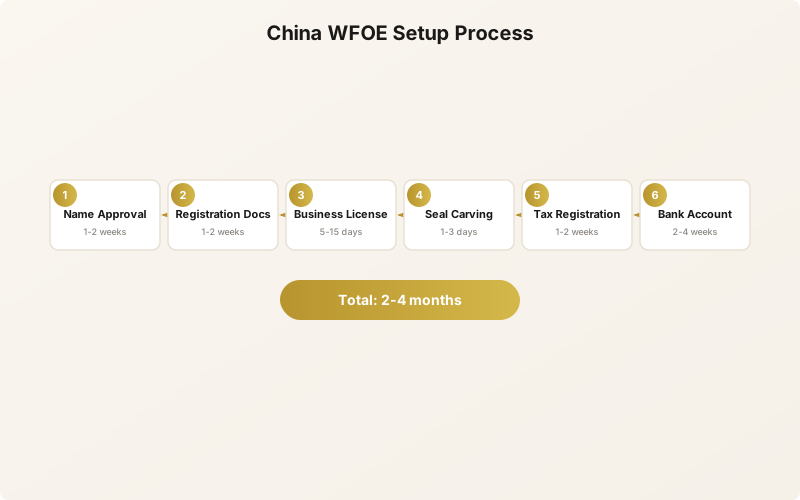
A4: The WFOE setup process typically takes 2-4 months from start to finish, depending on the industry and location. The timeline includes: name approval (1-2 weeks), preparing registration documents (1-2 weeks), business license application (5-15 business days), seal carving (1-3 days), tax registration (1-2 weeks), bank account opening (2-4 weeks), and any special industry licenses (variable timeline). Certain restricted industries may require additional approvals that can significantly extend the timeline.
Q5: What industries are restricted for foreign investment in China?
A5: China publishes a Foreign Investment Negative List that specifies industries where foreign investment is prohibited or restricted. Prohibited sectors include certain news media, compulsory education institutions, and some rare earth mining. Restricted sectors where foreign ownership is limited include telecommunications, education, healthcare, financial services, and agriculture. The negative list is periodically updated, generally becoming more open over time. Industries not on the negative list receive national treatment, meaning foreign investors enjoy the same treatment as domestic investors.
Further Reading
- Injection Molding in China: A Complete Guide for Hardware Product Teams — From prototype to injection molding
- PCB Manufacturing in China: A Complete Guide for Hardware Companies — PCB prototype fabrication
- MOQ in China Manufacturing: How to Handle Minimum Order Quantities as a Startup — Scaling from prototype to production
- Product Assembly, Testing, and Final Inspection in China: A Complete Guide — Prototype testing and validation
- Battery Sourcing and Manufacturing in China: A Guide for Hardware Companies — Battery pack prototyping
Next Steps
For hardware teams, the legal questions follow the sourcing sequence: select and vet a factory, fix tooling and payment terms, then protect the design and manage inspection, certification and export. The guides below follow that sequence.
Two service lines most often relevant at this stage:
- Which contracts does an AI company need before selling in China?
- How can a foreign AI company protect its models and code in China?
To discuss scope, timeline and fees for your own matter, Contact Us About Your China Entry. The initial consultation is free; the form prepares an email in your own mail application.
Related guides in this series
- China Hardware & Supply Chain Guide for Foreign AI Companies
- How to Select and Vet Factories in China: A Complete Sourcing Guide for Hardware Startups
- Cost of Manufacturing in China: What Foreign Hardware Startups Should Budget
Frequently Asked Questions↑ Back to article
How much does rapid prototyping cost in China?
Costs vary significantly by technology and complexity. 3D-printed plastic parts start at $10-50 per piece, CNC machined parts range from $50-500 depending on material and complexity, vacuum casting runs $30-150 per part for quantities of 10-100, and PCB prototypes cost $20-200 for bare boards. Compared to Western countries, Chinese prototyping is typically 50-70% cheaper for comparable quality.
What is the typical lead time for prototypes in China?
Lead times depend on the technology and complexity. 3D printing takes 1-3 days, CNC machining 3-7 days, vacuum casting 5-10 days, sheet metal 3-7 days, and PCB fabrication 2-5 days. For complete multi-part assemblies with electronics, plan on 2-4 weeks per iteration. Many Shenzhen prototype shops offer 24-48 hour expedited services for a 30-50% premium.
What prototyping technologies are available in China?
China offers the full spectrum of prototyping technologies: FDM, SLA, SLS, and MJF 3D printing for plastics, metal 3D printing (SLM, DMLS), CNC milling and turning for precision parts, vacuum/urethane casting for small-batch rubber-like and finished parts, sheet metal laser cutting and bending, and fast-turn PCB fabrication and SMT assembly. The Shenzhen-Dongguan corridor has the densest concentration of prototyping services in the world.
How many prototype iterations should I expect?
Most hardware startups go through 3-5 major prototype iterations before moving to production, with 1-2 minor revisions per major iteration. First iterations typically reveal mechanical fit issues and basic functional problems. Middle iterations refine ergonomics, durability, and electronics integration. The final iteration validates design-for-manufacturing decisions and cosmetic quality. Budget time and money for more iterations than you think you'll need.
Can the same factory do prototyping and mass production?
It depends. Dedicated prototype shops specialize in speed and flexibility but usually cannot handle mass production. Many mid-sized and large production factories do have in-house prototype departments, which is the ideal arrangement because design learnings carry directly into production tooling. However, production factories often have longer prototype lead times and higher minimum order requirements than specialist prototype shops.
What is vacuum casting and when should I use it?
Vacuum casting (also called urethane casting) is a bridge technology between 3D printing and injection molding. It uses a silicone mold cast from a master pattern to produce 10-100 copies of a part in polyurethane resin, with surface quality nearly indistinguishable from injection molding. It is ideal when you need 10-100 production-like plastic parts — too many for 3D printing but too few for injection molding tooling. Resins can simulate ABS, PP, PC, rubber, and clear materials. Cost is $30-150 per part with a mold cost of $200-800, and lead time is 5-10 days from an approved master pattern.
How do I transition from prototyping to mass production in China?
The transition from prototyping to mass production is one of the riskiest steps in hardware development. The key is to plan for it early: ideally, work with a factory that has both prototype and production capability so knowledge transfers smoothly. Before moving to production, you need to finalize the design (design freeze), create production tooling, set up the production line, run pilot batches (PVT), and validate the manufacturing process. Many companies underestimate how much work happens between "working prototype" and "mass production" — the NPI (New Product Introduction) phase typically takes 2-6 months depending on product complexity.