Key Takeaways
- China dominates global injection molding, producing over 30% of the world’s plastic parts with unmatched supply chain density and cost efficiency.
- Mold tooling costs in China range from $1,500 for simple prototype molds to $50,000+ for complex multi-cavity production tools — roughly 40–60% cheaper than equivalent tooling in the US or Europe.
- Typical mold making lead time is 25–45 days, with production parts ready 7–14 days after sample approval.
- Success depends on thorough DFM (Design for Manufacturing) review, clear quality standards, and choosing the right factory tier for your volume and complexity.
- The Guangdong, Zhejiang, and Jiangsu provinces form China’s injection molding heartland, each with different specialization and cost structures.
1. Introduction
Injection molding is the cornerstone of mass-produced plastic hardware. From the enclosure of your smartphone to the gears inside your coffee machine, nearly every plastic product you interact with daily has been through an injection molding machine. For hardware startups and product teams bringing a new physical product to market, understanding injection molding — and particularly how it works in China — is not optional. It is essential.
China is the world’s largest injection molding hub, home to tens of thousands of molding factories, mold shops, and material suppliers. The ecosystem is dense, experienced, and cost-competitive in a way no other country can match. For foreign hardware teams, the opportunity is enormous, but so is the learning curve. Navigating language barriers, cultural differences in quality expectations, and a bewildering array of factory options can overwhelm even experienced product managers.
This guide walks you through everything a hardware product team needs to know about injection molding in China: how the process works, how molds are made, what materials are available, how to design for manufacturability, what defects to watch for, how to manage quality, what costs to expect, and how to select the right manufacturing partner.
2. How Injection Molding Works
Injection molding is a manufacturing process in which molten plastic is injected under high pressure into a mold cavity, where it cools and solidifies into the desired shape. The process is highly repeatable, capable of producing thousands or millions of identical parts with consistent quality.
Every injection molding cycle follows four core stages. First, clamping: the two halves of the mold are pressed together with force sufficient to resist injection pressure, ranging from 50 to over 3,000 tons depending on machine size. Second, injection: plastic pellets are fed into a heated barrel with a reciprocating screw that melts the material through friction and heat, then injects it into the cavity at 800–2,000 bar of pressure. Third, cooling and packing: pressure is maintained as the plastic cools and solidifies. Cooling represents 60–80% of total cycle time. Fourth, ejection: the mold opens and ejector pins push the finished part out. The cycle then repeats.
Cycle times vary dramatically. Small thin-walled parts like electrical connectors might cycle in 10–20 seconds. Medium enclosures with 2–3mm walls typically take 30–60 seconds. Larger, thicker parts can take 2–5 minutes.
Injection molding becomes economically viable at roughly 1,000–5,000 parts per year. Below that, CNC machining or 3D printing are usually cheaper. Above 10,000 parts per year, injection molding is almost always the lowest unit-cost option. The high upfront tooling cost is amortized across thousands of units, making each additional part inexpensive and highly consistent.
3. China’s Injection Molding Industry
China accounts for roughly 30% of global plastic product output. Its supply chain ecosystem — resin producers, mold steel suppliers, mold makers, injection molders, secondary processing shops, and assembly factories — is unmatched in density and depth.
Guangdong Province (Dongguan, Shenzhen) is China’s most mature manufacturing region. Dongguan alone has thousands of injection molding factories with strong engineering capabilities and experience serving international clients. Shenzhen specializes in electronics-related plastic parts and cleanroom molding. Labor and overhead costs are the highest in mainland China but still 30–50% below Western levels.
Zhejiang Province (Ningbo, Taizhou) is known for high-volume, cost-competitive molding. Ningbo is China’s “injection molding machine capital” — home to Haitian, the world’s largest injection machine manufacturer. Taizhou specializes in household goods and commodity plastics. Prices are typically 15–25% lower than in Guangdong, but engineering quality varies more widely.
Jiangsu Province (Suzhou, Kunshan) has a strong focus on precision molding, automotive parts, and medical components. Many Taiwanese and Japanese-invested factories operate here with high process discipline. Costs are comparable to Guangdong.
Factories fall into three tiers. Tier 1 (200+ employees, 50+ machines) have in-house everything, full certifications, and serve major brands — with MOQs starting at 10,000–50,000 pieces. Tier 2 (50–200 employees, 15–50 machines) offer a good balance of cost and capability for 5,000–100,000 piece runs. Tier 3 (10–50 employees, 3–15 machines) have the lowest prices but vary significantly in quality, best suited for 500–10,000 piece runs of simple parts.
Compared to the US, Germany, or Japan, Chinese injection molding typically offers 30–60% lower total cost with 30–50% faster mold making. Compared to Vietnam, India, or Mexico, China offers greater engineering depth, a more mature supply chain, and faster tooling — often at comparable prices.
4. Mold Making in China
The mold is the most critical and capital-intensive element of any injection molding project. A poorly made mold causes endless quality problems; a good one produces hundreds of thousands of parts with minimal issues.
Prototype molds (or “soft tooling”) use cheaper materials like aluminum or P20 steel, are designed for 500–5,000 shots, cost $1,500–$8,000, and take 10–20 days. Production molds use hardened steel, are built for 50,000 to 1,000,000+ shots, and cost significantly more.
Single-cavity molds produce one part per cycle. Multi-cavity molds produce 2, 4, 8, 16, or more parts per cycle, proportionally increasing output but also cost and complexity. Multi-cavity tools generally make sense when annual volumes exceed 100,000 parts. Family molds produce different parts (e.g., front and back enclosure) in one tool, reducing cost but creating balancing challenges.
Common mold steels in China include: P20 (general purpose, 50k–200k shots, low cost); 718 (improved P20 with better polish, 100k–300k shots); S136/420SS (corrosion-resistant, high polish for transparent parts, 200k–500k shots); H13 (for high-temperature engineering resins, 300k–800k shots); and NAK80 (pre-hardened, high precision, 500k–1M+ shots). Both domestic (Great Wall, Baosteel) and imported (Assab, Bohler) steels are available. Imported steel costs 2–3x more but offers more consistent quality.
Typical mold costs range from $1,500–$4,000 for a very simple single-cavity tool to $10,000–$25,000 for a medium-large enclosure, and $20,000–$50,000+ for a multi-cavity production tool. Chinese mold pricing is generally 40–60% below US or European pricing.
The mold making process follows this sequence: DFM review and mold design (3–7 days), mold base and steel preparation (3–5 days), CNC machining (5–10 days), EDM for features that cannot be milled (3–7 days), polishing and texturing (2–5 days), assembly (2–4 days), T0 testing (1–2 days), T1 sample shipment to customer (1–3 days), modifications based on feedback (5–15 days, 1–3 rounds typical), and final approval (1–3 days). Total timeline from order to approved samples: 25–45 days for most projects.
5. Material Selection
The most commonly used plastics in China are widely available from both domestic (Sinopec, PetroChina) and international (BASF, Dow, Sabic, LG Chem) suppliers. Domestic grades are 20–40% cheaper and work well for standard applications; imported grades are preferred for critical applications requiring tight tolerances or specific certifications.
ABS ($1.50–$2.50/kg) is the workhorse — good impact strength, easy to paint or plate, low cost — used in enclosures and consumer electronics. PC ($2.80–$4.00/kg) offers high impact strength and transparency for lenses and protective covers. PC+ABS ($2.20–$3.50/kg) blends the best of both and is common in electronics enclosures. PP ($1.00–$1.80/kg) offers good chemical resistance and flexibility for containers and hinges. PA/Nylon ($2.50–$4.50/kg) provides high strength and wear resistance for gears and structural parts. POM ($2.20–$3.50/kg) offers dimensional stability and low friction for precision parts. PMMA/Acrylic ($2.00–$3.00/kg) has excellent clarity for lenses and displays. TPE/TPU ($2.50–$5.00/kg) provides rubber-like elasticity for grips and seals.
Chinese suppliers can provide standard certifications including RoHS, REACH, FDA/LFGB for food contact, UL 94 flammability ratings, and ISO 10993 for medical biocompatibility. Always request material certificates (COA). For critical products, consider third-party testing at SGS, Intertek, or Bureau Veritas — all have extensive operations in China. Material substitution is a known risk, so verification is worthwhile for high-stakes products.
When choosing a material, start with your requirements: mechanical loads, temperature range, chemical exposure, cosmetics, regulatory needs, and cost. Narrow to 2–3 candidates and ask your factory for recommendations — Chinese material engineers often suggest cost-effective local alternatives you might not have considered.
6. Design for Manufacturing (DFM)
Good DFM reduces mold cost, shortens cycle time, minimizes defects, and improves quality. For teams working with Chinese factories, DFM is doubly important: the better your design, the fewer issues you will encounter.
Wall thickness uniformity is the single most important DFM principle. Walls should be as uniform as possible, typically 1.5–3.0mm. Variations should not exceed 25%. Thick sections cause sink marks, long cycles, and voids. Where thickness changes are necessary, use gradual 3:1 tapers.
Draft angles are needed on all vertical surfaces so parts can eject without scuffing. Minimum draft is 0.5° per side for smooth surfaces and 1.5° for textured surfaces — up to 3–5° for heavy textures.
Ribs add stiffness without increasing overall wall thickness. Rib thickness should be 50–70% of nominal wall to avoid sink marks, with height no more than 3x the base width and a minimum 0.5mm fillet at the base.
Bosses (cylindrical features for screws) should have wall thickness of 50–60% of nominal wall to prevent sink marks. Use gusset supports for tall bosses.
Snap fits work well with flexible materials like PP and ABS but not with brittle materials like PMMA. Design with uniform thickness, proper undercut angles (30–45° for assembly, 5–15° for retention), and generous base fillets.
Undercuts require side actions (sliders), lifters, or unscrewing mechanisms — each adding $500–$2,000 to mold cost. Where possible, design parts to avoid undercuts.
Gating locations affect weld lines, air traps, cosmetics, and stress. Gates should be placed at the thickest section, ideally in non-cosmetic areas. Common types include edge gates (simple, low cost), sub-gates (automatic degating), and hot runner gates (best for multi-cavity high-volume).
Weld lines form where two flow fronts meet, creating a visible line and a structural weak point. Minimize them through strategic gate placement and locate unavoidable weld lines in non-critical areas.
Sink marks are small depressions caused by uneven shrinkage — the most common cosmetic defect, preventable through good wall thickness design.
Warpage is distortion from uneven cooling and differential shrinkage. Prevent it with uniform walls, symmetric design, and proper cooling circuit layout. High-shrinkage materials (PP, PE, POM) are more prone to warping.
Western designers commonly make DFM mistakes rooted in CNC or 3D printing habits: sharp internal corners, unnecessary undercuts, insufficient draft, walls that are too thick or variable, and features that are too small or deep for molding.
Most reputable Chinese factories provide complimentary DFM reviews before mold production, including redlined 3D models and sometimes mold flow analysis. However, depth varies dramatically — Tier 1 factories have dedicated DFM engineers; Tier 3 shops may give your design only a quick look. Always take DFM feedback seriously and ask for explanations when changes are suggested. A few days optimizing design before cutting steel saves weeks of mold modifications later.
7. Common Defects and How to Prevent Them
Even with good DFM, defects happen. Understanding their causes helps you diagnose problems quickly and work effectively with your factory.
Sink marks — small depressions opposite thick sections or ribs — are caused by uneven shrinkage. Prevent with uniform wall thickness and proper packing pressure. Remedy by increasing packing time or redesigning thick sections.
Weld lines — visible lines where flow fronts meet — result from melt cooling before fronts fuse. Prevent by increasing melt temperature and optimizing gate location. Remedy by raising barrel temperature and checking venting.
Warpage — part distortion — is caused by differential shrinkage and uneven cooling. Prevent with uniform walls and proper cooling design. Remedy by adjusting packing pressure, cooling time, and mold temperature balance.
Flash — thin excess plastic at parting lines — is caused by insufficient clamping force, mold damage, or excessive injection pressure. Remedy by reducing injection speed, increasing clamping force, or repairing the mold.
Short shots — incomplete part filling — result from insufficient material, low pressure, blocked gates, or trapped air. Remedy by increasing injection pressure, checking vents, and ensuring adequate shot size.
Voids — air bubbles inside parts — come from trapped air or shrinkage in thick sections. Remedy by slowing injection speed to allow air escape and adding vents.
Ejector pin marks — visible indentations — are caused by pin temperature, misalignment, or insufficient part rigidity. Locate pins on non-cosmetic surfaces and add ribs under pin locations.
Flow marks — wavy patterns near the gate — are caused by the melt front cooling as it flows. Remedy by raising temperatures and increasing injection speed.
Silver streaks — silvery lines radiating from the gate — are caused by moisture in hygroscopic materials (PC, PA, PET). Prevent by properly drying material before molding.
Delamination — layered peeling of the surface — is caused by material contamination or excessive regrind. Remedy by reducing regrind content and verifying material purity.
Most defects resolve through a combination of design optimization, mold adjustments, and process tuning. A basic understanding of these defects enables productive technical discussions with your factory rather than simply stating the part is “bad.”
8. Quality Control for Injection Molding
Quality control is a shared responsibility. Setting clear standards upfront — and verifying the factory can meet them — is the most important thing you can do for consistent quality.
The key quality stages include incoming material inspection (verify resin grade and lot, request COA), First Article Inspection or FAI (full dimensional, cosmetic, and functional verification before mass production), in-process checks (periodic weight, dimension, and visual checks every 1–2 hours), dimensional inspection (CMM, 3D scanning, calibrated tools), cosmetic inspection (graded by surface visibility), and functional testing (snap fit, drop, torque, pressure, environmental testing as applicable).
For final inspection, AQL sampling is the industry standard. Common levels for injection molded parts are AQL 0.65 for critical defects, AQL 1.0 for major defects, and AQL 2.5 for minor defects, at General Inspection Level II. You can have the factory perform AQL inspection or hire a third-party company (QIMA, SGS, Bureau Veritas) for pre-shipment inspections.
Before production begins, provide the factory with complete 2D drawings with GD&T, 3D STEP/IGES files, material specifications, cosmetic standards with surface grade definitions and golden samples, functional test criteria, AQL levels, and packaging requirements. Do not assume the factory will “know what you mean.” Be specific, provide reference samples, and document defect patterns as they arise.
9. Cost and Pricing
Injection molding pricing has two components: tooling cost (one-time, upfront) and part cost (per-unit, recurring).
Tooling cost, as discussed earlier, ranges from $1,500 for a simple prototype mold to $50,000+ for a complex multi-cavity production tool. Budget for ongoing maintenance and occasional repairs.
Part cost is composed of material cost (30–60%), machine cost (20–40%), labor (5–15%), and overhead/profit (10–25%). Material cost equals part weight × material price × waste factor (1.05–1.20). Machine hourly rates in China range from $8–$15 for small machines (80–150 tons) to $30–$60 for large machines (500–1000 tons).
Typical unit prices at different volumes: very small simple parts (1–5g) cost $0.15–$0.40 at 1,000 pieces, dropping to $0.05–$0.12 at 100,000 pieces. Small parts (5–20g) cost $0.30–$0.80 / $0.10–$0.25. Medium parts (20–100g) cost $0.80–$3.00 / $0.25–$0.80. Medium-large parts (100–500g) cost $2.50–$8.00 / $0.80–$3.00. These are estimates for ABS or PP; engineering resins are higher, commodity resins lower.
To reduce costs: optimize DFM (the biggest lever), use the right material rather than over-specifying, consider multi-cavity molds at higher volumes, consolidate parts where possible, negotiate volume pricing, and minimize color changes and custom packaging.
10. Lead Times
A typical injection molding project timeline: DFM review and mold design (3–7 days), mold making (15–30 days), T1 sample production and shipping (7–15 days including international shipping), mold modifications (5–15 days per round, 1–3 rounds typical), final approval (1–3 days), mass production setup (2–5 days), production (5–30 days depending on quantity), post-processing and QC (3–10 days), and shipping (3–7 days by air, 25–45 days by sea).
Total time from PO to parts on your doorstep: approximately 6–12 weeks for a typical project.
Factors that extend lead time include mold complexity (more cavities, side actions, tight tolerances), peak seasons (Q3–Q4 and before Chinese New Year can add 20–50%), material availability for special grades, design changes after mold cutting, and unforeseen quality issues.
To expedite without sacrificing quality: start with a prototype mold for testing while the production tool is made, freeze the design early to minimize changes, provide complete files upfront, pay for expedited mold making (20–30% premium for 20–50% faster), use air freight for first batches, and plan around Chinese holidays.
11. Choosing an Injection Molding Partner
Selecting the right factory is critical. A good partner proactively identifies issues and delivers consistent quality; a bad one costs time, money, and sleep.
Look for in-house mold making (better control over quality, cost, and timeline), engineering capability (dedicated DFM engineers, mold flow analysis), material certification (RoHS, REACH, FDA as needed), quality systems (ISO 9001 at minimum, SPC, calibrated equipment), relevant industry experience, and good communication (at least one English-speaking contact who responds promptly).
Red flags include prices well below market average, vague answers to technical questions, reluctance to share quality documentation, no in-house mold making, very fast quotes without detailed questions, poor English or slow responses, and pressure for large deposits before details are finalized.
Evaluate factories by getting 3–5 quotes, asking for DFM feedback before committing, requesting sample parts from similar projects, visiting in person if possible or hiring a third-party auditor, and starting with a trial order before large-volume production.
Key questions to ask: Can you provide DFM feedback before we order? Do you make molds in-house? What materials do you commonly work with? What quality certifications do you have? What is your typical defect rate for parts like ours? What inspection equipment do you have? Can you handle secondary operations? What are your payment terms? (Typically 30–50% deposit, balance on delivery.) Can you provide customer references?
12. Key Takeaways
Injection molding in China offers hardware teams an unbeatable combination of cost, speed, and capability — but success requires preparation, clear communication, and active management.
Start with DFM. Good design for manufacturing is the foundation of success. Invest time optimizing your design before talking to factories. Changes now save weeks of mold modifications and thousands in production costs.
Choose the right partner for your stage. Startups with low volumes should not chase the biggest factories. Find a mid-sized or small factory that is hungry for your business, has good engineering, and communicates well. You can scale up later.
Set clear expectations. Do not assume the factory knows what you want. Write down everything: dimensions, materials, cosmetic standards, functional requirements, packaging. Provide golden samples. The more specific you are, the fewer surprises.
Manage quality actively. Factory quality systems vary widely. Do your own incoming inspection or hire third-party inspectors for the first few production runs. Once trust is built and the process is stable, you can reduce inspection frequency.
Plan for the unexpected. In any manufacturing project, something will go wrong — a design issue, a material delay, a quality problem. Build 20–30% contingency into both schedule and budget.
Build the relationship. Manufacturing in China is as much about relationships as specifications. A good factory that values your business will go the extra mile when problems arise. Treat your factory as a partner, not a vendor.
With the right knowledge and the right partner, Chinese injection molding can give your hardware product a competitive edge that is hard to achieve anywhere else.
FAQ
Q1: How long does it typically take to set up a WFOE in China?
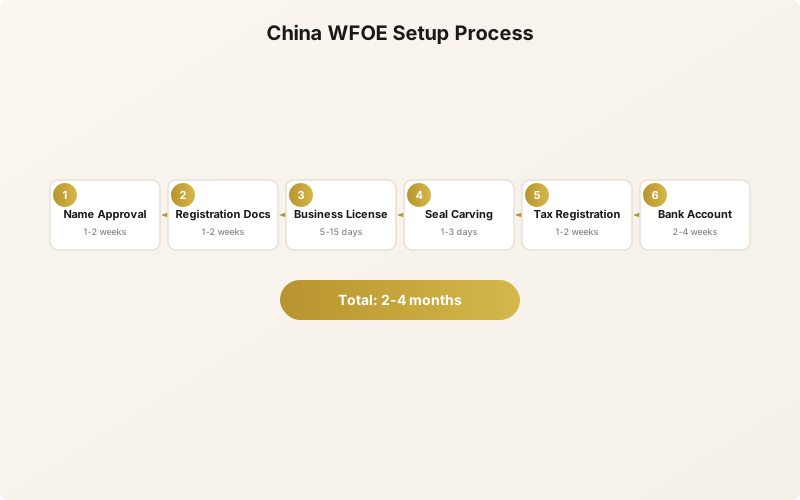
A1: The WFOE setup process typically takes 2-4 months from start to finish, depending on the industry and location. The timeline includes: name approval (1-2 weeks), preparing registration documents (1-2 weeks), business license application (5-15 business days), seal carving (1-3 days), tax registration (1-2 weeks), bank account opening (2-4 weeks), and any special industry licenses (variable timeline). Certain restricted industries may require additional approvals that can significantly extend the timeline.
Q2: Can a foreign company hire employees in China without a local entity?
A2: Foreign companies cannot directly hire employees in China without establishing a legal entity. The common alternatives include using a PEO (Professional Employer Organization) or staffing agency for temporary or initial staffing needs, engaging independent contractors (though this carries misclassification risks), or establishing a representative office (which is limited to non-commercial activities like market research and liaison work). For ongoing business operations, establishing a WFOE or joint venture is the proper way to hire local employees directly and issue employment contracts.
Q3: What is the difference between a WFOE and a joint venture in China?
A3: A WFOE (Wholly Foreign-Owned Enterprise) is a limited liability company entirely owned by foreign investors, offering full control over operations but requiring the foreign investor to handle all aspects of market entry independently. A joint venture involves partnering with a Chinese shareholder, which can provide market access, local expertise, and government relationships but requires sharing control and profits. The choice depends on the industry (some sectors require joint ventures under the negative list), the level of local market knowledge needed, and the desired degree of operational control.
Q4: What industries are restricted for foreign investment in China?
A4: China publishes a Foreign Investment Negative List that specifies industries where foreign investment is prohibited or restricted. Prohibited sectors include certain news media, compulsory education institutions, and some rare earth mining. Restricted sectors where foreign ownership is limited include telecommunications, education, healthcare, financial services, and agriculture. The negative list is periodically updated, generally becoming more open over time. Industries not on the negative list receive national treatment, meaning foreign investors enjoy the same treatment as domestic investors.
Q5: What is the minimum registered capital for a WFOE?
A5: China abolished the statutory minimum registered capital requirement for most industries in 2014 under the注册资本认缴登记制 (subscription system). However, companies must still specify a registered capital amount and contribution timeline in their articles of association. The practical registered capital amount should reflect the actual operational needs of the business and the industry norms. Some regulated industries still have minimum capital requirements, such as banking, insurance, securities, and certain types of consulting businesses.
Further Reading
- Tooling Cost in China: A Complete Guide to Mold Pricing, Payment and Ownership — Mold tooling costs and ownership
- Rapid Prototyping and Sampling in China: A Complete Guide for Hardware Startups — Prototype to production transition
- Product Assembly, Testing, and Final Inspection in China: A Complete Guide — Post-molding assembly and testing
- Product Packaging in China: A Complete Guide for Hardware Brands — Packaging design for molded parts
Next Steps
For hardware teams, the legal questions follow the sourcing sequence: select and vet a factory, fix tooling and payment terms, then protect the design and manage inspection, certification and export. The guides below follow that sequence.
Two service lines most often relevant at this stage:
- Which contracts does an AI company need before selling in China?
- How can a foreign AI company protect its models and code in China?
To discuss scope, timeline and fees for your own matter, Contact Us About Your China Entry. The initial consultation is free; the form prepares an email in your own mail application.
Related guides in this series
- China Hardware & Supply Chain Guide for Foreign AI Companies
- How to Select and Vet Factories in China: A Complete Sourcing Guide for Hardware Startups
- Cost of Manufacturing in China: What Foreign Hardware Startups Should Budget
Frequently Asked Questions↑ Back to article
How much does injection molding cost in China?
Mold tooling typically ranges from $1,500 for a simple single-cavity prototype mold to $50,000+ for complex multi-cavity production molds. Part costs depend on material, size, and cycle time — small simple parts can cost $0.10–$0.50 each at volume, while medium parts range from $0.50–$5.00. Expect a 30–60% cost advantage compared to Western manufacturing.
What is the lead time for injection mold making in China?
Typical mold making lead time is 25–45 days from design finalization to T1 (first shot) samples. Simple prototype molds can be done in 10–20 days, while complex multi-cavity molds with side actions may take 50–70 days. Add 7–14 days for sample approval and modifications before mass production.
What are the most common injection molding defects?
The most common defects include sink marks (thicker sections shrink), weld lines (where melt flows meet), warpage (uneven cooling), flash (excess material at parting lines), short shots (incomplete filling), voids (air bubbles inside), ejector pin marks, flow marks, silver streaks, and delamination. Most can be prevented through good DFM and process optimization.
How do I choose a good injection molding factory in China?
Look for factories with in-house mold making, engineering teams that can do proper DFM reviews, ISO 9001 certification, relevant material certifications (RoHS, REACH), and experience with your product type. Visit if possible, ask for client references, inspect their quality control process, and start with a trial order. Red flags include prices well below market, vague communication, and reluctance to share quality documentation.
What plastic materials are commonly used in China?
The most commonly used plastics in Chinese injection molding are ABS, PC, PC+ABS blend, PP, PE, PA (Nylon), POM, PMMA (Acrylic), and TPE/TPU. All major engineering resins are widely available through domestic and international suppliers. Material costs are generally 10–25% lower than in Western countries due to volume and proximity to petrochemical hubs.
What are the different tiers of injection molding factories in China?
Chinese injection molding factories fall into three main tiers. Tier 1 factories have 200+ employees and 50+ machines, with in-house capabilities across the full process chain, full certifications, and serve major brands, but typically have MOQs starting at 10,000-50,000 pieces. Tier 2 factories with 50-200 employees and 15-50 machines offer a good balance of cost and capability for 5,000-100,000 piece runs. Tier 3 workshops with 10-50 employees and 3-15 machines have the lowest prices but vary in quality, best suited for 500-10,000 piece runs of simple parts.
Why is DFM important for injection molding in China?
DFM (Design for Manufacturing) is critical for injection molding in China because even a well-designed product that is hard to mold will be expensive and have quality problems. Good DFM optimizes wall thickness, adds proper draft angles, simplifies undercuts, positions gates correctly, and ensures uniform cooling — reducing unit cost by 10-30%, lowering defect rates, reducing tooling costs, and shortening time to production. Most Chinese injection molding factories provide DFM feedback as part of their quotation process, and taking this feedback seriously is one of the most impactful things a product team can do.