Key Takeaways
- China tooling costs 40–60% less than equivalent molds in the US or Europe.
- Injection molds range from $1,500 to $50,000+, with most consumer product molds at $5,000–$20,000. Complexity, cavity count, and steel grade drive cost.
- Standard payment terms: 50/40/10 — 50% deposit, 40% after T1 samples, 10% after production qualification. Never pay 100% upfront.
- You do NOT own the tooling by default — contract clauses are essential, even if you pay 100%.
- Hidden costs can add 20–40% — modifications, sampling, and maintenance are the most common budget overruns.
1. Introduction
For hardware startups, tooling is the make-or-break investment. Before shipping a single unit, you need molds, dies, and fixtures — paid for long before revenue arrives. Tooling typically represents 30–70% of a startup’s manufacturing budget, making it the largest pre-production expense.
China produces over 40% of the world’s industrial molds, with thousands of specialized shops concentrated in the Pearl River Delta (Shenzhen, Dongguan) and Yangtze River Delta (Suzhou, Ningbo). Skilled labor, advanced CNC equipment, and dense supply chains mean foreign startups get production-quality tooling at a fraction of domestic costs.
But lower prices carry real risks. Quality varies enormously between shops. Payment disputes, ownership ambiguities, hidden modification costs, and factory reliability issues are common. This guide covers everything you need to budget accurately and protect your investment.
2. Types of Tooling
Tooling covers several manufacturing processes. The type you need depends on your product:
Injection Molds (Most Common) — For plastic parts (enclosures, housings, buttons, internal components). Typically the most expensive and critical tooling investment for consumer hardware.
Die-Casting Molds — For metal parts (zinc, aluminum, magnesium). Common for structural components and heat sinks. More expensive than injection molds due to higher temperatures and wear.
Stamping Dies — For sheet metal parts like brackets, shields, and connectors. Progressive dies produce high volumes quickly but are costly for complex parts.
Silicone Molds — For low-volume production (50–500 units) of soft rubber or urethane parts. Much cheaper than injection molds but with limited lifespan.
CNC Machining Fixtures — Custom jigs for secondary machining, assembly, or testing. Lower cost but essential for consistent quality.
Most consumer hardware startups need 2–5 injection molds, possibly a stamping die, and several assembly fixtures.
3. What Determines Mold Cost
Every mold is custom-engineered. Understanding the cost drivers helps you evaluate quotes and optimize design for manufacturability.
Part Complexity is the biggest factor. Simple parts with straight walls use a straightforward two-plate mold. Undercuts, side actions, lifters, threaded inserts, or snap-fit features require complex mechanisms that increase engineering and machining cost.
Part Size and Material — Larger parts need bigger mold bases and more steel. Abrasive or corrosive plastics (glass-filled nylon, PVC) require harder, more expensive steel.
Mold Material (Steel Grade) directly affects cost and lifespan:
- P20 steel: Most common for mid-volume production. Good cost/durability balance.
- S136 / 420 stainless: For high-gloss finishes, medical parts, or corrosive plastics. More expensive, longer-lasting.
- H13 hot-work steel: For die-casting and high-temperature applications.
- 718 / NAK80: Pre-hardened steels for prototype or low-volume molds.
Number of Cavities — A 4-cavity mold costs roughly 2.5–3x a single-cavity mold (not 4x) because the base and engineering are shared.
Surface Finish — High-gloss polishing or custom textures add 10–25% to mold cost due to labor-intensive hand work.
Production Volume — Higher volumes require more robust molds with better steel and more cooling channels. A prototype mold for 1,000 shots costs a fraction of a production mold for 500,000+ shots.
Tolerance Requirements — Medical and optical parts with micron-level tolerances cost 2–3x more than consumer-grade parts.
4. Typical Cost Ranges
Below are realistic injection mold cost ranges in China as of 2026 — use these for planning, as actual quotes vary by part geometry and supplier.
| Part Type | Complexity | Cavities | Steel | Cost Range (USD) |
|---|---|---|---|---|
| Small button / cover | Low | 1 | P20 | $1,500 – $3,500 |
| Small enclosure (50mm) | Medium | 1 | P20 | $3,000 – $6,000 |
| Device housing (150mm) | Med-High | 1 | P20 | $5,000 – $12,000 |
| Housing with undercuts | High | 1 | P20/S136 | $8,000 – $20,000 |
| 4-cavity housing mold | High | 4 | P20 | $15,000 – $35,000 |
| High-precision optical | Very High | 1 | S136 | $20,000 – $50,000+ |
| Large appliance housing | Very High | 1 | 718H | $25,000 – $60,000+ |
China vs. US/Europe Pricing: US tooling is typically 2–3x more expensive; European tooling is 1.5–2.5x more; Vietnam/India are 10–30% cheaper but with far fewer experienced shops.
The cost gap has narrowed as Chinese labor costs rise and Western shops adopt automation, but China still offers significant savings for complex, multi-cavity molds.
5. Mold Pricing Breakdown
When a Chinese mold shop quotes $10,000 for a mold, here’s roughly where the money goes:
| Component | Share | Description |
|---|---|---|
| Design & Engineering | 10–15% | DFM analysis, mold flow simulation, 2D/3D design |
| Mold Base | 15–20% | Standard base plates, guide pins, bushings |
| Cavity/Core Machining | 25–35% | CNC milling, EDM, wire cutting of forming surfaces |
| EDM / Sinker Work | 10–20% | Electrical discharge for deep features and fine details |
| Polishing / Texturing | 8–15% | Manual polishing, texture etching |
| Assembly & Fitting | 8–12% | Assembling components, fitting, adjusting |
| Mold Testing (T0/T1) | 5–10% | Trial shots, sample production, adjustments |
| Standard Components | 5–10% | Ejector pins, springs, hot runners, cooling |
| Profit Margin | 10–20% | Mold shop profit (varies by size and competition) |
If a supplier is 30% cheaper than others, they’re likely cutting corners on engineering, steel grade, or testing.
6. Payment Structures
Tooling payment terms in China follow standard patterns but are negotiable.
The 50/40/10 Standard — The most common structure:
- 50% deposit upon order placement (PO signed, design finalized)
- 40% after T1 sample approval (first test shots meeting specifications)
- 10% final payment after PPAP approval or production qualification
Milestone-Based Payments — For expensive or complex tooling, negotiate additional milestones: 30% on order, 20% on design review, 20% on T0 samples, 20% on T1 approval, 10% after production qualification.
Red Flags: 100% upfront payment (extremely risky), no sample approval milestone (you lose leverage), full payment before receiving final drawings.
Negotiating Tips: Use competitive quotes as leverage, tie payments to verifiable deliverables, consider third-party inspection for first-time suppliers, and use escrow for large packages ($50,000+).
7. Mold Ownership
Mold ownership is one of the most dispute-prone areas in China manufacturing. The rule is simple: unless your contract says you own the tooling, you probably don’t.
Why Ownership Matters
- You can’t move production to another factory without the mold
- The factory could use your mold for competitors
- If the factory closes, you may lose your tooling entirely
- You lose negotiating leverage for future pricing
How to Ensure Ownership
- Get it in writing — Your agreement must include explicit ownership clauses
- Pay for tooling separately — Tooling should be a distinct line item, not amortized into per-unit pricing
- Title transfer language — Specify that full payment transfers exclusive ownership to you
Essential Contract Clauses:
- Clear ownership statement identifying all tooling assets
- Mold return clause — right to demand return with 30–60 days’ notice
- Inspection access — right to audit the mold and production records
- Storage and care — factory responsibility for proper maintenance and insurance
- No unauthorized use — explicit prohibition on third-party production
Common Disputes — Most conflicts involve factories withholding tooling over alleged unpaid invoices, refusing release after relationship breakdowns, or claiming design improvements give them partial ownership. Clear contracts minimize risk, though enforcement in China remains challenging.
8. Evaluating Tooling Quotes
Quotes for the same part can range from $4,000 to $15,000. The variation usually reflects different approaches, not just markup.
Why Quotes Vary
- Different assumptions about cavity count, steel grade, and lifespan
- Different engineering and DFM effort levels included
- Different quality standards and overhead structures
- Language barriers causing different requirement interpretations
What to Look for Beyond Price: steel grade specification, cavity count and mold base standard (LKM, DME, HASCO), hot runner vs. cold runner, included test shots and modifications, warranty terms, and whether final drawings are included.
Questions to Ask Suppliers:
- What steel grade for cavity and core? Can you provide a material certificate?
- What’s the expected lifespan in shots, and what does the warranty cover?
- How many sample modification rounds are included?
- Do you provide full 2D and 3D mold drawings upon completion?
- Can you provide foreign customer references?
Comparing Apples-to-Apples — Create a comparison spreadsheet normalizing for steel grade, cavity count, included modifications, warranty, and documentation. The cheapest quote is rarely the best value.
9. Common Cost Pitfalls
Tooling almost always costs more than the initial quote. Here are the most common budget overruns.
Hidden Sampling Costs — Most quotes include one or two sample rounds, but additional iterations cost $500–$2,000 each in machine time, materials, and labor.
Design Modifications — Changes after steel is cut are expensive. Simple tweaks: $500–$2,000. Re-cutting a cavity: 20–50% of original mold price. Invest in DFM reviews before cutting steel.
Surface Finish Changes — Changing texture or polish late in the process is labor-intensive and costly. Lock in specs early.
Low-Ball Quotes — Some shops quote low to win business, then charge for every modification. If a quote seems too good to be true, it is.
Steel Grade Substitution — A dishonest supplier might quote S136 but use cheaper steel. You won’t know until the mold wears out prematurely. Ask for material certificates.
Maintenance and Spare Parts — Budget 5–10% of tooling cost per year for maintenance. Ejector pins break, springs fatigue — plan for spares.
10. Mold Lifespan and Maintenance
Mold lifespan is measured in “shots” — each time the mold opens and closes. It depends on steel grade, material, maintenance, and production conditions.
Typical Lifespan by Steel Grade:
- P20 steel: 300,000 – 500,000 shots (general-purpose plastics)
- S136 stainless: 800,000 – 1,500,000+ shots (corrosive materials, high-gloss)
- H13 hot-work steel: 500,000 – 1,000,000 shots (die casting)
- 718 / NAK80: 100,000 – 300,000 shots (prototype / low-volume)
Maintenance — Daily cleaning and lubrication, weekly disassembly, monthly system checks, and quarterly preventive maintenance keep molds running. Clarify in your contract who pays for what: routine maintenance is usually factory-covered, but major repairs are negotiated. If you own the tooling, you’re ultimately responsible for major repairs.
Replacement Planning — Start planning for replacement molds at 70–80% of expected lifespan. Building a new mold takes 4–8 weeks — don’t let production stop because your only mold wore out.
11. Protecting Your Tooling Investment
Your tooling is a significant capital asset. Here’s how to protect it.
Documentation — Maintain a complete tooling dossier: final CAD files (part and mold), mold BOM, material certificates, T0/T1/PPAP reports, maintenance records, and surface finish specs. Store securely in multiple locations.
Periodic Audits — Visit or send a third-party inspector to verify mold condition and check for unauthorized use. Schedule at least annually, quarterly for high-value tooling.
Insurance — Consider tooling insurance covering loss, damage, or theft. Cost is typically 1–3% of tooling value per year.
Mold Transfer Plan — Always have a transfer plan: identify 2–3 backup molders, maintain documentation, understand logistics costs, and budget 10–20% for factory adaptation.
Building Redundancy — For critical high-volume parts, consider dual-sourcing at two factories. For tighter budgets, having a backup mold design ready to cut reduces replacement lead time from 8 weeks to 2–3 weeks.
IP Strategy — Register design patents in China for legal recourse. NDAs alone are insufficient — combine with ownership clauses and design watermarks.
12. Key Takeaways
Tooling is the foundation of your manufacturing strategy. Get it right, and you have a reliable, cost-effective production path. Get it wrong, and you can burn through your runway with delays and cost overruns.
Budget 20–30% for contingencies — Plan for extra costs from modifications, sampling, and unforeseen issues.
Ownership is contractual, not automatic — Paying for the mold doesn’t mean you own it. Get clear terms in writing before you pay anything.
Don’t choose solely on price — The cheapest mold often ends up most expensive when you factor in poor quality and shorter lifespan. Evaluate on total value.
Invest in DFM upfront — A design-for-manufacturability review before cutting steel saves tens of thousands in later modifications.
Plan for the end before you start — Think about lifespan, maintenance, transferability, and replacement from day one.
China’s tooling industry offers unmatched value for hardware startups but requires careful management. With realistic budgeting, clear contracts, and proactive supplier management, you can build a manufacturing foundation that scales with your business.
Working with Chinese Partners and Distributors
Many foreign companies entering China consider working with a local partner or distributor as a way to accelerate market entry and reduce risk. Partners can provide local market knowledge, existing customer relationships, and regulatory expertise. But partnerships also come with challenges — and they rarely work out as well as expected without careful structuring and management.
The most common types of partners are: distributors (who buy your product and resell it), agents (who sell on your behalf for a commission), strategic partners (who invest in deeper collaboration), and licensing partners (who license your technology and sell their own products based on it). Each type has different implications for control, revenue share, and risk.
Key success factors for partnerships include: clear expectations from the beginning (what each side is responsible for, what the targets are, how success is measured), strong contracts (with clear terms for exclusivity, territory, pricing, IP protection, and termination), active management (partnerships need attention — they do not run themselves), and an exit strategy (what happens if it does not work out? How do you end the relationship cleanly?).
The biggest mistake companies make is treating the partnership as a shortcut that means they do not need to build their own China capability. In practice, even with a strong partner, you still need your own team on the ground to manage the relationship, protect your interests, and ensure you are learning about the market directly.
The Real Cost of Entering China: Beyond Setup Fees
When budgeting for China entry, foreign companies often focus on the setup fees — business license, registered capital, legal fees — and underestimate the ongoing operational costs. The setup cost is real, but it is typically the smallest part of the total cost of being in China.
The major ongoing costs fall into several categories. First, people: salaries, benefits, social insurance (which adds about 30-40% on top of base salary), and housing fund contributions. Second, office and infrastructure: rent in Shenzhen or Shanghai is comparable to major Western cities, plus IT infrastructure and compliance systems. Third, compliance: annual audit, tax filing, regulatory filings, and legal advisory. Fourth, taxes: corporate income tax (25% standard rate, though high-tech enterprises qualify for 15%), VAT (6-13% depending on activity), and withholding tax on profit repatriation.
There are also less obvious costs. The opportunity cost of management time spent on China operations is significant. The cost of mistakes — a misfiled tax return, an employment dispute, a compliance gap — can be high. And the cost of doing business slowly — taking longer to hire, longer to get approvals, longer to reach profitability — adds up.
The companies that succeed in China are the ones that budget for the full picture, not just the setup fees. They plan for at least 18-24 months of operating runway before expecting the China entity to be self-sustaining.
China Market Entry Timeline: What to Expect Month by Month
One of the most common questions from foreign companies is: how long does China entry actually take? The answer depends on what you mean by ’entry’ — just setting up an entity, or having a fully operational team with a launched product? Here is a realistic timeline for a typical AI or tech company.
Month 1-2: Planning and preparation. Finalise the entry strategy, choose the entity type and location, engage advisors, and start preparing documentation. If you are going the WFOE route, you need to gather various corporate documents from your home country and get them notarised and apostilled.
Month 2-4: Entity setup. Submit the WFOE application, go through the review process, and receive your business license. Then carve the official seals, open bank accounts, register for taxes, and set up social insurance and housing fund accounts.
Month 3-5: Team building. Start hiring your first employees — ideally the country or GM hire first, then they can help build the rest of the team. Set up office space, IT infrastructure, and basic operational systems.
Month 4-8: Product localisation and compliance. Adapt your product for the China market, set up the required compliance infrastructure (privacy policy, data systems, filing preparation), and start the regulatory filing process if needed.
Month 6-12: Launch and initial revenue. Soft launch your product or service, acquire your first customers, and begin generating initial revenue. Refine your go-to-market strategy based on early feedback.
This is a general timeline — some companies move faster, some slower. The most common delay factors are slow decision-making at headquarters, difficulty finding the right country lead, and underestimating the compliance work required for launch.
Hiring Your First China Employees: Key Considerations
Your first employees in China will shape the culture, direction and trajectory of your China operation. Getting the hiring right — especially for the country lead role — is one of the most important factors in China entry success.
The China country lead needs a rare combination of skills: deep understanding of the local market, ability to work with foreign headquarters, technical credibility in your industry, and the leadership skills to build a team from scratch. Finding someone who has all four is challenging, and many companies underestimate how long this search takes.
Employment law in China also differs from what many foreign companies are used to. Employment contracts are mandatory, probation periods have strict limits, and termination is more regulated — ‘at will’ employment does not exist. Social insurance (pension, medical, unemployment, work injury, maternity) and the housing fund are mandatory contributions that add significantly to total compensation cost.
For AI companies specifically, there is also the question of where to locate. Shenzhen is the natural choice for hardware and AI companies — it has the deepest talent pool, the strongest supply chain, and the most supportive policy environment. But competition for top AI talent is intense, and salaries have risen rapidly. Budget accordingly.
FAQ
Q1: How long does it typically take to set up a WFOE in China?
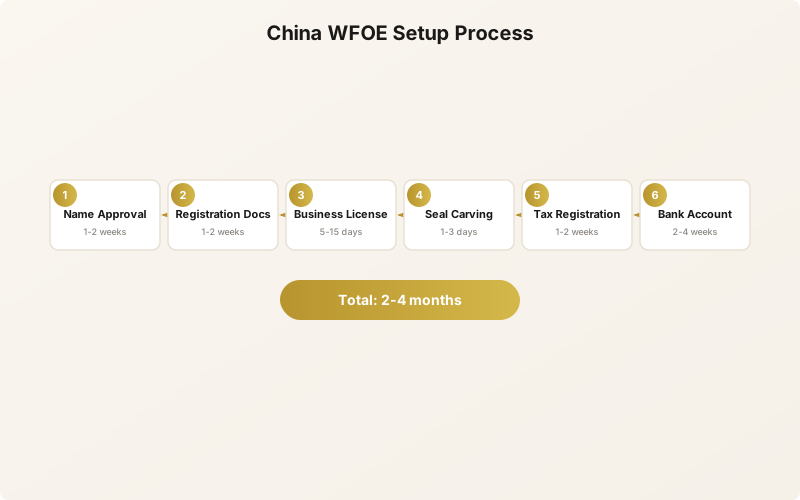
A1: The WFOE setup process typically takes 2-4 months from start to finish, depending on the industry and location. The timeline includes: name approval (1-2 weeks), preparing registration documents (1-2 weeks), business license application (5-15 business days), seal carving (1-3 days), tax registration (1-2 weeks), bank account opening (2-4 weeks), and any special industry licenses (variable timeline). Certain restricted industries may require additional approvals that can significantly extend the timeline.
Q2: What industries are restricted for foreign investment in China?
A2: China publishes a Foreign Investment Negative List that specifies industries where foreign investment is prohibited or restricted. Prohibited sectors include certain news media, compulsory education institutions, and some rare earth mining. Restricted sectors where foreign ownership is limited include telecommunications, education, healthcare, financial services, and agriculture. The negative list is periodically updated, generally becoming more open over time. Industries not on the negative list receive national treatment, meaning foreign investors enjoy the same treatment as domestic investors.
Q3: What is the difference between a WFOE and a joint venture in China?
A3: A WFOE (Wholly Foreign-Owned Enterprise) is a limited liability company entirely owned by foreign investors, offering full control over operations but requiring the foreign investor to handle all aspects of market entry independently. A joint venture involves partnering with a Chinese shareholder, which can provide market access, local expertise, and government relationships but requires sharing control and profits. The choice depends on the industry (some sectors require joint ventures under the negative list), the level of local market knowledge needed, and the desired degree of operational control.
Q4: What is the minimum registered capital for a WFOE?
A4: China abolished the statutory minimum registered capital requirement for most industries in 2014 under the注册资本认缴登记制 (subscription system). However, companies must still specify a registered capital amount and contribution timeline in their articles of association. The practical registered capital amount should reflect the actual operational needs of the business and the industry norms. Some regulated industries still have minimum capital requirements, such as banking, insurance, securities, and certain types of consulting businesses.
Q5: Can a foreign company hire employees in China without a local entity?
A5: Foreign companies cannot directly hire employees in China without establishing a legal entity. The common alternatives include using a PEO (Professional Employer Organization) or staffing agency for temporary or initial staffing needs, engaging independent contractors (though this carries misclassification risks), or establishing a representative office (which is limited to non-commercial activities like market research and liaison work). For ongoing business operations, establishing a WFOE or joint venture is the proper way to hire local employees directly and issue employment contracts.
Further Reading
- Injection Molding in China: A Complete Guide for Hardware Product Teams — Injection molding process and costs
- Payment Terms in China Manufacturing: A Guide for Foreign Hardware Companies — Payment terms for tooling and production
- Supplier Agreement vs Manufacturing Contract: What’s the Difference for China Sourcing? — Tooling ownership in contracts
- Warranty, Quality Guarantee and Defect Liability in China Manufacturing — Warranty for tooling and parts
Next Steps
For hardware teams, the legal questions follow the sourcing sequence: select and vet a factory, fix tooling and payment terms, then protect the design and manage inspection, certification and export. The guides below follow that sequence.
Two service lines most often relevant at this stage:
- Which contracts does an AI company need before selling in China?
- How can a foreign AI company protect its models and code in China?
To discuss scope, timeline and fees for your own matter, Contact Us About Your China Entry. The initial consultation is free; the form prepares an email in your own mail application.
Related guides in this series
- China Hardware & Supply Chain Guide for Foreign AI Companies
- How to Select and Vet Factories in China: A Complete Sourcing Guide for Hardware Startups
- Cost of Manufacturing in China: What Foreign Hardware Startups Should Budget
Frequently Asked Questions↑ Back to article
How much does an injection mold cost in China?
Injection mold costs in China typically range from $1,500 for a simple single-cavity prototype mold to $50,000+ for multi-cavity production molds with complex features like undercuts and side actions. Most consumer electronics enclosure molds fall in the $5,000–$20,000 range. Prices are generally 40–60% lower than equivalent tooling in the US or Europe.
Who owns the tooling — me or the factory?
By default, the factory owns the tooling unless your contract explicitly states otherwise. If you pay 100% of tooling costs, you should have clear ownership clauses in your agreement, including rights to inspect, transfer, or retrieve the mold. Always get tooling ownership in writing before production begins.
What is the typical payment structure for tooling?
The most common tooling payment structure in China is 50/40/10: 50% deposit upon order placement, 40% after T1 sample approval, and 10% after PPAP or mass production qualification. Milestone-based payments tied to deliverables (design review, mold trial, sample approval) are standard and recommended.
How long do molds last in production?
Mold lifespan depends heavily on the steel grade and maintenance. P20 steel molds typically last 300,000–500,000 shots, S136 stainless steel molds can reach 1,000,000+ shots for corrosive materials, and H13 hot-work steel handles 500,000–1,000,000 shots for die casting. With proper maintenance, production molds can last 3–7 years.
Can I move my tooling to another factory?
Yes, if you own the tooling per your contract. However, transferring molds between factories in China can be complex — you may face resistance from the current factory, incur modification costs at the new factory, and risk damage during transport. Always plan for a transfer buffer of 4–8 weeks and budget 10–20% of the original tooling cost for adaptation.
What factors most affect injection mold pricing in China?
The biggest factor in mold cost is part complexity — simple parts with straight walls use straightforward two-plate molds, while undercuts, side actions, lifters, threaded inserts, and snap-fit features require complex mechanisms that increase engineering and machining cost. Other key factors include cavity count (multi-cavity molds cost more but produce more parts per cycle), steel grade (higher-grade steel costs more but lasts longer), mold base size, surface finish requirements, and the factory's engineering capability and overhead structure.
What are common hidden costs in Chinese tooling projects?
Common hidden tooling costs include mold modifications (most products need 2-3 rounds of revisions after T1 samples), sampling and testing fees, spare parts for the mold, maintenance during production, engineering change orders, and shipping or crating costs if you need to transport the mold. These hidden costs can add 20-40% to your initial tooling budget. It is important to clarify what is included in the quote and what will be charged separately before you commit to a tooling project.