If you are a hardware startup sourcing from China, you have almost certainly encountered the same wall that every first-time founder hits: the minimum order quantity, or MOQ.
You email ten factories with your product drawing. Eight reply quoting 5,000 pieces minimum. Two quote 2,000 if you are lucky. Your entire budget might not even cover 500 units. Suddenly, your dream of launching a hardware product feels like it needs a million dollars in funding just to get off the ground.
You are not alone. MOQ is the single most common frustration foreign startups face when working with Chinese manufacturers. But MOQ is not a fixed law of nature — it is a starting point in a negotiation, and there are more paths to low-volume production than most founders realize.
This guide breaks down everything you need to know: why factories have MOQs, what is typical for different processes, how to negotiate them down, alternatives when you cannot, and when you should just bite the bullet and place a bigger order.
Key Takeaways
- MOQ is negotiable. Most factories will accept lower quantities if you accept a higher per-unit price or offer other concessions like upfront tooling payment.
- Different processes have very different MOQs. CNC and 3D printing start at one piece; injection molding and die casting typically need thousands.
- Low-volume specialists exist. Factories in Shenzhen and surrounding areas actively cater to startups and small-batch orders — you just need to know where to find them.
- The cheapest unit price is not always the lowest total cost. Inventory holding costs, obsolescence risk, and cash flow impact can make a smaller, more expensive order the smarter financial choice.
- Your MOQ will (and should) increase over time. Start with prototypes, run a pilot, then scale production as you validate demand.
What Is MOQ and Why Do Factories Have It
MOQ stands for Minimum Order Quantity — the smallest number of units a factory is willing to produce in a single order. But behind that simple number lies a web of practical, financial, and operational realities that every startup founder should understand.
The Real Reasons Factories Set MOQs
Setup and changeover time. Every time a factory switches from one product to another, they spend hours — or even days — preparing. For injection molding, this means installing and testing the mold, warming up the machine, dialing in parameters, and running test shots until parts come out correctly. For PCB assembly, it means programming the pick-and-place machine, loading component reels, and running the first article inspection. That setup time costs the factory real money, and it is easier to spread across a 5,000-piece order than a 500-piece order.
Material MOQs from suppliers. Factories do not make everything from scratch. They buy raw materials — plastic resin, sheet metal, electronic components — and their suppliers have their own MOQs. A plastic resin supplier might require a 25-kilogram bag minimum. A PCB board house might have a 1-square-meter panel minimum. If your product only uses a small amount of that material, the factory either has to buy more than they need or find a way to use the excess. Either way, it pushes the MOQ up.
Economic production runs. Factory lines are designed to run efficiently at a certain volume. Below that volume, the per-unit labor and overhead cost becomes too high for the factory to make a reasonable profit. A production line with 20 workers assembled for a 100-piece order is a money-loser for everyone.
Opportunity cost. Factory floor space and skilled labor are finite resources. A factory that takes a 200-piece order is giving up the chance to run a 10,000-piece order in that same time slot. The MOQ is partly a filter to ensure the order is worth their time.
Administrative overhead. Every order requires quoting, engineering review, purchase orders, quality inspection, shipping coordination, and invoicing. A $5,000 order and a $50,000 order might require almost the same amount of administrative work. Higher MOQs mean fewer, larger orders — and less overhead per dollar of revenue.
Why MOQs Vary So Much Between Factories
Two factories looking at the same product can quote MOQs that differ by an order of magnitude. Why? Because it depends on:
- Factory size and specialization. A 10-person workshop in Shenzhen might happily take a 100-piece order. A 500-person factory in Dongguan optimized for mass production will not even consider anything under 5,000.
- Existing production schedule. If a factory has a gap in their production schedule next week, they might accept a lower MOQ to fill it. If they are booked solid for two months, their MOQ goes up.
- Material availability. If the factory already has your material in stock from another customer’s order, they can offer a lower MOQ. If they have to special-order it, the MOQ climbs.
- Relationship history. First-time customers get standard MOQs. Repeat customers with a track record of payment and growing volume get flexibility.
Typical MOQ Ranges by Product Type and Process
MOQ is not one number — it is a spectrum that depends entirely on the manufacturing process and product complexity. Here is what you can generally expect:
Injection Molding
- Mold cost: $1,500–$25,000+ (one-time, depends on part size, complexity, number of cavities, and steel grade)
- Part MOQ: 1,000–10,000 pieces per part number for standard factories; 100–500 for low-volume specialists
- Why high: Each mold change takes 2–8 hours, and material suppliers sell resin in minimum bag quantities (typically 25kg)
PCB Assembly (PCBA)
- Bare PCB MOQ: 5–10 pieces (prototype services) to 100–500 pieces (production)
- Assembled PCBA MOQ: 50–500 boards for standard SMT lines; 1–10 for prototype houses
- Why the range: Pick-and-place setup time and component minimums (many components have reel MOQs of 1,000–5,000 pieces)
CNC Machining
- MOQ: 1–50 pieces for prototype shops; 100–500 for production CNC
- Why low: Each part is machined individually, so there is no minimum run required — you pay per part regardless of quantity
- Note: Unit prices drop significantly at higher volumes due to optimized fixturing and tooling
Sheet Metal
- MOQ: 50–500 parts for standard sheet metal; 1–10 for prototype laser cutting
- Why: Tooling setup (bending dies, punching) and material sheet minimums drive the floor
Die Casting
- Tooling cost: $5,000–$50,000+
- Part MOQ: 3,000–10,000 pieces minimum
- Why high: Die casting has very high setup costs and is only economical at volume
3D Printing
- MOQ: 1 piece (no minimum)
- Processes: SLA (high-resolution plastic), SLS (nylon, functional parts), FDM (low-cost, basic parts), MJF (high-quality nylon)
- Why no minimum: Additive manufacturing builds parts layer by layer with no tooling
Assembly and Packaging
- MOQ: 100–2,000 units for full product assembly; 500–5,000 for custom retail packaging
- Why: Assembly line setup, custom packaging tooling, and label printing minimums all contribute
The MOQ vs. Price Relationship
Here is the fundamental truth about MOQ that many founders miss: MOQ and unit price are two sides of the same coin. You can almost always trade one for the other.
Imagine a factory that quotes you 5,000 pieces at $4.50 each. That same factory will almost certainly accept 1,000 pieces — but at $7.00 each. And they might take 200 pieces at $12.00 each.
The reason is economies of scale. Fixed costs (setup, engineering, tooling, material waste from minimum buys) get spread across fewer units, so each unit carries a larger share of those costs.
The Economies of Scale Curve
The price-quantity relationship is not linear. Going from 100 to 500 pieces might drop the unit price by 30%. Going from 500 to 2,000 might drop it another 20%. Going from 2,000 to 10,000 might only drop it 10%. And beyond a certain volume — say 50,000 pieces — the price barely moves at all.
This means the biggest price leverage comes from going from very small quantities to modest quantities. Once you are past the first couple thousand units, each additional order of magnitude gives you diminishing returns.
When Paying More for Lower Volume Makes Sense
Startups often fixate on getting the lowest possible unit cost. But the lowest unit cost is rarely the right goal for an early-stage company. Consider the total cost:
- Inventory holding cost: Money tied up in inventory is money you cannot spend on marketing, hiring, or product development. If you have $50,000 sitting in a warehouse for six months, that is an opportunity cost.
- Obsolescence risk: What if you discover a design flaw after producing 5,000 units? What if the market changes? What if a competitor launches something better? Larger orders mean more risk.
- Cash flow impact: For a bootstrapped startup, cash flow is survival. A 500-piece order at $10 each ($5,000) might be manageable. A 5,000-piece order at $4.50 each ($22,500) could kill the company if sales are slow.
As a rule of thumb, if you have not yet proven product-market fit, prioritize smaller orders — even at a higher unit cost. The flexibility and reduced risk are worth the premium.
How to Negotiate Lower MOQs: 10 Practical Strategies
MOQ is almost never a take-it-or-leave-it number. Here are ten strategies that actually work:
1. Ask for a lower MOQ at a higher price. This is the most straightforward trade. Tell the factory: “I cannot do 5,000 pieces, but I can do 1,000 pieces at a higher unit price. What would that look like?” Most factories will work with you on this. Expect a 15–50% price increase for a 50–80% MOQ reduction.
2. Propose a phased approach. Offer to start with a small pilot order now, with a commitment to a larger order later if things go well. For example: “Let us start with 500 pieces for the first order. If sales go well, I will place a 5,000-piece order within six months.” Get the commitment in writing, but be realistic — factories have heard this promise before.
3. Offer to pay tooling/NRE separately. If the product requires custom tooling (molds, fixtures, stamping dies), offer to pay for it upfront and separately from the per-unit cost. This removes a major risk for the factory — they do not have to amortize the tooling cost across the first production run — and can significantly lower the MOQ.
4. Find factories that specialize in small batches. Not every factory is built for mass production. In Shenzhen, Dongguan, and other manufacturing hubs, there are entire workshops dedicated to small-batch and startup work. They have smaller teams, more flexible scheduling, and lower overhead. They will quote higher per-unit prices, but their MOQs are genuinely low.
5. Combine with other customers’ orders. Some factories will let you “piggyback” on another customer’s order if your product uses the same material, color, or process. This way, the factory hits their material MOQ by combining both orders, and you get a lower MOQ. This is not common, but it is worth asking about — especially for materials like specific plastic resins or specialty metal alloys.
6. Use a trading company that aggregates orders. Trading companies work with many small customers and can aggregate orders to hit factory MOQs. They add a margin (typically 10–25%), but they handle all the logistics, quality control, and communication. For startups that do not have the volume to work directly with factories, this can be a cost-effective middle ground.
7. Start with samples and ramp up. Order 10–50 sample units first. Pay the sample premium (often 2–3x the production price). Use those samples for testing, crowdfunding, or pre-sales. Once you have validated demand, come back with a larger order. By then, you have a relationship with the factory and a track record of payment.
8. Be transparent about your startup stage. Many founders try to pretend they are a big company to get better pricing. This usually backfires. Instead, be honest: “We are a startup. This is our first production run. It will be small, but we expect to grow quickly.” Good factories that work with startups will appreciate the honesty and may offer more flexible terms.
9. Offer longer lead times. If a factory has to squeeze your order into an already-full schedule, they will charge more and require higher MOQs. But if you can give them 6–8 weeks instead of 2–3 weeks, they can slot your order into gaps in their production schedule. This is especially effective during slow seasons (typically late spring and summer in China).
10. Build the relationship first. Chinese business culture runs on relationships (guanxi). Take the time to visit the factory if you can. Have video calls with the sales manager or engineer. Ask thoughtful questions. Show that you are serious about the business and not just tire-kicking. A factory that sees you as a partner, not just a customer, will be far more flexible on MOQ.
Alternatives for Low-Volume Production
Sometimes you cannot negotiate the MOQ low enough — or you simply do not need thousands of units yet. In those cases, these alternative processes can bridge the gap between prototype and full production:
3D printing. SLA (stereolithography) produces high-resolution, smooth plastic parts ideal for form and fit testing. SLS (selective laser sintering) and MJF (multi-jet fusion) produce durable nylon parts that can function as end-use parts for low-volume products. FDM is the cheapest option but has lower quality. For quantities under 50 pieces, 3D printing is often the fastest and most cost-effective option.
CNC machining for low volumes. CNC machines cut parts from solid blocks of material. There is no tooling cost, no MOQ, and you get real engineering materials (aluminum, steel, PEEK, etc.). For 1–100 pieces of metal or high-performance plastic parts, CNC is usually the best choice. The trade-off is that per-unit costs are higher, and complex internal features can be difficult or impossible to machine.
Vacuum casting (urethane casting). This process uses a silicone mold (made from a 3D-printed or CNC master) to cast polyurethane parts. It produces 10–50 parts per mold at a fraction of the cost of injection molding tooling. Parts can match production-level quality and material properties. This is ideal for 20–200 piece runs where you need injection-molded quality but cannot justify the tooling cost.
Sheet metal prototyping. Laser cutting and CNC bending services can produce sheet metal parts in quantities as low as one piece, with no tooling cost. For enclosures, brackets, and chassis, this is often the fastest path from design to physical part.
PCB prototype services. Companies like JLCPCB and PCBWay offer 1–10 piece PCB prototypes for as little as $2–$20, with 2–7 day turnaround. For assembled boards, prototype SMT services can do 1–50 assembled boards — though component costs can be high for small quantities.
Cost Comparison (Rough Guide)
For a simple plastic enclosure part (100 x 60 x 30mm):
| Process | 10 pcs | 100 pcs | 1,000 pcs | 10,000 pcs |
|---|---|---|---|---|
| 3D Printing (SLA) | $200 | $2,000 | $20,000+ | Not practical |
| CNC Machining | $500 | $5,000 | $50,000+ | Not practical |
| Vacuum Casting | $800 | $2,500 | Not practical | Not practical |
| Injection Molding | N/A | N/A | $4,500 + $3k tooling | $15,000 + $3k tooling |
The crossover point where injection molding becomes cheaper than vacuum casting is typically around 200–500 pieces, depending on part complexity.
Finding Low-MOQ Factories
Not all factories advertise their low-MOQ capabilities. Here is where to look:
Shenzhen and the Pearl River Delta small-batch specialists. The area around Shenzhen has the densest ecosystem of small, flexible factories in the world. Many of these 10–50 person shops specialize in rapid prototyping and small-batch production for hardware startups. They are used to working with foreign founders and often have English-speaking staff.
Online manufacturing platforms. Services like RapidDirect, Xometry, and Protolabs have built their entire business model around on-demand manufacturing with no MOQ. They work with networks of factories and can quote CNC, sheet metal, 3D printing, and injection molding in hours. Prices are higher than going direct, but the convenience and speed are unbeatable for early-stage work.
Maker spaces and hardware incubators. Shenzhen’s maker spaces (like Seeed Studio, Chaihuo, or TechSpace) often have relationships with local factories that do small-batch work. Hardware accelerators and incubators can also introduce you to their vetted manufacturing partners.
Hardware startup communities and networks. Join groups like Hardware Pioneers, the Hardware Startup Alliance, or relevant Reddit communities (r/Manufacturing, r/HardwareStartup). Founders who have gone through the same process are usually happy to share factory recommendations.
Red Flags for “Low MOQ” Factories
- Prices that seem too good to be true. A factory offering 100-piece MOQ at the same price as 5,000-piece MOQ is likely cutting corners on quality or materials.
- No quality control process. Ask about their QC procedures. If they cannot explain their inspection process, you will likely get inconsistent parts.
- Reluctance to provide references or photos. Legitimate factories are proud of their work and happy to show it.
- Very fast quotes with no questions. A serious factory should ask about your specifications, tolerances, material requirements, and application before quoting.
The Hidden Costs of Low MOQ
Low MOQ sounds great — and for early-stage startups, it is usually the right choice. But it is important to understand the trade-offs:
Quality consistency issues. Small production runs mean the factory does not have time to fully optimize the process. You may see more variation between parts, more defects, and less refined fit and finish. This is especially true for processes like injection molding where the first few hundred parts are essentially a tuning process.
Higher per-unit cost. This is the obvious one. Expect to pay 20–200% more per unit for low-volume production compared to mass production. For some products, this means you will not be profitable at small volumes — and that is okay as long as you have a clear path to scale.
Slower turnaround. Small orders are often lower priority. Factories will squeeze your 200-piece order into gaps between larger jobs, which means lead times can stretch if the factory is busy. A 2-week quote can easily become 4 weeks in practice.
Less factory attention. When you are a small customer, you get small-customer treatment. The best engineers work on the biggest accounts. Quality control might be less thorough. Communication might be slower. This is not malicious — it is just business.
Difficulty scaling later. If you start with a low-volume specialist factory, you may outgrow them quickly. Scaling from 500 to 5,000 pieces often means switching to a different factory entirely, which means re-qualifying the tooling, re-doing first articles, and potentially facing quality issues all over again.
Supplier reliability risk. Smaller factories are more vulnerable to cash flow problems, losing key staff, or shutting down entirely. If your sole supplier goes out of business, you are in trouble.
When to Accept High MOQs
Low MOQ is not always the goal. There comes a point in every hardware startup’s journey where placing a larger order is the right move. Here is how to know when you are ready:
You have proven demand. If you have pre-orders, a successful crowdfunding campaign, or paying customers waiting for more product, you have de-risked the order. This is the clearest signal that it is time to increase volume.
You have funding in place. If you have raised capital specifically for inventory and production, you can afford the larger upfront cost. Just make sure the math works — your runway should cover more than just the production cost.
You have a clear sales pipeline. Even without confirmed orders, if you have distributors, retailers, or enterprise customers lined up with purchase orders or letters of intent, you can place a larger order with confidence.
You have achieved product-market fit. When customers are actively seeking out your product, recommending it to friends, and buying repeat units, you know you have something worth scaling.
The Case for Placing a Bigger Order
Once you are ready, there are real benefits to higher MOQs:
- Lower unit cost. The most obvious benefit. At scale, you can often cut your per-unit cost in half or more.
- Better quality. Longer production runs give the factory time to optimize the process and work out kinks. The 5,000th part is usually better than the 50th.
- More attention from the factory. Bigger orders mean you become a more important customer. You get better communication, faster responses, and priority scheduling.
- Easier to scale further. Once you have a production-proven design and a factory relationship, scaling from 5,000 to 50,000 is much easier than going from 500 to 5,000.
Inventory Management Strategies
If you do place a large order, manage your inventory carefully:
- Use third-party logistics (3PL). Store inventory in a warehouse near your customers, not at the factory. This reduces shipping costs and speeds up delivery.
- Monitor sell-through rate. Track how fast inventory is moving. If it is slower than expected, you may need to adjust your next order size.
- Have a buffer, not a mountain. Aim for 2–4 months of inventory as a buffer. More than that and you are tying up too much cash. Less than that and you risk stockouts.
A Startup’s MOQ Journey: From Prototype to Mass Production
Every hardware product follows a similar trajectory from idea to scale. Here is what the MOQ journey typically looks like:
Sample Stage: 1–10 Pieces
This is when you are validating the design, testing fit and function, and iterating. You are probably using 3D printing, CNC machining, or PCB prototypes. Per-unit cost is high — sometimes 10x the production price — but you only need a handful. This stage typically takes 1–3 months and costs $500–$5,000 depending on complexity.
Pilot Run: 50–200 Pieces
You have a design you are confident in, and you want to test it with real customers or run a crowdfunding campaign. You might use vacuum casting for plastic parts, low-volume PCBA, and manual assembly. This is where you discover all the issues that did not show up in prototypes — tolerances that do not work, assembly steps that are too slow, components that are hard to source. Budget for 2–4 weeks of lead time and expect unit prices to be 2–5x the mass-production cost.
First Production: 500–2,000 Pieces
You have validated demand (through pre-orders, crowdfunding, or early sales), and you are ready for real production. This is when you invest in tooling — injection molds, stamping dies, custom fixtures. You work with a proper production factory, not just a prototype shop. Quality becomes critical, and you should plan for first article inspection (FAI) and in-process quality checks. Lead times are typically 4–8 weeks including tooling.
Scale Production: 5,000+ Pieces
Your product is selling consistently, and you are ready to optimize for cost and quality. You might move to a larger factory, invest in multi-cavity molds, or automate more of the assembly process. Per-unit prices drop significantly, and lead times stabilize. You are now dealing with the problems of success — inventory management, supplier negotiations, and quality control at scale.
Key Takeaways
MOQ is one of the most frustrating parts of manufacturing in China for hardware startups, but it is also one of the most misunderstood.
Remember: MOQ is not a fixed barrier — it is a starting point for a negotiation. Most factories will work with you on lower quantities if you are willing to accept a higher price, pay tooling upfront, or offer other concessions. If they will not, there are always alternative processes (3D printing, CNC, vacuum casting) and alternative factories (small-batch specialists, online platforms) that can meet your volume needs.
The right strategy is to match your production volume to your stage of business. Start small when you are validating, even if it means higher per-unit costs. Scale up when you have proven demand and the resources to handle larger orders. And always remember: the goal is not to get the lowest possible unit price — it is to build a sustainable business.
If there is one piece of advice that every experienced hardware founder will give you, it is this: your first production run will be more expensive, take longer, and have more problems than you expect. Plan for it. Budget for it. And keep your MOQs conservative until you have real proof that your product will sell.
FAQ
Q1: What is the difference between a WFOE and a joint venture in China?
A1: A WFOE (Wholly Foreign-Owned Enterprise) is a limited liability company entirely owned by foreign investors, offering full control over operations but requiring the foreign investor to handle all aspects of market entry independently. A joint venture involves partnering with a Chinese shareholder, which can provide market access, local expertise, and government relationships but requires sharing control and profits. The choice depends on the industry (some sectors require joint ventures under the negative list), the level of local market knowledge needed, and the desired degree of operational control.
Q2: Can a foreign company hire employees in China without a local entity?
A2: Foreign companies cannot directly hire employees in China without establishing a legal entity. The common alternatives include using a PEO (Professional Employer Organization) or staffing agency for temporary or initial staffing needs, engaging independent contractors (though this carries misclassification risks), or establishing a representative office (which is limited to non-commercial activities like market research and liaison work). For ongoing business operations, establishing a WFOE or joint venture is the proper way to hire local employees directly and issue employment contracts.
Q3: What is the minimum registered capital for a WFOE?
A3: China abolished the statutory minimum registered capital requirement for most industries in 2014 under the注册资本认缴登记制 (subscription system). However, companies must still specify a registered capital amount and contribution timeline in their articles of association. The practical registered capital amount should reflect the actual operational needs of the business and the industry norms. Some regulated industries still have minimum capital requirements, such as banking, insurance, securities, and certain types of consulting businesses.
Q4: What industries are restricted for foreign investment in China?
A4: China publishes a Foreign Investment Negative List that specifies industries where foreign investment is prohibited or restricted. Prohibited sectors include certain news media, compulsory education institutions, and some rare earth mining. Restricted sectors where foreign ownership is limited include telecommunications, education, healthcare, financial services, and agriculture. The negative list is periodically updated, generally becoming more open over time. Industries not on the negative list receive national treatment, meaning foreign investors enjoy the same treatment as domestic investors.
Q5: How long does it typically take to set up a WFOE in China?
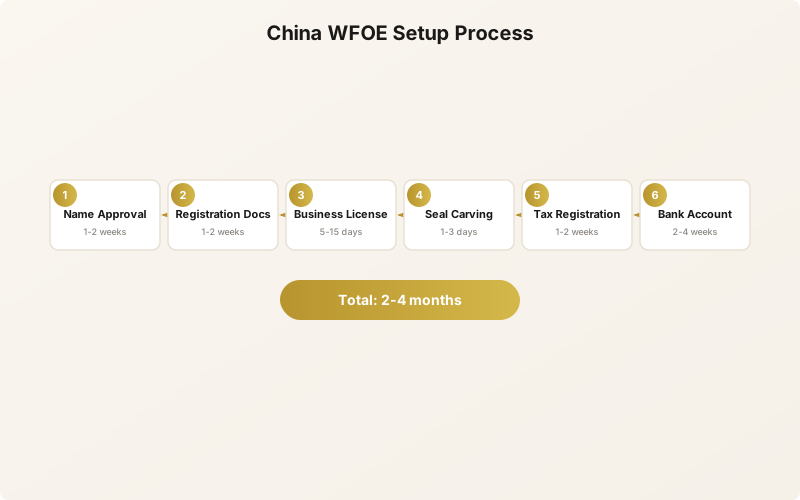
A5: The WFOE setup process typically takes 2-4 months from start to finish, depending on the industry and location. The timeline includes: name approval (1-2 weeks), preparing registration documents (1-2 weeks), business license application (5-15 business days), seal carving (1-3 days), tax registration (1-2 weeks), bank account opening (2-4 weeks), and any special industry licenses (variable timeline). Certain restricted industries may require additional approvals that can significantly extend the timeline.
Further Reading
- How to Select and Vet Factories in China: A Complete Sourcing Guide for Hardware Startups — Finding factories that match your volume
- Negotiating with Chinese Factories: Practical Tips for Hardware Startup Founders — Negotiating minimum order quantities
- Payment Terms in China Manufacturing: A Guide for Foreign Hardware Companies — Payment terms and MOQ tradeoffs
- Rapid Prototyping and Sampling in China: A Complete Guide for Hardware Startups — Prototyping before mass production
Next Steps
For hardware teams, the legal questions follow the sourcing sequence: select and vet a factory, fix tooling and payment terms, then protect the design and manage inspection, certification and export. The guides below follow that sequence.
Two service lines most often relevant at this stage:
- Which contracts does an AI company need before selling in China?
- How can a foreign AI company protect its models and code in China?
To discuss scope, timeline and fees for your own matter, Contact Us About Your China Entry. The initial consultation is free; the form prepares an email in your own mail application.
Related guides in this series
- China Hardware & Supply Chain Guide for Foreign AI Companies
- How to Select and Vet Factories in China: A Complete Sourcing Guide for Hardware Startups
- Cost of Manufacturing in China: What Foreign Hardware Startups Should Budget
Frequently Asked Questions↑ Back to article
What is a typical MOQ for manufacturing in China?
Typical MOQs in China vary dramatically by product type and process. For injection-molded plastic parts, expect 1,000–10,000 pieces per part number. For PCBA (PCB assembly), MOQs often range from 50–500 assembled boards. CNC machining can start at 1–50 pieces, while sheet metal typically requires 50–500 parts. Consumer electronics assembly MOQs are usually 500–3,000 units. Small-batch specialist factories can sometimes go lower, but at a higher per-unit cost.
Why do Chinese factories have such high MOQs?
Factories set MOQs for several practical reasons: setup and changeover time between production runs, minimum order quantities imposed by their own raw material suppliers, the economics of production line efficiency (longer runs reduce per-unit overhead), opportunity cost of tying up production capacity with small orders, and administrative overhead per order. In labor-intensive regions like Guangdong, factories need volume to keep lines running profitably. Many factory owners would rather run one large order than ten small ones.
Can I really negotiate MOQ down with factories?
Yes, MOQ is almost always negotiable to some degree, especially if you are willing to accept a higher unit price or offer concessions like paying tooling costs upfront, providing longer lead times, or committing to future volume. The key is understanding which levers the factory cares about and finding a win-win arrangement. Some factories will reduce MOQ by 30–70% if the per-unit price increases by 15–50%. Building a relationship and being transparent about your startup stage also helps.
What is the minimum quantity for injection molding?
Injection molding MOQs typically start at 1,000–5,000 pieces per part for standard factories, though some specialized low-volume molders will accept 100–500 pieces at a premium. The mold tool itself is a separate upfront cost ($2,000–$20,000+ depending on complexity). For truly low volumes (under 100 pieces), vacuum casting (urethane casting) or CNC machining are usually more cost-effective than investing in a production mold.
Where can I manufacture in small quantities in China?
For small-batch manufacturing in China, look to: (1) specialized low-volume factories in Shenzhen and Dongguan that focus on startup and prototype work, (2) online platforms like JLCPCB, PCBWay, or RapidDirect for PCBs and CNC parts, (3) maker spaces and hardware incubators with in-house or partner factories, and (4) trading companies that aggregate small orders across multiple customers. Trade shows like the Canton Fair or Hardware Pioneers can also connect you with smaller factories that actively seek startup clients.
What concessions can I offer to negotiate lower MOQs?
Several concessions can help you negotiate lower MOQs with Chinese factories. The most effective is accepting a higher per-unit price — many factories will reduce MOQ by 30-70% if the per-unit price increases by 15-50%. Other levers include paying tooling costs upfront, providing longer lead times, committing to future volume through a forecast, combining multiple part numbers into one order, or offering to take delivery in stages. Being transparent about your startup stage and growth plans can also help factories see the long-term value in working with you.
Why do MOQs vary so much between different factories?
MOQs vary between factories due to differences in size and specialization — a 10-person workshop in Shenzhen might accept 100-piece orders while a 500-person factory optimized for mass production requires 5,000 pieces minimum. Existing production schedules also matter: factories with gaps in their schedule may accept lower MOQs to fill capacity, while fully booked factories raise their minimums. Material availability is another factor — if the factory already has your material in stock from another order, they can offer a lower MOQ, whereas special-order materials push the MOQ up.