Key Takeaways
- Warranty in China is contractual, not automatic — whatever is not written down does not exist.
- Standard periods range from 3 months for plastic parts to 2 years for electronics, but these are norms, not legal requirements.
- The design vs. manufacturing defect distinction is the biggest battleground — factories almost always attribute failures to design.
- Prevention beats claims — invest in clear specifications, golden samples, and quality control.
- Enforcement is difficult — your best leverage is order volume and the relationship, not legal action.
- Negotiate warranty terms before production, not after a defect appears.
1. Introduction
If you are a hardware company manufacturing in China, one of the most unpleasant surprises is discovering that “warranty” does not mean what you think it means.
In Western markets, warranties are backed by consumer protection laws, industry norms, and a legal system that makes enforcement straightforward. In China’s manufacturing ecosystem, none of these hold. Warranty terms are contractual, the burden of proof falls on the buyer, and enforcing a claim against an uncooperative factory can be frustrating and expensive.
This is not to say Chinese factories never honor claims — many do, especially larger, professional suppliers that value long-term relationships. But the process and expectations are very different. Understanding how warranty works in Chinese manufacturing can save you significant money, time, and frustration.
2. What “Warranty” Means in Chinese Manufacturing
Reality vs. Western Expectations
When a Western buyer hears “one-year warranty,” they picture a straightforward commitment: if the product fails within a year due to manufacturing defects, the factory will replace it or refund the cost. In China, the reality is more nuanced.
Warranty is only as good as your contract. There is no universal legal warranty period for B2B transactions in China. Whatever terms you negotiate and put in writing are what you have — anything not written down is essentially unenforceable.
The burden of proof is on you, the buyer. You must demonstrate that the defect is a manufacturing defect, not a design flaw, misuse, or post-shipment damage. This requires detailed documentation, defective samples, and sometimes third-party analysis.
Factories will resist warranty claims. This is not unique to China, but the cultural context makes resistance particularly strong.
The Cultural Context
Two cultural factors shape how claims are handled: saving face (mianzi) — acknowledging defects means admitting failure, so factories go to great lengths to explain away problems — and blame allocation, where admitting fault can lead to penalties or job loss for individual employees. Approach negotiations strategically, giving the factory a “face-saving” way out.
What Is Typically Covered vs. Not Covered
Manufacturing warranties generally cover defects in materials and workmanship — wrong materials, poor assembly, bad solder joints, cosmetic defects outside tolerance, and functional failures from the manufacturing process. Not covered: design flaws, normal wear and tear, misuse, improper storage, shipping damage, and consumable parts.
3. Standard Warranty Terms by Product Type
Warranty periods vary by product category. These are industry norms, not legal requirements — your actual terms depend on negotiation.
Electronics and PCBA: 1–2 years. One of China’s more mature sectors. Many factories offer 1 year as standard; higher-end EMS providers may offer 2 years for higher volumes.
Mechanical Parts: 6 months to 1 year. Covers dimensional issues, material defects, and surface treatment failures.
Plastic Injection Parts: 3–6 months. Among the shortest standard periods since plastic defects are usually obvious upon receipt.
Tooling and Molds: 1 year or specified shot count. Both time and usage components (e.g., 1 year or 100,000 shots, whichever comes first).
Complete Products: 90 days to 2 years. Varies widely by complexity, value, and negotiation.
4. What Warranty Typically Covers
A manufacturing defect exists when the product was not produced according to agreed specifications — wrong material, poor assembly, bad solder joints, dimensional errors, cosmetic defects beyond agreed AQL levels, or functional failures from the manufacturing process.
Not covered: design issues (the product was built to spec but the design is flawed), normal wear and tear, misuse or abuse, improper storage damage, shipping damage (unless explicitly agreed otherwise), and consumable parts.
The “Design vs. Manufacturing” Grey Area
This is the single most common source of warranty disputes. When a product fails, the factory will almost always argue it is a design issue. For example, if a plastic bracket breaks, is it because the factory used weaker material or because you designed the wall too thin? Without clear material specifications, test data, and golden samples, resolving this can be nearly impossible.
The best defenses: extremely detailed specifications, signed golden samples at both locations, documented incoming inspection, and clear defect classification criteria in your quality agreement.
5. Defect Liability Allocation
Design defects — Buyer’s responsibility. If the product was manufactured exactly to your specs but fails due to a design flaw, liability is yours (poor material selection, inadequate structural design, electrical errors, software bugs).
Manufacturing defects — Supplier’s responsibility. If the factory deviated from specs, used wrong materials, or produced failing parts, liability is the supplier’s.
Component defects — Depends on who sourced them. Factory-sourced = factory responsibility. Consigned parts = your responsibility; the warranty only covers assembly work.
Packaging defects. Liability depends on who designed the packaging — factory standard = factory liability; your specs = your liability.
How liability is determined. Through visual inspection, factory investigation (production records, inventory checks), root cause analysis, and in contentious cases, third-party testing.
6. Warranty Claim Process
When you discover a defect, document everything immediately — photos, videos, batch numbers, quantities, failure rates — and retain at least 3–5 defective samples as evidence. Submit the claim in writing via email to your contact with a supervisor copied, referencing PO numbers, the specific specification violated, and your desired remedy.
Expect one of these responses: an investigation delay of 1–2 weeks (normal but sometimes a stalling tactic), blame shifting to design or your components, partial acceptance with disputed quantities, or silence (meaning the factory has no intention of paying).
In negotiation, start with evidence not accusations, give the factory a face-saving way out, and use volume leverage by referencing future orders. Be reasonable — replacements plus a process improvement plan is a realistic ask; a full refund on a 1% defect rate is not. If the factory refuses, escalate to senior management, use your leverage (unpaid balances, deposits, tooling), involve third parties, or walk away. Sometimes the cost of pursuing the claim exceeds the value.
7. Replacement and Remedy Options
Warranty claims typically result in one of these remedies, from most to least common: free replacement units on the next order (most common), credit toward next order, rework or repair at factory cost, discount on future orders, partial refund (rare), and full refund (extremely rare, usually only with significant leverage and a catastrophic, undeniable factory fault).
The next-order approach is popular because it preserves cash for the factory, maintains the relationship, and gives the factory incentive to improve quality — but it only works if you plan to keep ordering. Full refunds are hard to get because of thin margins, face concerns, lack of legal pressure, and disputes over whether the defect is truly manufacturing-related.
8. How to Negotiate Better Warranty Terms
Your leverage depends on order volume (higher = more leverage), relationship length (long-term customers get better terms), payment terms (upfront payments or larger deposits can buy better coverage), product complexity (simpler = easier to warrant), and industry sector (medical, automotive, aerospace factories expect comprehensive terms).
Key clauses to negotiate: longer warranty period (start by asking for 50% longer), clear defect definition referencing standards like IPC-A-610 or ISO 2768, replacement timeline (e.g., 30 days), defect rate threshold (e.g., >2% triggers extra remedies), 5-business-day response requirement, express warranty language, and return shipping cost allocation.
Better warranty terms are not free. Offer larger volumes or longer commitments, better payment terms, a 2–5% price increase, fewer engineering changes, or public references in return.
9. Quality Agreements and Warranty Clauses
A comprehensive quality agreement is your most important tool for managing warranty and quality issues. It should cover quality standards (AQL levels, reference standards like IPC or ISO, inspection criteria, golden sample procedures), warranty provisions (period, start date, coverage, exclusions, notification period), defect rate thresholds and penalties, claim response timeline (response time, investigation period, resolution deadline), RMA process, and liability caps (with exceptions for willful misconduct).
Sample Contract Clause
Warranty. Supplier warrants that all Products manufactured under this Agreement shall be free from defects in materials and workmanship, and shall conform to all applicable Specifications, for a period of twelve (12) months from the date of delivery to Buyer. Buyer shall notify Supplier of any alleged defect within thirty (30) days of discovery. Supplier shall, at its option, either repair, replace, or issue a credit for any Products confirmed to be defective within the warranty period. This warranty does not cover damage caused by misuse, abuse, accident, improper installation, or normal wear and tear.
10. Proactive Strategies to Reduce Warranty Issues
The best warranty claim is the one you never have to make. Prevention is almost always cheaper than fighting for compensation after the fact.
Clear specifications. The more specific your specs, the less room for interpretation. Include material grades with brand names, exact dimensions with tolerances, surface finish requirements, color specifications with Pantone numbers, and test procedures.
Golden samples. Maintain signed, dated golden samples at both your location and the factory — the ultimate reference for resolving disputes about appearance, fit, and finish. Also keep boundary samples showing the worst acceptable unit.
Incoming and in-process inspection. Never assume the factory shipped good product. Conduct incoming inspection on every shipment. For high-value orders, use third-party inspection during production — catching issues early prevents bad batches.
Factory audit and supplier development. Before starting with a new factory, audit their QC system, inspection records, and corrective action processes. Treat suppliers as partners — help them improve processes and share expectations clearly.
11. When Things Go Wrong: Enforcing Warranty Claims
Despite your best efforts, there will be times when a factory refuses to honor a legitimate claim. Here are your options, in order of practicality:
Direct negotiation. Always your first approach. Most disputes are resolved this way. Come prepared with evidence and use your leverage.
Mediation and third-party help. If direct negotiation fails, neutral third parties can help — industry associations, chambers of commerce, sourcing agents, or mediators. Platforms like Alibaba offer dispute resolution; negative reviews can also motivate cooperation.
Legal action and arbitration. Possible but often impractical. Legal fees are substantial, you need a Chinese lawyer, cases take 1–2 years, the burden of proof is high, and collecting damages even if you win is challenging — usually only worth it for claims above $100,000. Arbitration awards from most countries can be enforced in China (China is a New York Convention signatory), but enforcement is still slow and expensive. Consider specifying Hong Kong or Singapore as the venue.
Insurance. For companies doing significant volume, product liability or supplier default insurance may be worth considering, but it does not replace good contracts and QC.
The Practical Reality
Your leverage comes from your business relationship and order volume, not from legal threats. Most factories will work with you if they value your business and see you as a long-term customer. If they do not, legal action is usually more trouble than it is worth for all but the largest claims.
This is why choosing the right supplier matters most. A good factory that values quality and treats customers as partners will solve problems with you. A bad factory will disappear the moment things get difficult.
12. Key Takeaways
Warranty in China is contractual, not automatic. Whatever is not written in your contract does not exist. Negotiate terms before production starts.
Standard periods vary by product type — from 3 months for injection-molded parts to 2 years for electronics — but everything is negotiable with sufficient leverage.
The design vs. manufacturing defect distinction is the biggest battleground. Factories almost always blame design. Protect yourself with detailed specs, golden samples, and clear inspection criteria.
Prevention is far more effective than claims. Invest in clear specifications, incoming inspection, in-process QC, and supplier quality development.
When making a claim, document everything. Photos, samples, batch numbers, test data — the more evidence, the stronger your position.
Realistic remedies are replacements and credits, not refunds. Full refunds are extremely rare. The most common resolution is free replacement units on the next order.
Your leverage is your order volume and the relationship. Legal action is slow, expensive, and usually not worth it.
A comprehensive quality agreement is essential. Specify quality standards, warranty periods, defect rates, claim processes, and remedies. Do not rely on purchase orders or verbal promises.
Manufacturing in China offers tremendous cost and capability advantages, but requires a proactive approach to quality and warranty management. Understand the system, set clear expectations, build strong supplier relationships, and always get it in writing.
China Market Entry Timeline: What to Expect Month by Month
One of the most common questions from foreign companies is: how long does China entry actually take? The answer depends on what you mean by ’entry’ — just setting up an entity, or having a fully operational team with a launched product? Here is a realistic timeline for a typical AI or tech company.
Month 1-2: Planning and preparation. Finalise the entry strategy, choose the entity type and location, engage advisors, and start preparing documentation. If you are going the WFOE route, you need to gather various corporate documents from your home country and get them notarised and apostilled.
Month 2-4: Entity setup. Submit the WFOE application, go through the review process, and receive your business license. Then carve the official seals, open bank accounts, register for taxes, and set up social insurance and housing fund accounts.
Month 3-5: Team building. Start hiring your first employees — ideally the country or GM hire first, then they can help build the rest of the team. Set up office space, IT infrastructure, and basic operational systems.
Month 4-8: Product localisation and compliance. Adapt your product for the China market, set up the required compliance infrastructure (privacy policy, data systems, filing preparation), and start the regulatory filing process if needed.
Month 6-12: Launch and initial revenue. Soft launch your product or service, acquire your first customers, and begin generating initial revenue. Refine your go-to-market strategy based on early feedback.
This is a general timeline — some companies move faster, some slower. The most common delay factors are slow decision-making at headquarters, difficulty finding the right country lead, and underestimating the compliance work required for launch.
Protecting Your IP Before You Enter China
Intellectual property protection is often the number one concern for foreign AI and tech companies entering China. And with good reason — IP disputes are common, and the consequences can be severe. But many companies make the mistake of thinking about IP protection only after they have started operations, when the most important steps should happen before entry.
The first principle of China IP strategy is: register everything before you come. Patents, trademarks, software copyright — each needs to be registered in China to be enforceable there. China follows a first-to-file system, which means whoever files first gets the rights, regardless of who invented it first. If you wait until after you enter, you may find that someone else has already filed for your brand name or key technology.
Second, structure your contracts carefully. Your employment contracts should have clear IP assignment clauses, confidentiality provisions, and non-compete obligations (though non-competes are limited in scope and duration under Chinese law). Your supplier contracts should specify who owns the tooling, the designs, and any improvements made during the manufacturing relationship.
Third, build internal IP protection systems. Access controls, compartmentalisation of sensitive information, employee training, and regular audits all contribute to a defensible IP position. And if the worst happens — infringement or misappropriation — you need a plan for how to respond, whether through administrative channels, civil litigation, or criminal complaint.
Common China Entry Mistakes and How to Avoid Them
After working with dozens of foreign companies entering the China market, we have seen the same mistakes repeated many times. Here are the most common ones — and how to avoid them.
Mistake 1: Underestimating the time and cost. Many companies budget for setup fees but not for the first 1-2 years of operating losses. China entry is an investment, and you need adequate runway.
Mistake 2: Putting the wrong person in charge. The first China hire — usually the country manager or GM — is the most important decision you will make. A bad hire can set you back a year or more. Take the time to find the right person, even if it means the process takes longer.
Mistake 3: Treating compliance as an afterthought. Some companies launch first and figure out compliance later. This is risky in China, where enforcement is increasing and penalties can be significant. Building compliance in from the start is cheaper and less stressful than fixing it later.
Mistake 4: Not protecting IP early enough. Register your trademarks, copyrights, and patents before you come. China is first-to-file, and if someone else registers your brand before you do, it is expensive and time-consuming to fix.
Mistake 5: Trying to do everything yourself. You need local advisors who know the market, the regulations, and the culture. A good lawyer, accountant, and recruiter are worth their fees many times over. The key is finding the right advisors who understand your industry and your stage of growth.
Entity Structure Decision Tree: WFOE, JV, RO or No Entity?
One of the first and most important decisions when entering China is choosing the right legal entity structure. The options — and the tradeoffs between them — are often more nuanced than foreign companies expect.
A wholly foreign-owned enterprise (WFOE) is the most common choice for foreign tech and AI companies. It gives you full control, allows you to hire employees directly, issue RMB invoices, and conduct a wide range of business activities. The tradeoff is higher setup cost, more compliance obligations, and a longer setup timeline (typically 2-4 months).
A representative office (RO) is simpler and cheaper to set up, but it can only perform liaison activities — market research, contact facilitation, quality control oversight. It cannot generate revenue, sign contracts, or hire employees directly. ROs are suitable for the initial exploration phase but quickly become limiting as you grow.
A joint venture (JV) — partnering with a Chinese company — offers local market access and shared risk, but at the cost of control. For AI companies specifically, JVs also raise IP protection concerns that need careful contractual structuring.
Finally, some companies start without a China entity at all, serving the market cross-border through a Hong Kong or Singapore entity. This avoids China entity setup entirely but limits what you can do locally and may not work for products that require domestic licensing or filing.
FAQ
Q1: Can a foreign company hire employees in China without a local entity?
A1: Foreign companies cannot directly hire employees in China without establishing a legal entity. The common alternatives include using a PEO (Professional Employer Organization) or staffing agency for temporary or initial staffing needs, engaging independent contractors (though this carries misclassification risks), or establishing a representative office (which is limited to non-commercial activities like market research and liaison work). For ongoing business operations, establishing a WFOE or joint venture is the proper way to hire local employees directly and issue employment contracts.
Q2: What is the difference between a WFOE and a joint venture in China?
A2: A WFOE (Wholly Foreign-Owned Enterprise) is a limited liability company entirely owned by foreign investors, offering full control over operations but requiring the foreign investor to handle all aspects of market entry independently. A joint venture involves partnering with a Chinese shareholder, which can provide market access, local expertise, and government relationships but requires sharing control and profits. The choice depends on the industry (some sectors require joint ventures under the negative list), the level of local market knowledge needed, and the desired degree of operational control.
Q3: What industries are restricted for foreign investment in China?
A3: China publishes a Foreign Investment Negative List that specifies industries where foreign investment is prohibited or restricted. Prohibited sectors include certain news media, compulsory education institutions, and some rare earth mining. Restricted sectors where foreign ownership is limited include telecommunications, education, healthcare, financial services, and agriculture. The negative list is periodically updated, generally becoming more open over time. Industries not on the negative list receive national treatment, meaning foreign investors enjoy the same treatment as domestic investors.
Q4: How long does it typically take to set up a WFOE in China?
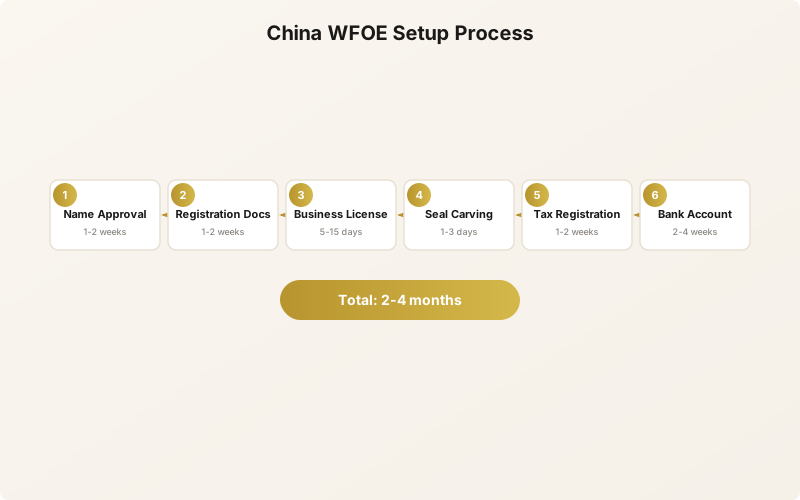
A4: The WFOE setup process typically takes 2-4 months from start to finish, depending on the industry and location. The timeline includes: name approval (1-2 weeks), preparing registration documents (1-2 weeks), business license application (5-15 business days), seal carving (1-3 days), tax registration (1-2 weeks), bank account opening (2-4 weeks), and any special industry licenses (variable timeline). Certain restricted industries may require additional approvals that can significantly extend the timeline.
Q5: What is the minimum registered capital for a WFOE?
A5: China abolished the statutory minimum registered capital requirement for most industries in 2014 under the注册资本认缴登记制 (subscription system). However, companies must still specify a registered capital amount and contribution timeline in their articles of association. The practical registered capital amount should reflect the actual operational needs of the business and the industry norms. Some regulated industries still have minimum capital requirements, such as banking, insurance, securities, and certain types of consulting businesses.
Further Reading
- Supplier Agreement vs Manufacturing Contract: What’s the Difference for China Sourcing? — Warranty clauses in contracts
- Payment Terms in China Manufacturing: A Guide for Foreign Hardware Companies — Payment tied to warranty periods
- Product Assembly, Testing, and Final Inspection in China: A Complete Guide — Quality control and testing
- Supply Chain Risk Management in China: A Practical Guide for Hardware Companies — Quality risk management
Next Steps
For hardware teams, the legal questions follow the sourcing sequence: select and vet a factory, fix tooling and payment terms, then protect the design and manage inspection, certification and export. The guides below follow that sequence.
Two service lines most often relevant at this stage:
- Which contracts does an AI company need before selling in China?
- How can a foreign AI company protect its models and code in China?
To discuss scope, timeline and fees for your own matter, Contact Us About Your China Entry. The initial consultation is free; the form prepares an email in your own mail application.
Related guides in this series
- China Hardware & Supply Chain Guide for Foreign AI Companies
- How to Select and Vet Factories in China: A Complete Sourcing Guide for Hardware Startups
- Cost of Manufacturing in China: What Foreign Hardware Startups Should Budget
Frequently Asked Questions↑ Back to article
What is the standard warranty period from Chinese factories?
Standard warranty periods vary by product type: electronics and PCBA typically carry 1–2 years for manufacturing defects, mechanical parts 6 months to 1 year, plastic injection parts 3–6 months, tooling 1 year or a specified shot count, and complete products vary widely. These are industry norms, not legal requirements.
Do Chinese factories actually honor warranty claims?
Many do, but the process is often slower and more contentious than Western buyers expect. Much depends on factory size, your relationship, order volume, and how clearly terms are defined in your contract. Larger, established factories understand that honoring claims is part of maintaining long-term relationships.
What counts as a manufacturing defect vs design issue?
A manufacturing defect is when the product was not built to agreed specifications — wrong material, poor assembly, bad solder joints, or cosmetic defects outside tolerance. A design issue is when the product was built exactly to spec but fails because the design itself is flawed. The grey area is significant, so golden samples and detailed specs are critical.
How do I make a warranty claim against a Chinese factory?
Document everything: photos, batch numbers, quantities, defective samples, and reference to relevant specifications. Submit the claim in writing with clear evidence and specify your desired remedy. Expect an investigation period. If the factory refuses, escalate to senior management and leverage future orders.
Can I negotiate a longer warranty period?
Yes, but you will need to offer something in return. Factories agree to extended warranties for higher volume commitments, longer-term contracts, better payment terms, or a small price increase. The most leverage comes from consistent, high-volume orders.
How does Chinese business culture affect warranty claim resolution?
Chinese business culture significantly affects how warranty claims are handled. The concept of 'saving face' (mianzi) means factories will go to great lengths to avoid admitting defects directly, as acknowledging failure can be seen as damaging to reputation and career. Blame allocation is also sensitive — admitting fault can lead to internal penalties for individual employees. Successful claim resolution requires giving the factory a face-saving way out and approaching negotiations strategically rather than confrontationally.
What is typically covered versus not covered under factory warranty?
Manufacturing warranties generally cover defects in materials and workmanship, including wrong materials, poor assembly, bad solder joints, cosmetic defects outside tolerance, and functional failures from the manufacturing process. They typically do not cover design flaws, normal wear and tear, misuse or improper handling by the buyer, improper storage conditions, shipping damage after risk transfer, or consumable parts with limited lifespans. The boundary between manufacturing defect and design issue is often the most contested area.