China Law Firms for Foreign Companies: How to Find the Right One
Entering the Chinese market is a significant undertaking for any foreign company. From setting up a legal entity and navigating regulatory approvals to hiring employees and protecting intellectual property, the legal complexity is substantial. The law firm you choose as your guide will shape your experience — and your success — in China.
The right firm will help you avoid pitfalls, move quickly, and make informed decisions. The wrong one can lead to costly delays, compliance failures, and structural problems that take years to fix. This guide explains what to look for in a China law firm, what mistakes to avoid, and how to compare your options so you can choose with confidence.
What to Look for in a China Law Firm for Foreign Companies
Not all China law firms are equipped to serve foreign clients. Foreign companies have different needs, face different constraints, and operate under different assumptions than domestic Chinese companies. Here are the key criteria to evaluate.
Foreign Company Experience
The most important question is whether the firm regularly advises foreign companies on China market entry and operations. China’s legal system works differently from what most Western companies are used to. A firm that primarily serves domestic clients may not understand your expectations around communication, documentation, or risk assessment.
Look for a firm with a track record of advising companies from your home country or region. They should understand the cross-border considerations that matter to you — things like repatriation of profits, foreign exchange rules, tax treaties, and home-country regulatory requirements.
At Geason Law Offices, foreign company advisory is at the core of our practice. We have helped companies from North America, Europe, and Southeast Asia enter and operate in China across a range of industries. Our incorporation and market entry services are built specifically for foreign investors.
English-Language Capability
Working with a law firm where you cannot communicate clearly creates unnecessary risk. Misunderstandings in legal matters can be expensive — and sometimes irreversible. Your lawyers should be able to explain Chinese legal concepts in clear, precise English, and they should be able to understand your business needs without relying on interpreters.
Do not just check whether the firm has “English-speaking staff.” Ask whether the lawyers who will actually handle your matter are bilingual. Having a non-lawyer translator in the room is not the same as having a lawyer who understands both the law and the language.
Our entire client-facing team at Geason Law Offices works bilingually. Our lead lawyer, He Qianggao (license no. 14403201310092337), has over ten years of experience advising foreign clients in both English and Chinese.
Industry-Specific Knowledge
Every industry has its own regulatory environment in China. An AI company faces different rules than a manufacturing company, which faces different rules than a consumer products company. A general corporate lawyer may miss critical industry-specific requirements.
Ask about the firm’s experience in your specific industry. What regulators do they deal with? What kinds of approvals have they helped clients obtain? What are the common pitfalls they see in your sector?
We specialize in technology and AI companies, but we also serve clients in advanced manufacturing, consumer electronics, and other tech-driven sectors. Our industries page covers the sectors we focus on most.
Transparent Fee Structure
One of the most common complaints from foreign companies working with Chinese law firms is unexpected fees. You agree to one price, then the bill comes back much higher. Or the firm charges for every email, every phone call, and every meeting you assumed was included.
Look for a firm that is transparent about pricing from the start. Fixed fees for defined projects are the most predictable. Retainer arrangements with clear scope are also reasonable. Whatever the structure, it should be in writing, and you should not be surprised by the bill.
At Geason Law Offices, we believe in transparent pricing. Most of our project work is fixed-fee, and we always provide a detailed written proposal before we start. You can read more about our approach on our contact page.
Integrated Service Offering
When you enter China, you will need more than just help setting up a company. You will need employment advice, contract drafting, IP protection, tax planning, compliance support, and more. If your law firm only does corporate setup, you will end up managing multiple advisors — and paying for each one to learn your business from scratch.
Look for a firm that can support you across the full lifecycle of your China operation. From incorporation to commercial contracts, from employment compliance to IP protection, from data compliance to financing, a single integrated team is more efficient and more effective.
Geason Law Offices provides end-to-end legal support for foreign companies in China. One team, one point of contact, comprehensive coverage across all your legal needs.
Local Presence and Accessibility
There is no substitute for having your lawyer on the ground in China. Local firms have better access to regulators, better understanding of enforcement practices, and better relationships with the government bodies you will need to work with.
But local presence means more than just an office. It means the firm is embedded in the local business community, follows regional regulatory developments, and can move quickly when you need them. Ask where the firm’s offices are, whether the lawyers who will handle your matter are based in China, and how available they are for in-person meetings.
Based in Shenzhen, we are at the center of China’s tech and innovation ecosystem. We work closely with regulators and industry bodies, and we are available for in-person meetings whenever our clients need them.
Track Record of Success
Experience matters, but results matter more. Ask for specific examples of work the firm has done for companies like yours. How many WFOEs have they set up? How long does it typically take? What is their success rate for license applications? Have they helped clients navigate regulatory audits or enforcement actions?
A good firm will be able to give you specific, verifiable examples of their work. They should also be able to provide client references you can speak with directly.
With over a decade of practice, He Qianggao and the Geason team have a proven track record of helping foreign companies succeed in China. We are happy to provide references and case examples during your initial consultation.
Clear Communication and Reporting
Working with a service provider in another country means you need clear, regular communication. You should not have to chase your lawyer for updates or wonder what is happening with your matter.
Ask about the firm’s communication practices. How often will you receive updates? What format will they use? Who is your primary point of contact? Will you have direct access to the partner or senior lawyer handling your case?
We believe our clients deserve to be kept informed. We provide regular progress updates, respond to inquiries within one business day, and make sure you always know the status of your matter.
Common Mistakes Foreign Companies Make
These are the mistakes we see most often from foreign companies choosing legal counsel in China. Avoiding them will save you time, money, and frustration.
Choosing Based on Price Alone
The cheapest quote is almost never the best value when it comes to legal services in China. A low-cost firm might cut corners, use junior staff, or reuse template documents that do not fit your situation. The cost of fixing mistakes later is almost always higher than the savings from choosing the cheapest option upfront.
Focus on value, not price. A slightly more expensive firm that gets it right the first time will save you money in the long run.
Not Verifying Lawyer Credentials
In China, only licensed lawyers can provide legal services. Unfortunately, there are unlicensed individuals and firms that hold themselves out as legal advisors. Working with someone who is not properly licensed means you have no professional liability protection and no regulatory recourse if something goes wrong.
Always verify the lawyer’s license number with the relevant justice bureau. Every licensed lawyer in China has a unique license number that can be verified publicly. He Qianggao, our lead lawyer, holds license number 14403201310092337.
Failing to Define Scope Clearly
Many problems arise from vague or ambiguous engagement terms. The firm thinks they are doing one thing, and you think they are doing another. By the time you discover the misunderstanding, deadlines may have passed and costs may have escalated.
Before you engage any firm, make sure the scope of work is clearly defined in writing. What exactly will they do? What deliverables will you receive? What is the timeline? What is not included? A clear scope protects both you and the firm.
Waiting Too Long to Engage Counsel
Too many companies start looking for a lawyer only when they have a problem — a contract dispute, a regulatory inquiry, or a blocked business license application. By then, your options are limited and the cost of fixing the problem is much higher.
Engaging counsel early, before you enter the market or make major decisions, allows you to structure your business correctly from the start and avoid problems before they arise. The earlier you involve a lawyer, the more value you get.
Signing Without Understanding
Some foreign companies sign engagement letters or legal documents in Chinese without fully understanding what they are agreeing to. They assume the terms are standard or that the firm has their best interests in mind.
Always make sure you understand every document you sign. If the document is in Chinese, get a translation or have your lawyer explain the key terms in English. Do not rely on verbal assurances — get everything in writing in a language you understand.
Lawyer vs Consultant vs In-House: Which Do You Need?
Foreign companies entering China typically consider three models for legal support: external law firms, business consultants, and in-house legal teams. Each has its place, and many companies use a combination.
| Factor | External Law Firm | Business Consultant | In-House Legal Team |
|---|---|---|---|
| Legal authority | Licensed lawyers, full legal authority | Not licensed, cannot provide legal services | Licensed lawyers on staff |
| Cost model | Project fees or monthly retainer | Monthly or project fees | Salary + benefits + overhead |
| Setup time | Days — start immediately | Days — start immediately | Months — hiring process |
| Breadth of expertise | Wide — multiple practice areas | Narrow — often market entry only | Depends on team size |
| Business integration | External — periodic contact | Variable — depends on engagement | Full integration |
| Liability protection | Professional liability insurance | Limited or none | Employment liability only |
| Best for | Legal work, compliance, disputes, transactions | Market research, partner sourcing, logistics | Large operations with high legal volume |
External Law Firm
An external law firm provides licensed legal expertise on a flexible basis. You pay for the work you need, when you need it, without the cost and commitment of full-time hires.
When to use an external law firm:
- You are setting up a legal entity in China
- You need compliance advice or regulatory filings
- You are negotiating contracts or commercial transactions
- You have disputes or litigation
- You need legal opinions or formal legal documents
The advantages are expertise, flexibility, and liability protection. The disadvantage is that per-hour or per-project costs can be higher than other options for very high ongoing volume.
Business Consultant
Business consultants can help with market research, finding suppliers or partners, navigating administrative processes, and general business advice. They are particularly useful for operational support during the early stages of market entry.
However, consultants are not lawyers. They cannot provide legal advice, draft legal documents, or represent you in legal proceedings. For anything that involves legal risk, you will still need a law firm. Some consultants work with affiliated law firms, but the quality and independence of that arrangement varies.
When to use a business consultant:
- You need market research or partner identification
- You want help with logistics, sourcing, or operational setup
- You need on-the-ground support for business development
- You already have legal counsel and need business support
In-House Legal Team
Building an in-house legal team gives you dedicated, fully integrated legal support. For companies with large China operations and significant ongoing legal volume, this can be the most efficient model.
But building an in-house team in China takes time and money. Finding qualified bilingual lawyers with the right experience is challenging, and turnover can be high. It typically takes three to six months to hire a senior in-house counsel, and total compensation costs are substantial.
When to build an in-house team:
- You have a large, established China operation
- You have high ongoing legal volume across multiple areas
- You need someone embedded in your day-to-day operations
- You can supplement with external firms for specialized work
Our Recommendation
For most foreign companies entering China, the best approach is to start with an external law firm for market entry and initial setup. As you grow and your legal volume increases, you can add in-house resources. A good external firm can help you transition smoothly — and continue to support you for specialized or high-stakes work even after you have an in-house team.
For more on how we work with foreign companies, see our annual legal counsel service.
Questions to Ask Before Engaging
Ask these questions when evaluating China law firms. The answers will help you compare firms and find the right fit.
How many foreign companies do you currently advise, and from which countries? Look for firms that regularly work with companies from your home market.
What is your experience with my specific industry or business model? Industry-specific knowledge is critical for effective legal advice in China.
Can you provide references from foreign clients in similar situations? Speaking with past or current clients is the best way to verify quality and service.
Who will be my primary point of contact, and what is their background? Make sure you know who you will actually be working with, not just who shows up to the first meeting.
What is your fee structure, and can you provide a written estimate? Insist on transparent pricing and a written fee agreement that clearly defines scope.
How do you communicate with foreign clients, and what is your response time? Clear communication is essential when working across borders and time zones.
Can you handle all of our legal needs in China, or only specific areas? If you will need multiple services, a firm that can handle everything is more efficient.
What is your process for handling urgent or time-sensitive matters? Know what to expect if you have an emergency or a tight deadline.
How do you handle conflicts of interest? Make sure the firm does not represent competitors or parties on the other side of your transactions.
What happens if we need to end the engagement? Understand the termination terms and what happens to your documents and information.
How Geason Law Offices Is Different
We started Geason Law Offices because we saw a gap in the market: foreign technology companies needed a China law firm that understood their business, spoke their language, and delivered real value without the big-firm overhead. Here is what makes us different.
Focus on Technology and Innovation
We are not a general practice firm. We specialize in advising technology and AI companies — from startups to established enterprises. Our lawyers understand the technology, the business models, and the regulatory environment because we work with tech companies every day. Whether you are launching an AI product, setting up a R&D center, or expanding your manufacturing operation, we speak your language.
Bilingual, Direct Access
When you work with Geason Law Offices, you communicate directly with the lawyer handling your matter — in English or Chinese, whichever you prefer. No account managers, no translators, no layers between you and the person giving you advice. Our lead lawyer, He Qianggao (license 14403201310092337), has over ten years of experience advising foreign clients and is fully bilingual.
Ten Years of Proven Experience
He Qianggao has been practicing law in China since 2013, with a focus on foreign investment, technology law, and commercial transactions. Over the past decade, he has advised hundreds of foreign companies on China market entry, compliance, and operations. Our clients stay with us because we deliver results — not just paperwork.
Transparent Pricing, Fixed Fees
We hate surprise bills as much as you do. That is why most of our work is offered on a fixed-fee basis, with clear scope and clear deliverables. You will know exactly what you are paying and what you are getting before we start. No hidden charges, no nickel-and-diming, no surprises.
One Team, Full Lifecycle Support
From incorporation to compliance, from contracts to IP, from employment to financing, we handle the full lifecycle of your China business. One team, one relationship, one deep understanding of your company. You will never have to explain your business to a new lawyer or coordinate across multiple departments.
Licensed and Accountable
We are a properly licensed Chinese law firm with all required professional liability insurance. He Qianggao’s license number is 14403201310092337 — you can verify it with the Shenzhen Justice Bureau at any time. We are bound by the ethical rules of the Chinese legal profession, and we take our professional obligations seriously.
Entity Structure Decision Tree: WFOE, JV, RO or No Entity?
One of the first and most important decisions when entering China is choosing the right legal entity structure. The options — and the tradeoffs between them — are often more nuanced than foreign companies expect.
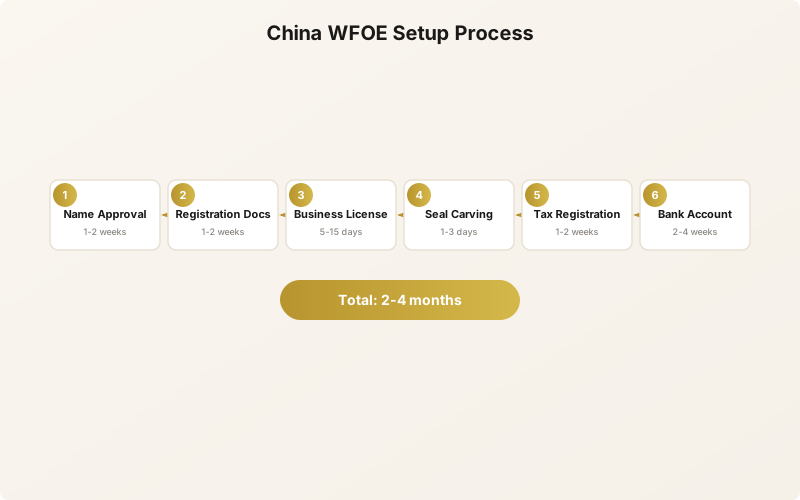
A wholly foreign-owned enterprise (WFOE) is the most common choice for foreign tech and AI companies. It gives you full control, allows you to hire employees directly, issue RMB invoices, and conduct a wide range of business activities. The tradeoff is higher setup cost, more compliance obligations, and a longer setup timeline (typically 2-4 months).
A representative office (RO) is simpler and cheaper to set up, but it can only perform liaison activities — market research, contact facilitation, quality control oversight. It cannot generate revenue, sign contracts, or hire employees directly. ROs are suitable for the initial exploration phase but quickly become limiting as you grow.
A joint venture (JV) — partnering with a Chinese company — offers local market access and shared risk, but at the cost of control. For AI companies specifically, JVs also raise IP protection concerns that need careful contractual structuring.
Finally, some companies start without a China entity at all, serving the market cross-border through a Hong Kong or Singapore entity. This avoids China entity setup entirely but limits what you can do locally and may not work for products that require domestic licensing or filing.
Related Articles
- How to Choose a China AI Lawyer: A Complete Guide for Foreign Companies
- Enterprise SaaS China Entry Guide for Foreign Companies
- Legal Support for Manufacturing in China: Factory Lawyers vs Sourcing Agents vs Law Firms
- AI Compliance Firms in China: Lawyer vs Consultant vs In-House
FAQ
Do I need a Chinese law firm to enter the China market?
While you can technically handle some aspects of market entry on your own, working with a Chinese law firm is strongly recommended. China’s legal and regulatory environment is complex and differs significantly from Western systems. A qualified China lawyer can help you structure your entry correctly, avoid common pitfalls, and ensure compliance with all applicable laws and regulations.
How much does it cost to hire a China law firm for market entry?
Costs vary depending on the scope of work. A typical WFOE setup engagement ranges from RMB 25,000 to 50,000. Ongoing legal counsel is usually RMB 5,000 to 15,000 per month. More complex projects — such as license applications or compliance audits — are priced based on scope. We always provide a clear written estimate before starting work.
How long does it take to set up a company in China?
The timeline depends on the type of entity and the industry. A standard WFOE setup typically takes 2-4 months from start to finish, including business license, tax registration, and bank account opening. Certain industries with special licensing requirements may take longer. We will give you a detailed timeline during your initial consultation.
Can a foreign company work with a Chinese law firm directly?
Yes, foreign companies can engage Chinese law firms directly. You do not need to have a local entity first. We regularly advise foreign companies before they have any presence in China, helping them plan their entry strategy and structure their investments appropriately.
What documents do I need to provide to engage a China law firm?
The specific documents depend on the nature of your matter, but generally you will need to provide: company incorporation documents from your home jurisdiction, proof of identity for authorized signatories, and information about your business activities in China. We will provide a detailed document checklist once we understand your specific needs.
Finding the right China law firm is one of the most important decisions you will make for your China business. The right partner will make the process smoother, faster, and less risky. If you would like to discuss your situation and learn more about how we help foreign companies enter and operate in China, we invite you to schedule a free initial consultation. We will listen to your goals, explain your options, and give you clear next steps — no sales pitch, no pressure.
Frequently Asked Questions↑ Back to article
What are the key criteria for evaluating a China law firm for foreign companies?
Key criteria include foreign company experience with market entry and operations, English-language capability of the actual handling lawyers, industry-specific knowledge in the client's sector, transparent fee structures preferably with fixed fees, integrated service offering across the full lifecycle, local presence and accessibility, proven track record with verifiable references, and clear communication practices.
Why is foreign company experience the most important criterion?
China's legal system works differently from what most Western companies are used to. A firm that primarily serves domestic clients may not understand expectations around communication, documentation, or risk assessment. Firms with cross-border experience understand considerations like profit repatriation, foreign exchange rules, tax treaties, and home-country regulatory requirements.
What common mistakes do foreign companies make when choosing legal counsel in China?
Common mistakes include choosing based on price alone, not verifying lawyer credentials with the justice bureau, failing to define scope clearly in writing, waiting too long to engage counsel until problems arise, and signing engagement letters or legal documents in Chinese without fully understanding the terms.
How do external law firms, business consultants, and in-house teams differ?
External law firms provide licensed legal expertise on a flexible basis with professional liability protection. Business consultants help with market research and operations but cannot provide legal advice. In-house legal teams offer full integration but require substantial time and cost to build, typically three to six months for a senior counsel hire.
What entity structures are available to foreign companies entering China?
The main options are wholly foreign-owned enterprises (WFOEs) that give full control but higher setup costs and compliance obligations, representative offices (ROs) that are simpler but limited to liaison activities, joint ventures (JVs) that offer local market access but at the cost of control and IP concerns, and cross-border service through Hong Kong or Singapore entities that avoids China entity setup entirely.
How long does a typical WFOE setup take and what is the cost range?
A standard WFOE setup typically takes 2-4 months from start to finish, including business license, tax registration, and bank account opening. Typical engagement fees range from RMB 25,000 to 50,000, while ongoing legal counsel usually costs RMB 5,000 to 15,000 per month.
What should foreign companies verify before engaging a Chinese law firm?
Foreign companies should verify the lawyer's license number with the relevant justice bureau, as only licensed lawyers can provide legal services in China. Working with unlicensed individuals means no professional liability protection and no regulatory recourse if something goes wrong.