China is not just a place to manufacture cheaply — it is home to the world’s most advanced, fastest, and densest hardware supply chain. For AI hardware companies — humanoid robots, smart devices, edge AI appliances, autonomous vehicle components, AR/VR hardware — the China supply chain advantage is about speed, density, and ecosystem, not just cost.
This guide covers what foreign AI hardware companies need to know about working with Chinese supply chains: how the ecosystem works, which engagement model is right for you, what contracts you need, and how to protect your IP.
Why AI Hardware Companies Come to China
1. The Shenzhen ecosystem effect
Shenzhen is the global capital of hardware prototyping and manufacturing. What makes it unique is not any single factory — it is the density of the entire ecosystem:
- Component markets (Huaqiangbei) where you can source almost any electronic component in hours
- Thousands of specialised factories, from PCB assembly to precision machining to injection moulding
- Design houses, ID studios, test labs, and certification bodies all within hours of each other
- A huge pool of hardware engineers, manufacturing engineers, and supply chain professionals
The result: speed. A prototype iteration that takes 4-8 weeks in Silicon Valley or Tokyo takes 1-2 weeks in Shenzhen. For AI hardware startups, where iteration speed determines survival, this advantage is decisive.
2. Scale and cost
China produces the vast majority of the world’s consumer electronics and an increasing share of industrial hardware. The scale of the supply chain drives down costs at every volume level, from 100-unit pilot runs to million-unit mass production.
For AI hardware companies, the cost advantage is especially important because hardware is capital-intensive — and China is where you can get the most hardware for your budget.
3. AI hardware cluster effect
China is not just a manufacturing base — it has become a leader in AI hardware innovation:
- AI chips and processors — Chinese AI chip companies (Cambricon, Horizon Robotics, Black Sesame, etc.) are maturing fast
- Sensor technology — lidar, cameras, IMUs, and other sensors used in robotics and autonomous vehicles
- Batteries and power systems — China dominates global battery production (CATL, BYD, and hundreds of others)
- Humanoid robot supply chain — Shenzhen is rapidly becoming the global centre for humanoid robot components and assembly
For foreign AI hardware companies, being close to this ecosystem means access to the latest components, faster integration, and better supply chain resilience.
4. Domestic market opportunity
China is also the largest market for many AI hardware categories:
- Industrial robots and automation
- Consumer smart devices
- EV and autonomous vehicle components
- Surveillance and security AI
- Service robots
If you are selling hardware, the Chinese market is too big to ignore — and manufacturing locally gives you a competitive advantage in selling locally.
Engagement Models: OEM vs ODM vs JDM vs CM
One of the first decisions you will make is what kind of manufacturing relationship you want. Each model has different implications for cost, control, IP, and legal risk.
OEM (Original Equipment Manufacturer)
What it is: You provide the full design (schematics, PCB layout, mechanical design, firmware). The factory builds the product exactly to your specifications.
Pros:
- You retain full control over design and IP
- You own the product roadmap
- Brand is clearly yours
- Easier to switch factories if needed
Cons:
- More engineering work on your side
- Longer time to first production
- Higher NRE (non-recurring engineering) costs
- You carry the design risk
Best for: Companies with strong in-house hardware engineering teams, unique designs, or strong IP they want to control.
ODM (Original Design Manufacturer)
What it is: The factory designs and builds the product. You brand it and sell it. ODMs typically have reference designs that you can customise to varying degrees.
Pros:
- Faster time to market
- Less engineering needed from your team
- Lower upfront costs
- Factory takes on design risk
Cons:
- IP ownership is often unclear — this is the #1 legal issue with ODM
- Less control over design and quality
- Harder to differentiate your product
- Switching costs are high (design is tied to the ODM)
Best for: Companies entering a new product category quickly, or where the hardware is not the core differentiator.
JDM (Joint Design Manufacturer)
What it is: You co-design the product with the factory. You bring certain expertise (e.g. AI algorithms, system architecture), the factory brings manufacturing expertise and reference designs.
Pros:
- Leverages both sides’ strengths
- Faster than pure OEM, more control than pure ODM
- Shared NRE costs
Cons:
- IP ownership needs very clear contracts
- Coordination overhead
- Switching costs are high
Best for: AI hardware companies where the AI software is the differentiator but the hardware design benefits from manufacturing partner input.
CM (Contract Manufacturer)
What it is: Similar to OEM but focused purely on assembly — you provide all the design, components, and supply chain management; the CM just puts it together.
Pros:
- Maximum control
- Transparent costing
- Flexible
Cons:
- You manage the entire supply chain
- More complex operations
- Higher overhead
Best for: Companies with mature products and supply chain teams.
Which model is right for you?
| Factor | OEM | ODM | JDM | CM |
|---|---|---|---|---|
| Your hardware team size | Large | Small | Medium | Large |
| Time to market | Slower | Fastest | Fast | Medium |
| IP control | High | Low | Medium | High |
| Upfront cost | High | Low | Medium | Medium |
| Switching difficulty | Low | High | High | Low |
For most AI hardware startups coming to China, JDM or OEM are the most common starting points — you have enough IP to differentiate, but you need the manufacturing partner’s expertise to get to production efficiently.
Key Legal Areas for Hardware Supply Chain
1. Manufacturing agreements
The manufacturing agreement is your foundation. Key clauses that foreign companies often get wrong:
- Scope of work — exactly what the factory does vs. what you provide
- Pricing and payment terms — unit price, MOQ, price adjustment mechanisms, payment schedule
- Quality standards — acceptance criteria, AQL levels, defect handling, warranty
- Delivery — lead times, delivery terms (FOB/DDP/etc.), delay penalties
- IP ownership — who owns what (critical for ODM/JDM)
- Tooling and moulds — who pays, who owns, who maintains, what happens at end of relationship
- Confidentiality — NDA provisions that actually work in China
- Non-compete / exclusivity — can the factory make competing products?
- Termination — what happens if you want to switch? What about tooling, inventory, WIP?
2. IP protection
IP is the #1 concern for foreign hardware companies working in China. The good news: China has a strong IP legal system, and you can protect yourself — if you do it before you start working with factories.
Key IP areas for hardware:
- Patents — file in China before you disclose your design to anyone. This includes utility models (faster to grant, good for structural innovations) in addition to invention patents.
- Trademarks — register your brand in China before you start manufacturing (otherwise counterfeits with your own brand are a real risk).
- Copyrights — software copyright registration for firmware, design copyrights for product appearance.
- Trade secrets — identify what is a trade secret, label it, restrict access, and have proper NDA and confidentiality clauses in all contracts.
- Integrated circuit layout designs — if you have custom chip layouts.
Related: IP Strategy for Hardware Companies in China
3. Tooling ownership
Tooling (moulds, jigs, fixtures, test equipment) is a common source of disputes. The key questions:
- Who pays for tooling? (You, the factory, or amortised into unit price?)
- Who owns the tooling legally?
- Where is it stored?
- Who maintains it?
- What happens when the relationship ends — can you take your tooling elsewhere?
Best practice: You pay for tooling, you own it, it is clearly labelled as your property, and the contract specifies your right to remove it at any time. If tooling is amortised into unit price, make sure the contract specifies when ownership transfers to you.
4. Quality and acceptance
Quality disputes are the most common type of manufacturing conflict. The contract needs to specify:
- What are the quality standards? (Industry standards + your specific requirements)
- How is quality inspected? (Incoming, in-process, final)
- What is the acceptable defect rate? (AQL levels)
- What happens with defective products? (Rework, replacement, refund)
- Who bears the cost of quality issues?
- What is the warranty period?
5. Supply chain security
For AI hardware companies, supply chain security goes beyond quality:
- Component sourcing — are components genuine? Counterfeit components are a real risk, especially for scarce chips
- Supply chain resilience — single-source risks, alternative suppliers
- Inventory management — consignment, VMI, safety stock
- Export/import compliance — tariff classification, origin rules, export controls
The Shenzhen Advantage for AI Hardware
Shenzhen is not just a city — it is a hardware ecosystem. Here is why it is the default choice for most foreign AI hardware companies:
| Aspect | Shenzhen |
|---|---|
| Speed | Fastest prototyping and iteration cycles in the world |
| Component access | Huaqiangbei market + thousands of distributors = same-day parts |
| Factory density | Every type of manufacturing within a 1-hour drive |
| AI hardware cluster | Humanoid robots, drones, smart devices, all concentrated here |
| Talent | Largest pool of hardware engineers in China |
| Proximity to HK | Easy international access, 15 minutes from Hong Kong |
| Policy support | Special zones, hardware accelerators, industry-specific subsidies |
Other hardware hubs: Dongguan (manufacturing, lower cost), Suzhou (precision manufacturing, industrial hardware), Shanghai (automotive and semiconductor), Hangzhou (smart devices, Alibaba ecosystem).
Common Pitfalls
- Not doing IP registration before going to factories — once you show your design to a factory without IP protection, you have limited recourse if something goes wrong. File patents and register copyrights first.
- Using a template contract from your home country — Chinese manufacturing contracts need to work under Chinese law, with Chinese dispute resolution mechanisms. A contract written for US or EU law may be unenforceable or ineffective in China.
- Underestimating the importance of on-the-ground presence — email-only factory relationships rarely work well long-term. You need someone on the ground who speaks the language, understands the culture, and can visit factories regularly.
- Not having an exit strategy — what if the relationship goes bad? Can you move your tooling? Your IP? Your inventory? Plan the breakup before you get married.
- Ignoring export control rules — AI hardware can involve dual-use items, encryption technology, or controlled components. Both Chinese export controls and your home country’s export controls apply.
- Assuming ODM means no IP issues — ODM relationships have the most IP risk, not the least. If the ODM contributed design work, they may claim ownership of parts of the product.
Next Steps
If you are an AI hardware company considering working with Chinese supply chains, the right first step depends on where you are:
- Early stage / prototyping: Start with a supply chain audit and IP review before you engage factories
- Moving to production: Get a proper manufacturing agreement with clear IP, quality, and tooling provisions
- Scaling up: Consider whether you need a local entity and what structure makes sense
- Already in China: Audit your existing supply chain contracts and IP position
Contact us for a free initial consultation. We work with foreign AI hardware companies at all stages — from first factory visits to full-scale China operations.
Related resources
- Do I Need a Chinese Entity? When to Set Up and When to Stay Cross-Border
- China Manufacturing Contracts: OEM, ODM and IP Protection
- China Entry Readiness Checklist
- IP Strategy for Hardware Companies in China
- Export Controls for AI Hardware: What Foreign Companies Need to Know
China Market Entry Timeline: What to Expect Month by Month
One of the most common questions from foreign companies is: how long does China entry actually take? The answer depends on what you mean by ’entry’ — just setting up an entity, or having a fully operational team with a launched product? Here is a realistic timeline for a typical AI or tech company.
Month 1-2: Planning and preparation. Finalise the entry strategy, choose the entity type and location, engage advisors, and start preparing documentation. If you are going the WFOE route, you need to gather various corporate documents from your home country and get them notarised and apostilled.
Month 2-4: Entity setup. Submit the WFOE application, go through the review process, and receive your business license. Then carve the official seals, open bank accounts, register for taxes, and set up social insurance and housing fund accounts.
Month 3-5: Team building. Start hiring your first employees — ideally the country or GM hire first, then they can help build the rest of the team. Set up office space, IT infrastructure, and basic operational systems.
Month 4-8: Product localisation and compliance. Adapt your product for the China market, set up the required compliance infrastructure (privacy policy, data systems, filing preparation), and start the regulatory filing process if needed.
Month 6-12: Launch and initial revenue. Soft launch your product or service, acquire your first customers, and begin generating initial revenue. Refine your go-to-market strategy based on early feedback.
This is a general timeline — some companies move faster, some slower. The most common delay factors are slow decision-making at headquarters, difficulty finding the right country lead, and underestimating the compliance work required for launch.
Visa, Work Permits, and Relocation for Foreign Staff
If you are sending foreign employees to China to build your operation, you need to navigate the visa and work permit system. The process has become more streamlined in recent years but still requires careful planning and documentation.
The standard path for foreign workers in China is: first, obtain a work permit notification from the local foreign experts bureau (or equivalent), then apply for a Z visa (work visa) at a Chinese embassy or consulate in your home country, travel to China, then complete the work permit and residence permit process after arrival. The whole process typically takes 2-4 months from start to finish.
Eligibility for a work permit is based on a points system that considers factors like education, work experience, salary, age, and Chinese language ability. There are three tiers (A, B, C) with different requirements and benefits. Tier A (high-end talent) gets the fastest processing and the most benefits; Tier C (unskilled workers) is restricted. For AI and tech professionals, most qualify for Tier A or B.
There are also special programmes for high-end talent — like the Shenzhen Peacock Plan — that provide faster processing, preferential treatment, and sometimes financial incentives. If you qualify, these programmes are worth pursuing as they can significantly speed up the process and reduce the administrative burden.
Relocation support — housing, schooling for children, healthcare access, cultural adaptation — is also important. Employees who are well-supported in their relocation are more productive and more likely to stay long-term. Budgeting for this support is an investment, not a cost.
Working with Chinese Partners and Distributors
Many foreign companies entering China consider working with a local partner or distributor as a way to accelerate market entry and reduce risk. Partners can provide local market knowledge, existing customer relationships, and regulatory expertise. But partnerships also come with challenges — and they rarely work out as well as expected without careful structuring and management.
The most common types of partners are: distributors (who buy your product and resell it), agents (who sell on your behalf for a commission), strategic partners (who invest in deeper collaboration), and licensing partners (who license your technology and sell their own products based on it). Each type has different implications for control, revenue share, and risk.
Key success factors for partnerships include: clear expectations from the beginning (what each side is responsible for, what the targets are, how success is measured), strong contracts (with clear terms for exclusivity, territory, pricing, IP protection, and termination), active management (partnerships need attention — they do not run themselves), and an exit strategy (what happens if it does not work out? How do you end the relationship cleanly?).
The biggest mistake companies make is treating the partnership as a shortcut that means they do not need to build their own China capability. In practice, even with a strong partner, you still need your own team on the ground to manage the relationship, protect your interests, and ensure you are learning about the market directly.
Protecting Your IP Before You Enter China
Intellectual property protection is often the number one concern for foreign AI and tech companies entering China. And with good reason — IP disputes are common, and the consequences can be severe. But many companies make the mistake of thinking about IP protection only after they have started operations, when the most important steps should happen before entry.
The first principle of China IP strategy is: register everything before you come. Patents, trademarks, software copyright — each needs to be registered in China to be enforceable there. China follows a first-to-file system, which means whoever files first gets the rights, regardless of who invented it first. If you wait until after you enter, you may find that someone else has already filed for your brand name or key technology.
Second, structure your contracts carefully. Your employment contracts should have clear IP assignment clauses, confidentiality provisions, and non-compete obligations (though non-competes are limited in scope and duration under Chinese law). Your supplier contracts should specify who owns the tooling, the designs, and any improvements made during the manufacturing relationship.
Third, build internal IP protection systems. Access controls, compartmentalisation of sensitive information, employee training, and regular audits all contribute to a defensible IP position. And if the worst happens — infringement or misappropriation — you need a plan for how to respond, whether through administrative channels, civil litigation, or criminal complaint.
Hiring Your First China Employees: Key Considerations
Your first employees in China will shape the culture, direction and trajectory of your China operation. Getting the hiring right — especially for the country lead role — is one of the most important factors in China entry success.
The China country lead needs a rare combination of skills: deep understanding of the local market, ability to work with foreign headquarters, technical credibility in your industry, and the leadership skills to build a team from scratch. Finding someone who has all four is challenging, and many companies underestimate how long this search takes.
Employment law in China also differs from what many foreign companies are used to. Employment contracts are mandatory, probation periods have strict limits, and termination is more regulated — ‘at will’ employment does not exist. Social insurance (pension, medical, unemployment, work injury, maternity) and the housing fund are mandatory contributions that add significantly to total compensation cost.
For AI companies specifically, there is also the question of where to locate. Shenzhen is the natural choice for hardware and AI companies — it has the deepest talent pool, the strongest supply chain, and the most supportive policy environment. But competition for top AI talent is intense, and salaries have risen rapidly. Budget accordingly.
Common China Entry Mistakes and How to Avoid Them
After working with dozens of foreign companies entering the China market, we have seen the same mistakes repeated many times. Here are the most common ones — and how to avoid them.
Mistake 1: Underestimating the time and cost. Many companies budget for setup fees but not for the first 1-2 years of operating losses. China entry is an investment, and you need adequate runway.
Mistake 2: Putting the wrong person in charge. The first China hire — usually the country manager or GM — is the most important decision you will make. A bad hire can set you back a year or more. Take the time to find the right person, even if it means the process takes longer.
Mistake 3: Treating compliance as an afterthought. Some companies launch first and figure out compliance later. This is risky in China, where enforcement is increasing and penalties can be significant. Building compliance in from the start is cheaper and less stressful than fixing it later.
Mistake 4: Not protecting IP early enough. Register your trademarks, copyrights, and patents before you come. China is first-to-file, and if someone else registers your brand before you do, it is expensive and time-consuming to fix.
Mistake 5: Trying to do everything yourself. You need local advisors who know the market, the regulations, and the culture. A good lawyer, accountant, and recruiter are worth their fees many times over. The key is finding the right advisors who understand your industry and your stage of growth.
Related guides in this series
- How to Select and Vet Factories in China: A Complete Sourcing Guide for Hardware Startups
- Cost of Manufacturing in China: What Foreign Hardware Startups Should Budget
- Tooling Cost in China: A Complete Guide to Mold Pricing, Payment and Ownership
Related Articles
- Supply Chain Risk Management in China: A Practical Guide for Hardware Companies
- China Manufacturing Cities Compared: Shenzhen vs Dongguan vs Suzhou vs Ningbo for Hardware Startups
- Legal Support for Manufacturing in China: Factory Lawyers vs Sourcing Agents vs Law Firms
- PCB Manufacturing in China: A Complete Guide for Hardware Companies
FAQ
Q1: What industries are restricted for foreign investment in China?
A1: China publishes a Foreign Investment Negative List that specifies industries where foreign investment is prohibited or restricted. Prohibited sectors include certain news media, compulsory education institutions, and some rare earth mining. Restricted sectors where foreign ownership is limited include telecommunications, education, healthcare, financial services, and agriculture. The negative list is periodically updated, generally becoming more open over time. Industries not on the negative list receive national treatment, meaning foreign investors enjoy the same treatment as domestic investors.
Q2: Can a foreign company hire employees in China without a local entity?
A2: Foreign companies cannot directly hire employees in China without establishing a legal entity. The common alternatives include using a PEO (Professional Employer Organization) or staffing agency for temporary or initial staffing needs, engaging independent contractors (though this carries misclassification risks), or establishing a representative office (which is limited to non-commercial activities like market research and liaison work). For ongoing business operations, establishing a WFOE or joint venture is the proper way to hire local employees directly and issue employment contracts.
Q3: What is the minimum registered capital for a WFOE?
A3: China abolished the statutory minimum registered capital requirement for most industries in 2014 under the注册资本认缴登记制 (subscription system). However, companies must still specify a registered capital amount and contribution timeline in their articles of association. The practical registered capital amount should reflect the actual operational needs of the business and the industry norms. Some regulated industries still have minimum capital requirements, such as banking, insurance, securities, and certain types of consulting businesses.
Q4: How long does it typically take to set up a WFOE in China?
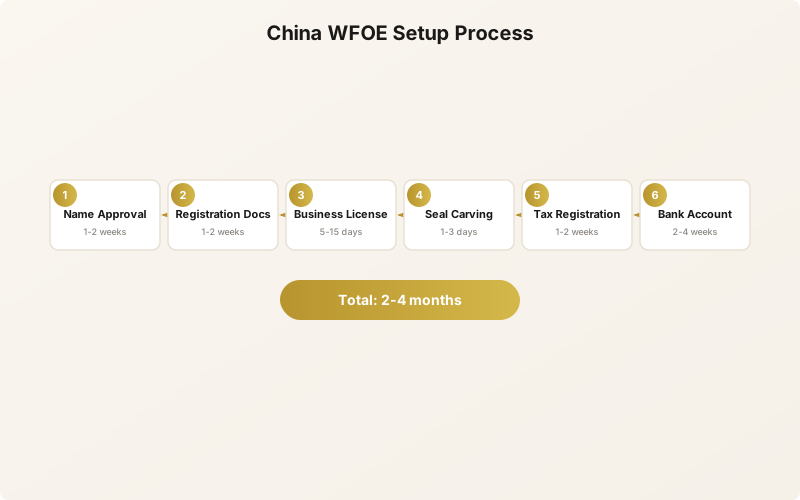
A4: The WFOE setup process typically takes 2-4 months from start to finish, depending on the industry and location. The timeline includes: name approval (1-2 weeks), preparing registration documents (1-2 weeks), business license application (5-15 business days), seal carving (1-3 days), tax registration (1-2 weeks), bank account opening (2-4 weeks), and any special industry licenses (variable timeline). Certain restricted industries may require additional approvals that can significantly extend the timeline.
Q5: What is the difference between a WFOE and a joint venture in China?
A5: A WFOE (Wholly Foreign-Owned Enterprise) is a limited liability company entirely owned by foreign investors, offering full control over operations but requiring the foreign investor to handle all aspects of market entry independently. A joint venture involves partnering with a Chinese shareholder, which can provide market access, local expertise, and government relationships but requires sharing control and profits. The choice depends on the industry (some sectors require joint ventures under the negative list), the level of local market knowledge needed, and the desired degree of operational control.
Frequently Asked Questions↑ Back to article
Why do foreign AI hardware companies come to China?
China has the world's densest and fastest hardware supply chain, concentrated in Shenzhen and the Greater Bay Area. For AI hardware companies — robotics, smart devices, edge AI, autonomous vehicles — the speed advantage is the biggest draw: prototyping cycles that take months elsewhere take weeks in Shenzhen. Cost, scale, and the growing domestic AI hardware market are additional reasons.
What is the difference between OEM, ODM and JDM?
OEM (Original Equipment Manufacturer) means you provide the design and the factory builds it to your specifications. ODM (Original Design Manufacturer) means the factory designs and builds the product and you brand it. JDM (Joint Design Manufacturer) is a middle ground where you co-design with the factory. Each model has different IP implications, cost structures, and control trade-offs.
Do I need a Chinese entity to manufacture in China?
Not necessarily. Many foreign companies manufacture in China through cross-border purchasing arrangements without setting up a local entity. However, whether you need an entity depends on your activities: if you are only placing purchase orders with factories, you may not need one. If you have local staff, a local office, ongoing R&D cooperation, or direct sales in China, you probably do.
What are the biggest IP risks in Chinese manufacturing?
The biggest IP risks are: (1) ODM scenarios where IP ownership is unclear, (2) tooling and mould ownership disputes, (3) leakage of designs and trade secrets through supply chain partners, (4) counterfeit and parallel products from factories, and (5) not registering your IP in China before you start working with manufacturers. Many of these risks are manageable with proper contracts and IP strategy.
How do I find reliable component suppliers in China?
Key approaches include: attending trade shows like Electronica China and the Canton Fair, using B2B platforms like 1688.com and Made-in-China, working with sourcing agents, getting referrals from industry contacts, and visiting component markets like Huaqiangbei in Shenzhen. Always verify capabilities, request samples, and check certifications before committing to volume orders.
What are the main engagement models for manufacturing in China?
The four main models are OEM, ODM, JDM, and CM. OEM (Original Equipment Manufacturer) means you provide the full design and the factory builds to your specifications, giving you full IP control but requiring more engineering work. ODM (Original Design Manufacturer) means the factory designs and builds the product you brand, offering faster time to market but with IP ownership risks. JDM (Joint Design Manufacturer) is a middle ground where you co-design with the factory. CM (Contract Manufacturer) focuses purely on assembly to your exact specifications.
What makes the Shenzhen hardware supply chain unique?
Shenzhen is unique not for any single factory but for the density of its entire ecosystem. It has component markets like Huaqiangbei where you can source almost any electronic component in hours, thousands of specialised factories from PCB assembly to precision machining, design houses and test labs all within hours of each other, and a huge pool of hardware engineers and supply chain professionals. The result is speed: a prototype iteration that takes 4-8 weeks in Silicon Valley or Tokyo takes 1-2 weeks in Shenzhen.