Key Takeaways
- Know your requirements first. Define product complexity, volume range, quality standards, certifications, and budget before searching.
- Cast wide, narrow aggressively. Start with 10-15 candidates from multiple sources, shortlist 3-5 for deep evaluation, run trial orders with 1-2 finalists.
- Price is only one factor. The cheapest quote often costs more long-term through quality issues and delays. Evaluate holistically.
- Audit in person. No amount of online research replaces walking the production floor and seeing QC processes firsthand.
- Start small, scale up. Always begin with a trial order to test quality, communication, and problem-solving.
- Have a backup. Relying on a single factory is risky. Maintain at least one qualified backup supplier.
1. Introduction: Why Factory Selection Is Make-or-Break
For hardware startups, the factory you choose is more than a supplier — it is a strategic partner that can make or break your product. A great factory helps you iterate quickly and hit launch windows. A bad one can drain your runway and sink your company.
In China, quality ranges enormously — from world-class facilities rivaling Japan and Germany to backyard workshops. The challenge is telling them apart.
This guide walks you through the entire process: defining requirements, finding candidates, conducting audits, evaluating quotes, and building long-term supplier relationships.
2. Defining Your Requirements First
Before you search for factories, you need to know exactly what you are looking for. Most selection failures happen because startups lack clear criteria and choose based on price alone.
- Product complexity. Is your product a simple molded part, or does it combine electronics, precision machining, PCB assembly, and firmware? Complex products need factories with strong engineering and relevant experience.
- Volume range. What are your initial quantities and projected annual volume? Factories optimize for specific tiers. Be honest about current and projected volumes to find the right fit.
- Quality expectations. Consumer electronics with 1% defect rates differ sharply from aerospace or medical components with zero-defect requirements. Higher quality needs robust QC systems and inspection equipment.
- Certification needs. Does your product need CE, FCC, UL, RoHS, REACH, FDA, or ISO certifications? Some factories claim certifications they do not hold. List what you need and plan to verify each.
- Timeline and budget. How fast do you need to go from prototype to production? What is your target unit cost and tooling budget? These help you quickly eliminate factories that are too expensive — or suspiciously cheap.
Document all this in a one-page requirements brief. You will use it repeatedly.
3. Where to Find Factories
China has more manufacturing options than any country. Here are the most effective channels, ranked by quality:
- Industry referrals. The best factories thrive on word of mouth. Ask other hardware founders, engineers, and investors who they trust. Referrals come with implicit vetting.
- Trade shows. Nothing beats face-to-face meetings. The Canton Fair (Guangzhou, twice yearly) is the largest. For electronics, Electronica China (Shanghai) and HKTDC Electronics Fair (Hong Kong) are essential.
- Industrial clusters. Shenzhen leads in electronics, with Dongguan as its hinterland. Suzhou and the Yangtze River Delta excel at precision machining and automotive. Ningbo and Yiwu dominate small commodities. Visiting reveals factories you will never find online.
- Huaqiangbei ecosystem. Shenzhen’s Huaqiangbei district is the densest hardware supply hub on earth. Invaluable for prototypes and small-batch production.
- Online platforms. Alibaba.com leads for international buyers. Made-in-China.com and 1688.com are also useful. Treat verified status as a starting point, not an endorsement.
- Sourcing agents. A good agent has a vetted factory network and saves months of work for 3-10% commission. Quality varies dramatically.
4. Initial Screening and Shortlisting
With 15-20 potential factories, narrow them down using these checks:
- Response quality and speed. Send a brief product inquiry. Fast, personalized responses signal a factory that values communication — critical when production problems arise.
- English ability. Poor communication makes every step slower and more expensive. If it is strained during sales, it worsens after you order.
- Relevant experience. Do they make similar products? Ask for past examples and client names. A factory new to your category will learn at your expense.
- Website and presence. A professional website is a positive signal, but many excellent factories have bad websites, and some bad factories have great ones. Treat it as one data point.
- Business license verification. Verify the business license (营业执照) through gsxt.gov.cn. Confirm registration, manufacturing scope, and absence of major irregularities.
- Initial quote analysis. A price 50% above the pack may mean overqualification; 50% below may mean corner-cutting or planned price hikes.
Narrow to 5-8 factories and proceed to the RFQ phase.
5. The RFQ Process
A Request for Quote (RFQ) is your formal bid invitation. RFQ quality directly affects quote quality — vague RFQs produce apples-to-oranges comparisons.
Your RFQ package should include: a complete BOM, 2D/3D drawings and CAD files, performance and material specifications, target volumes at multiple tiers, quality standards (AQL levels), packaging requirements, and timeline expectations.
Ask for separate quotes on: unit price at volume tiers, tooling costs, sample cost and lead time, production lead time, payment terms, testing costs, packaging costs, and warranty terms.
How many factories? 5-8 detailed RFQs works well for startups — enough to understand the market and negotiate without overwhelming your team.
Response time: Expect initial replies in 2-5 business days, detailed quotes in 1-2 weeks. More than two weeks without explanation signals disorganization or low interest.
6. Evaluating Quotes
Resist the urge to sort by price and pick the cheapest. Many startups that chose the lowest quote paid twice as much fixing quality problems or switching factories mid-project.
Evaluate these factors beyond the bottom line:
- Included vs. excluded. The cheapest quote may omit tooling, testing, packaging, or shipping. Normalize quotes in a spreadsheet to compare total landed cost.
- MOQ analysis. A $5 unit price with 10,000 MOQ may be worse than $6 at 1,000 MOQ for a capital-constrained startup. Ask about price breaks at 1K, 5K, 10K, and 50K units.
- Payment terms. Standard for new relationships is 30% deposit / 70% before shipment. Be wary of 100% upfront demands.
- Lead time. A 10% premium for two-week-faster delivery may be worth it if you are racing to market. Fast sampling signals responsiveness.
- Quality assumptions. What AQL standard is the quote based on? AQL 2.5 costs less than AQL 0.65, but you may need the higher standard.
- Engineering support. Does the quote include DFM feedback? Thoughtful suggestions demonstrate competence and can save money.
After evaluation, you should have 2-4 finalists for factory audits.
7. Factory Audit Checklist
A factory audit verifies everything you have been told and shows you operations firsthand. Audit in person whenever possible — video calls cannot replace being on the floor.
Here is a comprehensive audit checklist:
- Pre-visit research: Confirm address matches registration, check for legal disputes or environmental violations, verify certifications with issuing bodies, prepare document requests.
- Production floor: Organized or chaotic? Equipment condition? Documented processes? Do worker and machine counts match claims?
- Quality control: Dedicated QC team? Inspection points at incoming, in-process, and final stages? Calibrated testing equipment? Quality records and defect handling procedures?
- Worker conditions: Proper training and safety gear? Evidence of excessive overtime? Turnover rate (high turnover correlates with quality issues)? Safe workplace with ventilation and exits?
- R&D and engineering: In-house team size? Examples of DFM feedback or design improvements? Tools used? Involvement in product development vs. pure manufacturing?
- Warehouse and inventory: Incoming material storage? Proper FIFO? Finished goods protection? Inventory tracking system?
- Environmental practices: Waste disposal and wastewater treatment? Chemical smells or visible pollution? ISO 14001 certification?
- Documentation review: Business license, certifications, 2-3 client references, financial statements or credit reports, organizational charts.
- Post-audit scoring: Create a weighted scoring system based on your priorities. Objective scoring prevents gut-feeling decisions.
8. Red Flags to Watch For
Watch for these warning signs during evaluation. The more you see, the higher the risk:
- Poor communication. Slow responses, vague answers, difficulty with technical questions. Bad sales communication means worse production communication.
- Evasive answers. Direct questions about processes or certifications get deflection instead of answers — a sign something is being hidden.
- Reluctance to provide references. Legitimate factories proudly share client contacts. Refusal or only personal mobile numbers is suspicious.
- Undisclosed subcontracting. Some factories pass everything to an unknown shop, costing you visibility and quality control. Ask explicitly and verify during the audit.
- Sample quality issues. Samples represent a factory’s best work. Defects, rough finishes, or functional problems mean production will be worse. Reject “it is just a prototype” excuses.
- High staff turnover. Multiple sales contact changes over a few months signal instability and knowledge gaps.
- Legal or environmental violations. Check court records, administrative penalties, and environmental databases. A history of labor disputes, IP infringement, or environmental penalties is a serious warning.
- Pressure tactics. “This price expires in 48 hours” or “a slot opens next week” are high-pressure tactics. Good factories have steady work and do not rush clients.
9. The Trial Order Phase
After audits and reference checks, you may think you have found the right factory. But you will not truly know how they perform until you give them money and a deadline — that is why trial orders are essential.
Why start small. A trial order — typically 50-500 units, depending on product and MOQ — tests actual performance without risking a large order.
What to test:
- Quality. Does production match the sample? Are defect rates acceptable? Use formal inspection — your own or a third-party service — on all units or a significant sample.
- Communication. Responsiveness during production? Proactive updates or do you chase them? When issues arise (and they always do), how quickly are solutions proposed?
- Delivery. Do they hit the promised date? For delays, is there advance warning, or do you find out when the shipment is late?
- Problem-solving. When defects surface, do they take responsibility and fix them? Conduct root cause analysis? Or make excuses and try to ship anyway?
Success metrics. Define clear pass/fail criteria before the trial. What defect rate is acceptable? What delay tolerance? Evaluate objectively. If a factory fails the trial, do not proceed to full production — improvement almost never happens.
10. Building Long-Term Relationships
Once you find a factory that performs well, invest in the relationship. A strong factory partnership is one of a hardware company’s most valuable assets.
Communication best practices. Establish regular contact — weekly during active projects, monthly otherwise. Use single points of contact. Document agreements in writing. Be clear and direct.
Loyalty and growth. Factories value predictable, growing customers. Consistent orders and on-time payment earn better pricing and priority scheduling. Share production forecasts so they can plan capacity.
Visit regularly. One or two factory visits per year make an enormous difference. They signal commitment and surface issues early. Bring your engineers — engineer-to-engineer relationships are often the most valuable.
Have backup suppliers. Even with a great primary factory, maintain at least one qualified backup. Factories fail, get acquired, or hit capacity limits. A second source protects you from disruptions. Keep it active with occasional small orders.
11. Sourcing Agents vs. Direct Factory
Should you work directly with factories or use a sourcing agent? Both have merits.
Direct with factories:
- Pros: No commission, direct communication, stronger relationship, more control
- Cons: Steeper learning curve, time-intensive, language and cultural barriers, no local presence
With a sourcing agent:
- Pros: Pre-vetted factory network, local expertise, time savings, on-site QC, better negotiation leverage
- Cons: 3-10% commission, highly variable quality, less direct control, relationship risk
When to use which. If you have someone with China sourcing experience, going direct saves money and builds capability. If you are a small team without manufacturing experience, a good agent is worth every penny in avoided mistakes. Many startups start with an agent and transition to direct relationships as they scale.
Choosing a good agent: Look for product category specialization, call client references, visit their China office, ensure transparent fees, test with a small project first, and avoid agents who own factories — that is a conflict of interest.
12. Key Takeaways
Selecting the right factory is one of the most important decisions a hardware startup makes. Get it right and you have a partner for efficient scaling. Get it wrong and you can burn through runway and damage your brand.
Expect to spend 2-4 months from research to first production order. That investment pays for itself many times over by avoiding costly factory switches.
Keep these core principles: define requirements before searching, use multiple sourcing channels, evaluate holistically not by price alone, audit in person when possible, start with a trial order, invest in supplier relationships, and maintain a backup factory.
China’s manufacturing ecosystem is unmatched in depth, speed, and scale. By approaching factory selection systematically — with clear criteria and due diligence — you can find partners for success.
Common China Entry Mistakes and How to Avoid Them
After working with dozens of foreign companies entering the China market, we have seen the same mistakes repeated many times. Here are the most common ones — and how to avoid them.
Mistake 1: Underestimating the time and cost. Many companies budget for setup fees but not for the first 1-2 years of operating losses. China entry is an investment, and you need adequate runway.
Mistake 2: Putting the wrong person in charge. The first China hire — usually the country manager or GM — is the most important decision you will make. A bad hire can set you back a year or more. Take the time to find the right person, even if it means the process takes longer.
Mistake 3: Treating compliance as an afterthought. Some companies launch first and figure out compliance later. This is risky in China, where enforcement is increasing and penalties can be significant. Building compliance in from the start is cheaper and less stressful than fixing it later.
Mistake 4: Not protecting IP early enough. Register your trademarks, copyrights, and patents before you come. China is first-to-file, and if someone else registers your brand before you do, it is expensive and time-consuming to fix.
Mistake 5: Trying to do everything yourself. You need local advisors who know the market, the regulations, and the culture. A good lawyer, accountant, and recruiter are worth their fees many times over. The key is finding the right advisors who understand your industry and your stage of growth.
The Real Cost of Entering China: Beyond Setup Fees
When budgeting for China entry, foreign companies often focus on the setup fees — business license, registered capital, legal fees — and underestimate the ongoing operational costs. The setup cost is real, but it is typically the smallest part of the total cost of being in China.
The major ongoing costs fall into several categories. First, people: salaries, benefits, social insurance (which adds about 30-40% on top of base salary), and housing fund contributions. Second, office and infrastructure: rent in Shenzhen or Shanghai is comparable to major Western cities, plus IT infrastructure and compliance systems. Third, compliance: annual audit, tax filing, regulatory filings, and legal advisory. Fourth, taxes: corporate income tax (25% standard rate, though high-tech enterprises qualify for 15%), VAT (6-13% depending on activity), and withholding tax on profit repatriation.
There are also less obvious costs. The opportunity cost of management time spent on China operations is significant. The cost of mistakes — a misfiled tax return, an employment dispute, a compliance gap — can be high. And the cost of doing business slowly — taking longer to hire, longer to get approvals, longer to reach profitability — adds up.
The companies that succeed in China are the ones that budget for the full picture, not just the setup fees. They plan for at least 18-24 months of operating runway before expecting the China entity to be self-sustaining.
Working with Chinese Partners and Distributors
Many foreign companies entering China consider working with a local partner or distributor as a way to accelerate market entry and reduce risk. Partners can provide local market knowledge, existing customer relationships, and regulatory expertise. But partnerships also come with challenges — and they rarely work out as well as expected without careful structuring and management.
The most common types of partners are: distributors (who buy your product and resell it), agents (who sell on your behalf for a commission), strategic partners (who invest in deeper collaboration), and licensing partners (who license your technology and sell their own products based on it). Each type has different implications for control, revenue share, and risk.
Key success factors for partnerships include: clear expectations from the beginning (what each side is responsible for, what the targets are, how success is measured), strong contracts (with clear terms for exclusivity, territory, pricing, IP protection, and termination), active management (partnerships need attention — they do not run themselves), and an exit strategy (what happens if it does not work out? How do you end the relationship cleanly?).
The biggest mistake companies make is treating the partnership as a shortcut that means they do not need to build their own China capability. In practice, even with a strong partner, you still need your own team on the ground to manage the relationship, protect your interests, and ensure you are learning about the market directly.
Shenzhen vs. Shanghai vs. Beijing: Where to Locate
Where you establish your China entity matters — for talent access, supply chain proximity, policy environment, and cost. The three main options for tech and AI companies are Shenzhen, Shanghai, and Beijing — each with different strengths and cultures.
Shenzhen is the hardware and manufacturing capital of China, with the deepest supply chain ecosystem in the world. It has a young, entrepreneurial culture, strong government support for tech and AI companies, and a pragmatic regulatory environment. For AI hardware, robotics, or any company that works closely with manufacturing, Shenzhen is usually the first choice. Salaries and rent are lower than Beijing or Shanghai, and the pace of business is faster.
Shanghai is China’s financial and commercial capital, with the largest concentration of multinational companies. It has a more international business environment, strong legal and financial services, and excellent global connectivity. For SaaS, enterprise software, or companies focused on serving multinational clients in China, Shanghai is a strong choice. It is also the most ‘international’ of the three cities, which can make it easier for expat employees.
Beijing has the deepest AI research talent pool, with top universities and research institutions, plus the headquarters of many of China’s largest internet companies. It is also where most national regulators are based, which can be an advantage for companies with heavy regulatory engagement. The downside is higher cost, more bureaucracy, and a slower, more relationship-driven business culture.
The right choice depends on your industry, your talent needs, your supply chain requirements, and your personal preference. Many companies start with one city and expand to others as they grow.
FAQ
Q1: How long does it typically take to set up a WFOE in China?
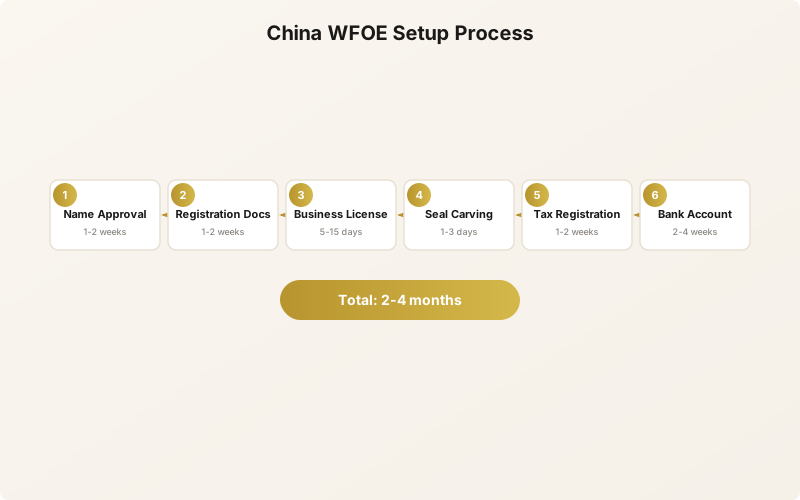
A1: The WFOE setup process typically takes 2-4 months from start to finish, depending on the industry and location. The timeline includes: name approval (1-2 weeks), preparing registration documents (1-2 weeks), business license application (5-15 business days), seal carving (1-3 days), tax registration (1-2 weeks), bank account opening (2-4 weeks), and any special industry licenses (variable timeline). Certain restricted industries may require additional approvals that can significantly extend the timeline.
Q2: What industries are restricted for foreign investment in China?
A2: China publishes a Foreign Investment Negative List that specifies industries where foreign investment is prohibited or restricted. Prohibited sectors include certain news media, compulsory education institutions, and some rare earth mining. Restricted sectors where foreign ownership is limited include telecommunications, education, healthcare, financial services, and agriculture. The negative list is periodically updated, generally becoming more open over time. Industries not on the negative list receive national treatment, meaning foreign investors enjoy the same treatment as domestic investors.
Q3: Can a foreign company hire employees in China without a local entity?
A3: Foreign companies cannot directly hire employees in China without establishing a legal entity. The common alternatives include using a PEO (Professional Employer Organization) or staffing agency for temporary or initial staffing needs, engaging independent contractors (though this carries misclassification risks), or establishing a representative office (which is limited to non-commercial activities like market research and liaison work). For ongoing business operations, establishing a WFOE or joint venture is the proper way to hire local employees directly and issue employment contracts.
Q4: What is the difference between a WFOE and a joint venture in China?
A4: A WFOE (Wholly Foreign-Owned Enterprise) is a limited liability company entirely owned by foreign investors, offering full control over operations but requiring the foreign investor to handle all aspects of market entry independently. A joint venture involves partnering with a Chinese shareholder, which can provide market access, local expertise, and government relationships but requires sharing control and profits. The choice depends on the industry (some sectors require joint ventures under the negative list), the level of local market knowledge needed, and the desired degree of operational control.
Q5: What is the minimum registered capital for a WFOE?
A5: China abolished the statutory minimum registered capital requirement for most industries in 2014 under the注册资本认缴登记制 (subscription system). However, companies must still specify a registered capital amount and contribution timeline in their articles of association. The practical registered capital amount should reflect the actual operational needs of the business and the industry norms. Some regulated industries still have minimum capital requirements, such as banking, insurance, securities, and certain types of consulting businesses.
Further Reading
- Supplier Agreement vs Manufacturing Contract: What’s the Difference for China Sourcing? — Supplier vs manufacturing agreements
- Negotiating with Chinese Factories: Practical Tips for Hardware Startup Founders — Factory negotiation strategies
- MOQ in China Manufacturing: How to Handle Minimum Order Quantities as a Startup — Understanding minimum order quantities
- Warranty, Quality Guarantee and Defect Liability in China Manufacturing — Warranty and quality agreements
- China Manufacturing Cities Compared: Shenzhen vs Dongguan vs Suzhou vs Ningbo for Hardware Startups — Manufacturing city comparison
Next Steps
For hardware teams, the legal questions follow the sourcing sequence: select and vet a factory, fix tooling and payment terms, then protect the design and manage inspection, certification and export. The guides below follow that sequence.
Two service lines most often relevant at this stage:
- Which contracts does an AI company need before selling in China?
- How can a foreign AI company protect its models and code in China?
To discuss scope, timeline and fees for your own matter, Contact Us About Your China Entry. The initial consultation is free; the form prepares an email in your own mail application.
Related guides in this series
- China Hardware & Supply Chain Guide for Foreign AI Companies
- Cost of Manufacturing in China: What Foreign Hardware Startups Should Budget
- Tooling Cost in China: A Complete Guide to Mold Pricing, Payment and Ownership
Frequently Asked Questions↑ Back to article
Where is the best place to find hardware factories in China?
The best places depend on your product category. For electronics, Shenzhen and Dongguan are the primary hubs. Trade shows like the Canton Fair and Electronica China offer face-to-face access, while platforms like Alibaba, Made-in-China, and 1688.com provide online discovery. Industry referrals and industrial cluster visits often yield the highest-quality leads.
How do I verify a factory is legitimate before visiting?
Start by checking their business license through the National Enterprise Credit Information Publicity System. Verify certifications like ISO 9001 directly with the issuing body. Ask for past client references and follow up with them. Cross-check their claimed factory size and capabilities against what you see in photos, videos, and Google Maps street view. Request a sample before committing to a visit.
What should I look for during a factory audit?
A thorough factory audit covers: production floor organization and equipment condition, quality control processes at each production stage, worker conditions and turnover rates, R&D and engineering capabilities, warehouse and inventory management, environmental compliance, and documentation review including certifications, financial stability, and past client references. Score each category and compare against your requirements.
How many factories should I get quotes from?
For hardware startups, aim to get initial quotes from 8-12 factories, then narrow down to 3-5 for detailed RFQ comparison, and finally select 2-3 for sampling or trial orders. This range gives you enough market data to understand pricing norms while keeping the evaluation workload manageable. Going below 5 quotes risks overpaying; going above 15 wastes time on low-probability options.
What are the biggest red flags when evaluating a Chinese factory?
Major red flags include: poor or inconsistent communication, vague answers to technical questions, reluctance to provide client references, undisclosed subcontracting, quality issues in sample parts, high staff turnover especially in management and QC roles, visible legal disputes or environmental violations, and pressure to commit quickly to a deal without proper due diligence.
How do trial orders help in factory selection?
Trial orders are one of the most effective ways to evaluate a factory before committing to volume production. They test the factory's real-world quality, communication, problem-solving, and delivery performance under actual production conditions, revealing issues that samples and audits cannot. Starting with a small trial order of 50-500 pieces gives you concrete data with limited financial risk.
How should I evaluate and compare quotes from Chinese factories?
Compare quotes on more than just price. Evaluate total cost of ownership including tooling, packaging, testing, and shipping, not just unit price. Assess what is included versus what is extra — some factories quote low but add charges for engineering, quality inspection, or modifications. Also factor in factory capability, quality track record, communication quality, and financial stability. The cheapest quote often costs more in the long run.