Key Takeaways
- Accurate HS classification is the foundation of compliance — a wrong code can lead to overpaid duties, penalties, or shipment delays. For AI hardware with multiple functions, classification disputes are common and costly.
- Documentation completeness determines clearance speed. Missing or inconsistent paperwork is the top reason for customs holds. Prepare commercial invoices, packing lists, and supporting certificates before your shipment departs.
- AEO certification delivers tangible benefits including faster clearance and lower inspection rates. While foreign parent companies cannot directly obtain AEO status, their Chinese subsidiaries or trusted import partners can.
- Electronics face unique customs risks: battery shipping regulations, dual-use item controls, IP enforcement, and 3C certification requirements all affect AI hardware shipments.
- A specialized customs broker is worth the investment. Look for one with deep electronics and AI hardware experience, transparent fee structures, and a track record of handling classification disputes.
1. Introduction: Why Understanding China Customs Is Critical for Hardware Businesses
For foreign AI hardware companies manufacturing or sourcing in China, customs clearance is not an administrative afterthought — it is a core operational function that directly impacts cost, speed, and legal risk. A single misclassification on an HS code can result in 30%+ duty differences, a detained shipment can delay product launches by weeks, and a compliance audit can expose your entire supply chain to penalties.
China’s customs system, administered by the General Administration of Customs (GAC, 海关总署), has evolved rapidly over the past decade. While digital reforms have streamlined many processes, the regulatory environment remains complex, with product-specific rules, frequent policy updates, and enforcement that varies by port and region. For hardware companies importing components like GPUs, sensors, and batteries, and exporting finished AI devices like smart cameras, edge computing boxes, or robotics platforms, the stakes are particularly high.
This guide walks through the practical essentials of China customs clearance: how HS codes work, what import and export procedures look like, how duties are calculated, what AEO certification means for your business, which issues most commonly affect electronics shipments, and how to select and work with customs brokers effectively.
2. China Customs System Overview
The General Administration of Customs (GAC) is the central authority overseeing all import and export activities in China. It operates through a network of provincial and municipal customs offices, with major ports such as Shanghai, Shenzhen, Guangzhou, Qingdao, and Tianjin handling the bulk of international trade volume.
Key regulations governing customs procedures include the Customs Law (海关法), the Regulations on Import and Export Duties (进出口关税条例), and the Customs Inspection Regulations (海关稽查条例). GAC also issues departmental rules and announcements on an ongoing basis — a reality that means companies must monitor policy changes continuously.
In recent years, GAC has pushed forward several important reforms: paperless clearance through the China International Trade Single Window (单一窗口), a two-step declaration system for faster release, AEO expansion with mutual recognition across over 40 economies, and RCEP tariff reductions on electronics components.
For hardware companies, the most important practical point is that enforcement is not uniform across China. Customs offices in tech-heavy regions like Shenzhen and Suzhou tend to have more experience with electronics products but also enforce more rigorously given higher volumes.
3. HS Code Classification
What Are HS Codes?
The Harmonized Commodity Description and Coding System (HS code) is a global nomenclature developed by the World Customs Organization. China uses a 10-digit coding system based on the 6-digit international HS standard, with the additional four digits providing more granular product differentiation for tariff and regulatory purposes.
The first six digits are consistent across WCO member countries. Digits 7–8 represent China’s subheadings for tariff purposes. Digits 9–10 identify statistical suffixes and regulatory conditions such as license requirements or inspection mandates.
Why Accuracy Matters
HS code classification determines three critical things for your shipment:
- The applicable duty rate — different codes can have duty rates ranging from 0% to 35% or more.
- Regulatory requirements — whether you need import licenses, 3C certification, or dual-use item permits.
- Export tax rebate eligibility — for products you export from China, the HS code determines the rebate rate.
Example: An AI-powered smart camera could potentially be classified under 8525.89 (other television cameras), 8517.62 (communication apparatus), or even 8471.49 (automatic data processing machines), depending on its primary function. The difference in duty rates between these codes could be 0% vs. 10%, and the regulatory requirements differ significantly.
Common Classification Challenges for Electronics
- Multi-function devices: AI hardware often combines computing, sensing, communication, and power functions. GAC’s general rule is to classify based on the “principal function” (主要功能), but determining what is principal can be subjective.
- Software-enabled hardware: Products whose value comes substantially from embedded software can face classification debates about whether the hardware or software aspect dominates.
- Semiconductor components: GPUs, NPUs, and other advanced chips face heightened scrutiny due to export control regulations and dual-use classifications.
- Batteries: Lithium-ion batteries have specific classifications (8507.60) and shipping requirements that are frequently updated.
How to Get a Pre-Classification Ruling
If you are uncertain about classification, you can apply for a pre-classification ruling (归类预裁定) from GAC. The ruling is legally binding for three years and applies nationwide. To apply, submit an application through the China Customs website or Single Window platform with detailed product information (specifications, datasheets, intended use, structural diagrams, sample photos). There is no fee, and processing takes approximately 60 days. Many companies work with a customs broker or trade lawyer to prepare the application, as technical details must align with GAC’s classification logic.
4. Import Procedures
Step-by-Step Import Process
- Pre-arrival preparation: Confirm HS classification, verify if any import licenses or certifications are required, and prepare all documentation. Register with customs as an importer if you have a Chinese entity; otherwise, engage an import agent.
- Shipment and document transmission: Your supplier ships the goods and sends you the original or electronic documents (bill of lading, invoice, packing list, etc.).
- Declaration: Submit a customs declaration through the Single Window system, typically within 14 days of the means of transport arriving at the port of entry.
- Duty assessment: Customs reviews the declaration and assesses duties and taxes. You will receive a tax payment notice.
- Payment: Pay import duties and VAT through the designated bank or online payment system.
- Inspection (if selected): A percentage of shipments are randomly selected for inspection, or inspection may be triggered by risk factors. Inspections can be document-only or physical.
- Release: Once duties are paid and any inspections are cleared, customs issues a release order and the goods can be collected from the port.
Required Documents
Standard import documentation includes:
- Commercial invoice: Must show accurate product descriptions, quantities, unit prices, total value, and Incoterms. Customs compares declared values against its own database.
- Packing list: Itemized list showing contents, weights, dimensions, and package markings per carton.
- Bill of lading (sea) / Air waybill (air): Transport document serving as receipt of goods and contract of carriage.
- Customs declaration form (报关单): Standardized form submitted electronically through the Single Window.
- Certificate of origin: Required to claim preferential tariff rates under FTAs (e.g., RCEP, ASEAN-China FTA).
- Import license (if applicable): Certain products require licenses from MOFCOM or other authorities.
- 3C certification (if applicable): Mandatory for many electronics products sold on the Chinese market.
- Battery documents: UN38.3 test report, MSDS, and battery letter for lithium battery shipments.
5. Export Procedures
Export Declaration
Export procedures from China are generally simpler and faster than import procedures. The basic flow mirrors imports but in reverse:
- Pre-export preparation: Confirm export HS code, verify if any export licenses or restrictions apply (especially for dual-use items), and prepare documents.
- Booking and cargo delivery: Book space with a freight forwarder and deliver goods to the port/airport warehouse.
- Export declaration: Submit the declaration through the Single Window before the cargo is loaded onto the means of transport.
- Inspection (if selected): Customs may inspect export goods, particularly for restricted items or products subject to export duties.
- Release and loading: Customs issues release, and goods are loaded onto the vessel or aircraft.
- Post-export procedures: Obtain the export declaration form (stamped by customs) for tax rebate applications.
Export Licenses
Most hardware products do not require export licenses, but there are important exceptions:
- Dual-use items: Products with both civilian and military applications may require export licenses from MOFCOM. Certain advanced semiconductors, AI chips, and sensitive electronic components fall into this category.
- Export-controlled goods: GAC maintains an export control catalog that is updated periodically. Hardware companies should verify whether their products or components are listed.
- Rare earth materials and certain metals: Strategic materials may be subject to export quotas or duties.
Export Tax Rebates
China’s export tax rebate (出口退税) system refunds VAT paid on domestically manufactured goods that are exported. For hardware companies manufacturing in China, this is a significant financial consideration:
- Rebate rates range from 0% to 13% (the standard VAT rate), depending on the product’s HS code.
- Most electronics products enjoy rebate rates of 13% (full rebate) or 9%.
- To claim the rebate, you need the customs-stamped export declaration form, VAT invoices from suppliers, and foreign exchange verification documents.
- Processing trade enterprises (进料加工) have specific rebate rules that differ from ordinary trade.
Processing Trade Procedures
Many foreign hardware companies operate under processing trade arrangements, where components are imported duty-free for assembly or manufacturing, with finished products then exported. Key considerations:
- You must register with both customs and MOFCOM and obtain a Processing Trade Manual (加工贸易手册), either physical or electronic.
- All imported materials must be tracked and accounted for — they cannot be sold domestically without paying duties and going through proper procedures.
- The “balance” between imported materials and exported products must reconcile within specified tolerance levels.
- Domestic sales of processing trade products (内销) require approval and payment of back duties plus possible interest.
6. Customs Valuation and Duties
How Customs Value Is Determined
China customs uses six methods to determine dutiable value, applied in order of preference. The primary method is transaction value (成交价格法) — the price actually paid or payable for the goods, plus certain adjustments. If that cannot be used, customs falls back on the transaction value of identical or similar goods, deductive value (resale price minus duties), computed value (production cost plus profit), or a reasonable fallback method.
Dutiable Value Components
The dutiable value (完税价格) generally includes:
- The cost of the goods themselves
- Freight charges to the port of importation (CIF basis)
- Insurance charges during international transport
- Royalties and license fees related to the imported goods, if paid by the buyer as a condition of sale
Important: For related-party transactions (e.g., between a foreign parent and its Chinese subsidiary), customs will scrutinize whether the transaction price reflects arm’s length value. Transfer pricing policies should be documented and defensible.
Common Valuation Methods for Hardware
For AI hardware, valuation challenges often arise in these scenarios:
- R&D-intensive products with high software value: Customs may question whether the declared value fully reflects the product’s market value, especially for early-stage products with low unit costs but high IP content.
- Consignment or demo shipments: Products sent for trade shows, testing, or customer evaluation must still be properly valued. Using a “no commercial value” declaration may trigger customs scrutiny.
- Warranty replacements: Replacement parts shipped under warranty can be eligible for duty-free treatment if properly documented, but the process is often cumbersome.
Duty Rates by Product Category
China applies MFN (Most Favored Nation) duty rates to WTO members, and preferential rates under free trade agreements. For common hardware categories (MFN rates, approximate):
| Product Category | HS Code Example | MFN Duty Rate |
|---|---|---|
| Desktop computers / servers | 8471.41 | 0% |
| Laptops / tablets | 8471.30 | 0% |
| Printed circuit boards | 8534.00 | 0–7.5% |
| Integrated circuits (processors) | 8542.31 | 0% |
| Memory modules | 8542.32 | 0% |
| Lithium-ion batteries | 8507.60 | 8% |
| Cameras / smart cameras | 8525.89 | 0–15% |
| Sensors (various) | 8543.70 / 9032.89 | 0–10% |
| LED displays | 8528.72 | 0–5% |
Import VAT is additionally charged at 13% on the dutiable value plus duty amount.
7. AEO Certification
What Is AEO?
Authorized Economic Operator (AEO) is a certification program under the WCO SAFE Framework that recognizes companies with high standards of customs compliance, supply chain security, and financial solvency. China’s AEO system was introduced in 2014 and has been expanded progressively.
Benefits of AEO Certification
AEO-certified companies enjoy significant practical advantages:
- Lower inspection rates: Advanced AEO companies have inspection rates roughly 50–80% lower than non-certified companies.
- Faster clearance: Priority processing lanes and dedicated customs officers reduce clearance time by 30–50%.
- Reduced deposits: Lower or waived guarantees for processing trade operations and duty deferrals.
- Dedicated account manager: A point person at the local customs office for issue resolution.
- Mutual recognition: Faster clearance in partner countries that have AEO mutual recognition with China.
- Fewer audits: Less frequent customs audits and inspections.
Types of AEO Certification
China has two tiers of AEO certification:
- AEO General (AEO 一般认证企业): Entry-level certification with moderate benefits. Requires meeting basic compliance, financial, and security standards.
- AEO Advanced (AEO 高级认证企业): The highest level, with maximum benefits. More stringent requirements across all dimensions, including internal control systems, financial health, compliance records, and supply chain security measures.
How to Apply
AEO applications are submitted to the local customs office where the company is registered. The process involves self-assessment against GAC criteria, implementing any necessary improvements, submitting the application with supporting documents, undergoing an on-site audit, and receiving a certification decision within 90 days. AEO Advanced applications undergo additional review by higher-level customs authorities.
Can Foreign Companies Get AEO Certification?
Foreign companies without a Chinese legal entity cannot directly obtain China AEO certification. However, there are practical paths:
- Chinese subsidiaries: Your wholly foreign-owned enterprise (WFOE) or joint venture in China can apply for AEO certification.
- Import/export partners: If you work with a Chinese trading company or import agent that holds AEO certification, you can indirectly benefit from faster clearance when using that partner as the importer of record.
- Mutual recognition: If your home country has an AEO mutual recognition arrangement with China and your company holds AEO-equivalent certification at home, you may receive certain facilitation measures when exporting to China.
8. Common Customs Issues for Electronics
Classification Disputes
The most common issue for electronics shipments is disagreement over HS classification. Customs may reclassify your product based on its own interpretation, leading to higher duty rates or unexpected licensing requirements.
Practical tip: Maintain detailed technical documentation — product specifications, block diagrams, software architecture descriptions, and marketing materials — to support your classification position. If customs proposes a reclassification, you have the right to appeal and submit evidence.
Valuation Challenges
Customs frequently questions declared values for electronics, especially when:
- The transaction is between related parties
- Product prices have dropped significantly since the last shipment
- The declared value is below customs’ internal reference database
- New products are being imported with limited market data
Example: A foreign AI startup importing its first batch of edge computing devices at $500/unit might face valuation questions if customs’ database shows similar devices at $800–$1200. The company must provide evidence: manufacturing cost breakdowns, transfer pricing studies, or market launch pricing strategies.
IP Enforcement
China customs actively enforces intellectual property rights at the border. This works both ways:
- Your IP protection: You can register your trademarks, patents, and copyrights with GAC (知识产权海关备案). If customs detects counterfeit products infringing your IP, it can seize them at the border.
- Accusations against you: Conversely, customs may detain your shipment if it suspects IP infringement by your products. This can happen if a competitor files a complaint or if customs identifies potential issues during routine inspection.
Battery Shipping Restrictions
Lithium-ion batteries — a critical component of almost all portable hardware — face strict shipping and customs regulations:
- UN38.3 test report required for all lithium battery shipments
- Proper packaging, labeling, and documentation per IATA DGR (air) or IMDG (sea)
- Restrictions on shipping lithium batteries with or in equipment
- Some ports have stricter battery handling rules than others
Dual-Use Items
Products that can be used for both civilian and military purposes are subject to export controls in China. For AI hardware companies, particular attention should be paid to:
- Advanced chips and semiconductor components above certain performance thresholds
- Certain AI training and inference systems
- Encryption technology integrated into hardware products
- Precision sensors and imaging equipment
If your product falls under the dual-use catalog, you will need an export license from MOFCOM before shipping from China. Penalties for violating export controls are severe and can include criminal liability.
9. Working with Customs Brokers
When Do You Need a Customs Broker?
While it is technically possible for a Chinese-registered company to handle customs declarations internally, most companies — especially foreign-invested enterprises — work with licensed customs brokers (报关行) for several reasons:
- Expertise: Customs regulations are complex and change frequently. Professional brokers stay current.
- Efficiency: Brokers submit declarations daily and know how to avoid common errors that cause delays.
- Port relationships: Experienced brokers have working relationships with customs officials at their local ports, which can help resolve issues faster.
- Resource savings: Maintaining an in-house customs team may not be cost-effective for smaller companies.
How to Choose a Customs Broker
Key criteria for selecting a broker:
- Electronics/hardware specialization: Look for a broker with demonstrable experience handling electronics, semiconductors, and AI hardware products. Ask for client references in your industry.
- Port coverage: Ensure the broker covers the ports you actually use. Some brokers specialize in specific ports or regions.
- License and track record: Verify their customs brokerage license (报关企业注册登记证书) and check their customs credit rating (企业信用等级).
- Service scope: Beyond basic declaration, do they offer classification consulting, AEO application assistance, audit support, or duty planning?
- Language capabilities: If your team does not speak Chinese, confirm the broker has English-speaking account managers.
- Technology integration: Can they integrate with your ERP or logistics systems for smoother data exchange?
Fee Structures
Customs broker fees are typically structured as:
- Per-shipment declaration fee: RMB 200–800 per declaration, depending on complexity and port.
- Percentage of shipment value: Some brokers charge 0.1–0.5% of shipment value, though this is less common for standard declarations.
- Additional service fees: Classification consulting, AEO application support, and audit defense are usually billed separately.
- Pass-through costs: Duties, taxes, inspection fees, and port charges are passed through at cost.
Red flags to watch for:
- Quoting unusually low fees that may indicate cutting corners
- Refusing to provide detailed breakdowns of charges
- Promising “special relationships” with customs that can “solve any problem”
- Lacking proper licensing or having a low customs credit rating
- Poor communication or long response times
10. Penalties and Compliance Risks
Common Violations
The most frequent customs violations committed by hardware companies include:
- HS code misclassification: Whether accidental or intentional, incorrect classification is the most common violation and can result in duty underpayment or non-compliance with licensing requirements.
- Undervaluation: Declaring a value lower than the actual transaction price to reduce duties is considered smuggling (走私) in serious cases.
- Missing or incomplete documentation: Failure to provide required licenses, certificates, or accurate paperwork.
- Processing trade irregularities: Unauthorized domestic sales of bonded materials, unreported waste, or discrepancies between imported materials and exported products.
- IP infringement: Importing or exporting goods that infringe trademarks, patents, or copyrights.
Penalty Structure
China customs penalties scale based on the nature and severity of the violation:
- Minor violations (违规): Fines typically up to RMB 50,000, often for documentation errors. The company may receive a warning or demerit that affects its customs credit rating.
- Smuggling (走私): More serious cases involving intentional evasion of duties or prohibitions. Penalties include fines of 30% to 300% of the evaded duty amount, confiscation of goods, and potential criminal liability for cases involving large amounts.
- Credit rating impact: Violations can cause a company’s customs credit rating to drop, leading to higher inspection rates, slower clearance, and loss of AEO status.
How to Handle Customs Audits
Customs may conduct audits (稽查) of companies within three years of import/export activities, reviewing books, records, and electronic data. The audit period can cover up to three years of history, or five years in suspected violation cases.
Best practices: Maintain complete customs records for at least five years, conduct periodic internal reviews of classification and valuation practices, and consider voluntary disclosure if you identify issues before an audit begins.
Voluntary Disclosure
If your company discovers a compliance issue — for example, an HS code error that has resulted in underpaid duties — you can make a voluntary disclosure (主动披露) to customs. Benefits include:
- Reduced or waived penalties
- No negative impact on your customs credit rating
- Protection from smuggling charges for unintentional errors
To make a voluntary disclosure, you must:
- Proactively report the issue before customs initiates an investigation
- Fully disclose all relevant facts
- Pay any back duties and interest owed
11. Recent Trends and Developments
Paperless Clearance and Digitalization
China’s customs system is increasingly digital. The Single Window platform now handles the entire declaration process electronically, and GAC is rolling out AI-powered risk assessment systems that select shipments for inspection based on data analytics rather than random sampling. For companies with clean compliance records, this means fewer inspections and faster clearance.
Cross-Border E-Commerce (CBEC)
While most hardware companies use general trade or processing trade channels, the CBEC channel (cross-border e-commerce) is worth noting for certain use cases — such as direct-to-consumer sales of small electronics or replacement parts. CBEC offers simplified procedures and preferential tax treatment (comprehensive tax of 9.1% for most goods within value limits), but it is not suitable for bulk B2B shipments or products requiring 3C certification.
RCEP Impacts
The Regional Comprehensive Economic Partnership, which took effect for China in January 2022, is progressively reducing tariffs among 15 Asia-Pacific member countries. For hardware companies with regional supply chains:
- Many electronics components are eligible for reduced or zero tariffs under RCEP rules of origin.
- Companies need to obtain RCEP certificates of origin and document regional value content to qualify.
- Cumulative rules of origin allow sourcing from multiple RCEP countries while still qualifying for preferences.
Practical example: An AI hardware company sourcing components from Japan, South Korea, and Malaysia and assembling in China can cumulate value from all RCEP countries to meet the 40% regional value content threshold, qualifying for preferential rates on exports to other member markets.
12. Key Takeaways
Navigating China’s customs system effectively is essential for foreign AI hardware companies that import components and export finished products. The complexity is real, but with proper systems and expert support, it is manageable. Here are the essential points to remember:
Get classification right from the start. Invest time and expert resources in accurate HS code classification. The cost of getting it wrong — whether in overpaid duties, penalties, or shipment delays — far exceeds the cost of getting it right. When in doubt, seek a pre-classification ruling.
Build a documentation-first culture. Customs issues most often arise from incomplete or inconsistent paperwork. Standardize your documentation processes, verify the completeness of every shipment’s documents before departure, and maintain organized records for at least five years.
Leverage AEO where possible. If you have a Chinese entity, work toward AEO certification — the benefits in clearance speed and reduced inspection rates directly improve your supply chain efficiency. If not, partner with AEO-certified import/export agents.
Address electronics-specific risks proactively. Battery regulations, dual-use controls, IP enforcement, and 3C certification requirements are not one-time issues but ongoing concerns. Assign ownership within your organization for monitoring regulatory changes in these areas.
Choose your customs broker carefully. A good broker with electronics expertise is an investment, not an expense. They will save you money through proper classification, prevent delays through accurate documentation, and protect you from compliance risks through proactive advice.
Stay current on policy changes. China’s customs regulations evolve continuously — paperless reforms, RCEP implementation, export control updates, and new AEO rules are just recent examples. Subscribe to official GAC announcements and work with advisors who can interpret changes in the context of your business.
China remains the world’s largest trading nation and the heart of global electronics manufacturing. For hardware companies that get customs compliance right, the reward is a reliable, efficient, and cost-effective supply chain that supports growth in both the Chinese market and global exports.
FAQ
Q1: What industries are restricted for foreign investment in China?
A1: China publishes a Foreign Investment Negative List that specifies industries where foreign investment is prohibited or restricted. Prohibited sectors include certain news media, compulsory education institutions, and some rare earth mining. Restricted sectors where foreign ownership is limited include telecommunications, education, healthcare, financial services, and agriculture. The negative list is periodically updated, generally becoming more open over time. Industries not on the negative list receive national treatment, meaning foreign investors enjoy the same treatment as domestic investors.
Q2: How long does it typically take to set up a WFOE in China?
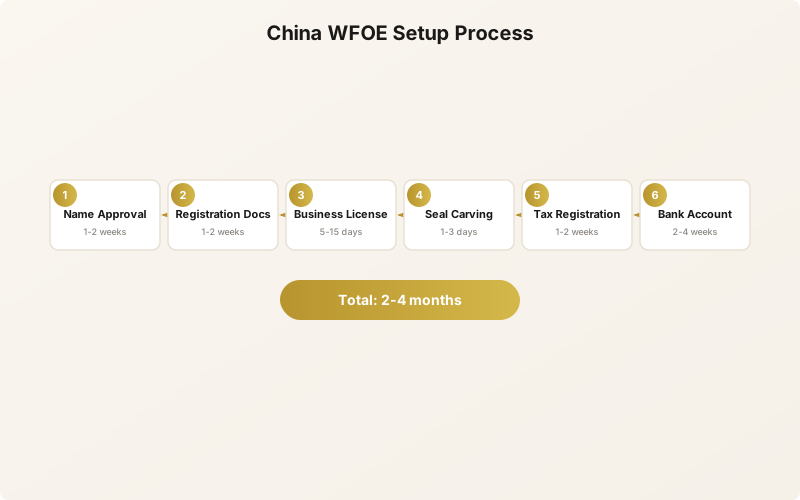
A2: The WFOE setup process typically takes 2-4 months from start to finish, depending on the industry and location. The timeline includes: name approval (1-2 weeks), preparing registration documents (1-2 weeks), business license application (5-15 business days), seal carving (1-3 days), tax registration (1-2 weeks), bank account opening (2-4 weeks), and any special industry licenses (variable timeline). Certain restricted industries may require additional approvals that can significantly extend the timeline.
Q3: What is the minimum registered capital for a WFOE?
A3: China abolished the statutory minimum registered capital requirement for most industries in 2014 under the注册资本认缴登记制 (subscription system). However, companies must still specify a registered capital amount and contribution timeline in their articles of association. The practical registered capital amount should reflect the actual operational needs of the business and the industry norms. Some regulated industries still have minimum capital requirements, such as banking, insurance, securities, and certain types of consulting businesses.
Q4: What is the difference between a WFOE and a joint venture in China?
A4: A WFOE (Wholly Foreign-Owned Enterprise) is a limited liability company entirely owned by foreign investors, offering full control over operations but requiring the foreign investor to handle all aspects of market entry independently. A joint venture involves partnering with a Chinese shareholder, which can provide market access, local expertise, and government relationships but requires sharing control and profits. The choice depends on the industry (some sectors require joint ventures under the negative list), the level of local market knowledge needed, and the desired degree of operational control.
Q5: Can a foreign company hire employees in China without a local entity?
A5: Foreign companies cannot directly hire employees in China without establishing a legal entity. The common alternatives include using a PEO (Professional Employer Organization) or staffing agency for temporary or initial staffing needs, engaging independent contractors (though this carries misclassification risks), or establishing a representative office (which is limited to non-commercial activities like market research and liaison work). For ongoing business operations, establishing a WFOE or joint venture is the proper way to hire local employees directly and issue employment contracts.
Further Reading
- China Product Certification: CCC, CQC, SRRC and More — A Complete Guide for Foreign Hardware Companies — Product certification requirements (CCC, SRRC)
- Trading WFOE setup guide — Trading WFOE setup for import/export
- Supply Chain Risk Management in China: A Practical Guide for Hardware Companies — Supply chain risk management
- Product Packaging in China: A Complete Guide for Hardware Brands — Product packaging and shipping considerations
Next Steps
For hardware teams, the legal questions follow the sourcing sequence: select and vet a factory, fix tooling and payment terms, then protect the design and manage inspection, certification and export. The guides below follow that sequence.
Two service lines most often relevant at this stage:
- Which contracts does an AI company need before selling in China?
- How can a foreign AI company protect its models and code in China?
To discuss scope, timeline and fees for your own matter, Contact Us About Your China Entry. The initial consultation is free; the form prepares an email in your own mail application.
Related guides in this series
- China Hardware & Supply Chain Guide for Foreign AI Companies
- How to Select and Vet Factories in China: A Complete Sourcing Guide for Hardware Startups
- Cost of Manufacturing in China: What Foreign Hardware Startups Should Budget
Frequently Asked Questions↑ Back to article
How do I find the correct HS code for my product?
Start with the WCO HS nomenclature and cross-reference with China's 10-digit tariff schedule. For hardware products, pay close attention to function, composition, and intended use. When in doubt, apply for a pre-classification ruling (归类预裁定) from GAC, which is legally binding for 3 years. A reputable customs broker with electronics expertise can also assist with classification.
What documents do I need for China customs clearance?
Standard documents include: commercial invoice, packing list, bill of lading or airway bill, customs declaration form, and certificate of origin. Depending on your product, you may also need import licenses, 3C certification (for electronics), inspection certificates, or battery UN38.3 test reports. Processing trade operations require additional registration documents.
How long does customs clearance usually take?
For standard air freight shipments with complete documentation, clearance typically takes 1–3 working days. Sea freight may take 3–7 days due to port congestion and documentation volume. AEO-certified companies often receive same-day clearance. Complications such as classification disputes, valuation questions, or inspections can extend the process to several weeks.
What is AEO certification and why does it matter?
AEO (Authorized Economic Operator) is a WCO-framework certification offered by China Customs that recognizes companies with high compliance standards and supply chain security. Benefits include faster clearance, reduced inspection rates, lower customs deposit requirements, and dedicated account managers. Foreign companies cannot directly obtain China AEO certification, but their Chinese subsidiaries or trading partners can.
What happens if customs detains my shipment?
If customs detains your shipment, you will receive a notification specifying the reason—common causes include missing documentation, classification disputes, valuation concerns, or suspected IP infringement. You should respond promptly with supporting documents and, if needed, negotiate a resolution. Working with an experienced customs broker is critical during this process. Penalties may apply if violations are confirmed, but voluntary disclosure can reduce fines.
What are the common HS classification challenges for AI hardware?
AI hardware faces several classification challenges. Multi-function devices that combine computing, sensing, communication, and power functions are difficult to classify because GAC's rule is to classify by principal function, which can be subjective. Software-enabled hardware whose value comes largely from embedded software faces debates about whether hardware or software dominates classification. Advanced chips like GPUs and NPUs face heightened scrutiny due to export controls and dual-use classifications, and lithium batteries have specific classifications and frequently updated shipping requirements.
What is the step-by-step import process for goods entering China?
The import process has seven main steps: pre-arrival preparation including HS classification confirmation and document preparation; shipment and document transmission from your supplier; customs declaration submitted through the Single Window system typically within 14 days of arrival; duty assessment by customs; payment of import duties and VAT; inspection if the shipment is randomly selected or flagged for risk factors; and finally release once duties are paid and any inspections are cleared. Standard air freight with complete documentation typically clears in 1–3 working days.