One of the first questions foreign companies ask when entering China is: Can we move data out?
The short answer is yes — but you need to follow the rules. China has one of the world’s most comprehensive cross-border data transfer regimes, and getting it wrong can result in heavy fines, operational disruption, and reputational damage.
This guide explains the three legal paths for transferring data from China, when each applies, how the process works, and what foreign companies need to know.
The Legal Framework
China’s cross-border data rules come from three main sources:
| Law / Regulation | Role |
|---|---|
| Data Security Law (数据安全法) | Establishes the basic framework for cross-border data transfer of “important data” |
| Personal Information Protection Law (PIPL) (个人信息保护法) | Sets out the rules for cross-border transfer of personal information |
| Cybersecurity Law (网络安全法) | Requires data localisation for critical information infrastructure operators |
| CAC Measures for Security Assessment of Cross-Border Data Transfers | Implements the security assessment pathway |
| CAC Standard Contract Measures | Implements the standard contract pathway for PI transfers |
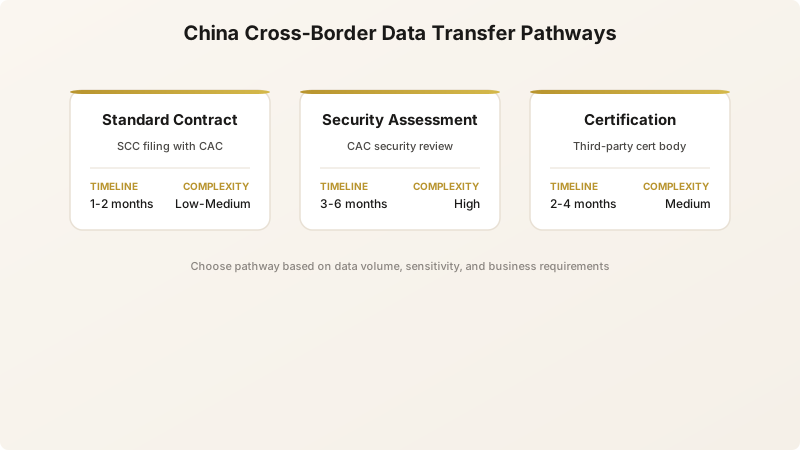
There are three legal pathways for cross-border data transfer, and which one you use depends on what you are transferring and how much:
The Three Pathways
Pathway 1: Security Assessment (安全评估)
The most rigorous pathway. Required when:
- You are a critical information infrastructure (CII) operator
- You are transferring important data (重要数据) out of China
- You are transferring personal information of 1 million or more individuals
- You are transferring sensitive personal information of 10,000 or more individuals
- Other circumstances specified by the CAC
What it involves:
- Detailed application to the CAC (through local cyberspace administration)
- Comprehensive data security assessment
- Review of the data transfer agreement
- Assessment of the overseas recipient’s legal and regulatory environment
- Risk assessment of the data transfer
Timeline: 3–6 months
Level of scrutiny: High
Validity period: 3 years (then renewal required)
Pathway 2: Standard Contract (标准合同)
The most common pathway for foreign companies. Applies when:
- You are transferring personal information out of China
- The volume does not meet the security assessment threshold
- You are not a CII operator
What it involves:
- Sign the CAC’s mandatory standard contract template with your overseas recipient
- Complete a personal information protection impact assessment (PIA)
- File the contract and PIA report with the local cyberspace administration
- The contract takes effect after the filing is accepted (not “approved” — filing is registration, not licensing)
Timeline: 20–40 working days for filing acceptance
Level of scrutiny: Moderate
Important note: You cannot modify the standard contract terms — you must use the template as-is. Supplementary terms are allowed only if they do not conflict with the standard clauses.
Pathway 3: Certification (认证)
The newest pathway. For companies that:
- Transfer personal information on an ongoing basis
- Have complex or multiple data flows
- Want a single certification covering multiple transfers
What it involves:
- Obtain certification from an accredited personal information protection certification body
- The certification covers your data protection management system and specific data transfer activities
- Annual surveillance audits required
Timeline: 2–4 months for initial certification
Level of scrutiny: Moderate to high
Note: This pathway is newer and fewer certification bodies are accredited. It is most suitable for larger organisations with multiple data transfer streams.
Which Pathway Do You Need?
Use this decision tree:
Are you a CII operator?
├── Yes → Security Assessment
└── No → Are you transferring "important data"?
    ├── Yes → Security Assessment
    └── No → Are you transferring personal information?
        ├── No → No special transfer procedure needed
        └── Yes → How many individuals?
            ├── 1M+ personal info OR 10k+ sensitive → Security Assessment
            └── Below threshold → Standard Contract or Certification
Important: This is a simplified overview. The rules are nuanced and there are edge cases. We recommend getting a professional assessment before deciding on your approach.
The Standard Contract Process Step by Step
This is the most common pathway for foreign companies, so we go into more detail here.
Step 1: Data mapping and classification
Before anything else, you need to understand:
- What data are you transferring? (personal information, sensitive personal information, important data, or general business data)
- How much data are you transferring?
- Where is it going? (which country, which entity)
- What is the purpose of the transfer?
- How will the data be processed overseas?
Step 2: Personal Information Protection Impact Assessment (PIA)
Required before any cross-border transfer of personal information. The PIA report must assess:
- The legality, legitimacy and necessity of the transfer purpose and scope
- The scale, scope and type of data being transferred
- The risks to data subjects’ rights and interests
- The data protection responsibilities of the overseas recipient
- The risk of data leakage, tampering, loss or misuse after transfer
- Whether the recipient’s country/region has an adequate data protection level
Step 3: Sign the standard contract
Use the CAC’s standard contract template. You can add supplementary clauses but they cannot conflict with the standard clauses.
Key standard contract provisions cover:
- Purpose, scope and type of data transfer
- Data processing methods and retention period
- Obligations of the data exporter (Chinese side)
- Obligations of the overseas recipient
- Data subject rights
- Security measures
- Liability for breach
- Dispute resolution
Step 4: File with the local CAC
Submit to the local cyberspace administration at the provincial level where the data exporter is located. Required materials:
- Signed standard contract
- PIA report
- Entity qualification documents
- Other supporting materials as required
Step 5: Acceptance and implementation
If materials are complete, the regulator will issue a filing acceptance notice. If not, they may ask for supplementary materials. Once accepted, the transfer can proceed.
Step 6: Ongoing compliance
You must:
- Update the contract and re-file if the transfer changes significantly
- Maintain records of the data transfer
- Ensure the overseas recipient continues to meet their obligations
- Conduct periodic PIA reviews
Common Pitfalls for Foreign Companies
1. Assuming “it’s just our own data, we can move it”
Many foreign companies assume data generated by their Chinese subsidiary can be freely transferred to headquarters. This is not how Chinese data law works. If the data includes personal information of Chinese individuals — which it almost always does — the cross-border transfer rules apply.
2. Starting the process too late
We frequently see companies that have already started transferring data — sometimes for months — before they realise they need to legalise it. Retroactive compliance is harder, more expensive, and carries enforcement risk.
3. Trying to use your own contract
The standard contract is mandatory — you cannot substitute your own data processing agreement. You can add supplementary clauses, but they cannot contradict the standard terms. Many multinational companies try to use their global DPA and discover it does not work for China.
4. Underestimating the data mapping work
Before you can file anything, you need a clear picture of exactly what data is flowing where. For companies with complex systems — especially AI companies with training data, user data, product analytics, and more — this can be a significant exercise.
5. Forgetting about ongoing obligations
Cross-border data compliance is not a one-time filing. You need to update filings when data flows change, conduct periodic PIAs, and ensure the overseas recipient maintains their data protection obligations.
6. Confusing “filing” with “approval”
The standard contract pathway is a filing system (备案), not an approval system. The regulator checks that your materials are complete and the contract follows the template, but they do not conduct a full risk assessment. This does not mean you are off the hook — you are still responsible for the substance of the compliance.
Related guides
- China Algorithm Filing: A Complete Guide for Foreign Companies — if your AI product operates in China, you likely need algorithm filing too
- China AI Regulation 2026: The Complete Guide for Foreign Companies — the full picture of China’s AI regulatory framework
Related services
- Cross-Border Data Transfer — standard contract filing, security assessment support
- Data Compliance and Privacy — PIPL compliance and data governance infrastructure
- Export Controls and Economic Sanctions — if your data or technology is export-controlled
Special Considerations for AI Companies
AI companies face unique cross-border data challenges:
Training data
If your AI model is trained on Chinese data — especially if it includes personal information — transferring that training data overseas may trigger cross-border data transfer requirements. This is a complex and evolving area.
Model weights
There is ongoing debate about whether model parameters and weights constitute “data” for the purposes of cross-border transfer rules. The answer depends on what the model was trained on and what it contains.
Cloud and infrastructure
If you use a global cloud provider with China regions, you need to ensure the architecture complies with China’s data localisation and cross-border transfer rules. Not all “global” cloud deployments are China-compliant.
AI service user data
If your AI service collects user interactions, prompts, or feedback from Chinese users, transferring this data overseas triggers personal information cross-border rules.
How We Help
We work with foreign companies on all aspects of cross-border data transfer compliance:
- Assessment — Map your data flows and determine which transfer pathway applies
- Data classification — Help you classify data types and volumes
- PIA preparation — Prepare the personal information protection impact assessment
- Standard contract filing — Draft, file and manage the standard contract process
- Security assessment support — Support for the more rigorous security assessment pathway when needed
- Ongoing compliance — Periodic reviews, regulatory updates, and filing maintenance
We work with your global team in English, coordinate with your China entity, and handle all regulator communications in Chinese. One team, one point of contact, no handoffs.
Next Steps
If you are planning to transfer data from China — or already doing so and want to confirm you are compliant — the first step is a data flow assessment.
Contact us for a free initial consultation. Tell us about your China operations and data flows, and we will tell you what pathway you need, what the process looks like, and how much it will cost.
Data Subject Rights: From Policy to Operations
PIPL grants data subjects several rights: the right to know and decide, the right to access and copy, the right to correct, the right to delete (the ‘right to be forgotten’), the right to data portability, and the right to explanation for automated decision-making. Having these rights listed in your privacy policy is necessary but not sufficient — you need operational processes to actually fulfil them.
Setting up a data subject rights process involves several components: a clear intake channel (usually an email address or web form), identity verification procedures, standard timelines for responding (PIPL requires responses within a reasonable period, typically interpreted as 15-30 working days), procedures for verifying and fulfilling different types of requests, and an escalation process for complex or unusual requests.
For AI companies, some rights raise specific challenges. The right to explanation for automated decision-making, for example, requires thinking about what you can actually explain about your AI system’s decisions without disclosing proprietary information. The right to delete can be complicated when personal information has been used to train models — can you truly delete someone’s data from a trained model? These are areas where the law is still evolving, and you need processes that are flexible enough to adapt as expectations become clearer.
Cross-Border Data Transfer: Choosing the Right Path
China has three legal pathways for cross-border data transfer: the security assessment route (for large-volume or sensitive data transfers), the standard contract route (for most routine transfers), and the certification route (for companies seeking a multi-year approval). Choosing the right path depends on data volume, data sensitivity, and transfer frequency.
The security assessment is the most rigorous — it requires a full review by the Cyberspace Administration and typically takes three to six months. The standard contract (SCC) route is faster — typically one to two months — and is appropriate for most foreign companies with moderate data volumes. The certification route, administered through professional bodies, offers longer validity but higher upfront effort.
A common mistake is assuming one pathway covers all your transfers. In practice, many companies use a combination: standard contracts for routine customer data transfers, security assessment for large-scale training data exports, and internal policies that keep some data entirely within China. The right mix depends on your specific data profile and business model.
Data Retention: How Long to Keep What, and Why
Data retention is one of those compliance areas that seems simple but gets complicated quickly. The basic principle is straightforward: you should not keep personal data longer than you need it for the purposes for which you collected it. But figuring out exactly how long you need to keep different types of data — and then actually implementing those retention periods in your systems — is the hard part.
Different types of data have different retention drivers. Some are driven by legal requirements (tax records must be kept for 10 years in China, employment records for a certain period after employment ends). Some are driven by business needs (customer data for as long as the customer relationship is active, plus a reasonable period afterwards). Some are driven by security and compliance (access logs, audit trails).
The best approach is to build a data retention schedule that lists each data category, the retention period, the reason for the retention period, and what happens at the end of the period (deletion, anonymisation, archiving). Then you need to implement this schedule in your systems — which can be technically challenging, especially for complex data ecosystems. But having clear policies and making reasonable efforts to implement them goes a long way toward compliance.
Data Localisation vs. Cross-Border: Strategic Tradeoffs
One of the most consequential decisions for a foreign company entering China is where to store and process data. Full data localisation — keeping all data within mainland China — simplifies compliance with PIPL and data security rules but increases infrastructure cost and complicates global product development.
A more nuanced approach is to segment your data by type and risk. Core personal information and sensitive data may need to stay in China by default, with cross-border transfers only when necessary and through an approved pathway. Non-personal, aggregated, or anonymised data may have more flexibility.
The decision also depends on your architecture. Companies with a single global database tend to default to cross-border transfer pathways, which means more compliance work upfront. Companies that design a China-specific data layer from the start often have an easier time, even though the engineering investment is higher. There is no universally right answer — the optimal approach balances compliance risk, engineering cost, and business flexibility.
Privacy by Design: Building Compliance into the Product
Privacy by design is the principle of building data protection into products and systems from the earliest stages, rather than adding it as an afterthought. For AI companies entering China, this is not just a best practice — it is increasingly an expectation under PIPL and related regulations.
Practical privacy by design measures include: data minimisation (collecting only what you need), purpose limitation (not repurposing data without new consent), default privacy settings (starting with the most protective configuration), and privacy impact assessments for high-risk processing activities. For AI products specifically, it also means thinking about things like federated learning (training models without centralising data), differential privacy (adding noise to protect individual records), and on-device processing where feasible.
The business case for privacy by design is strong. Companies that build compliance in early spend less on remediation later, face lower regulatory risk, and often find that the discipline of thinking through data flows improves their product architecture. It is also a strong signal to customers, partners, and regulators that you take data protection seriously.
Data Breach Response: Planning for When It Happens
No company wants to experience a data breach, but the reality is that even well-protected companies can have security incidents. The difference between a manageable incident and a catastrophic one is usually how prepared you are.
Under PIPL and the Data Security Law, companies have specific obligations when a data security incident occurs: they must take immediate remedial measures, notify affected users, and report to the relevant authorities. The specific notification requirements and timelines depend on the type and severity of the incident.
A good data breach response plan should include: a clear incident response team with defined roles, procedures for containing and assessing the incident, notification workflows (who to notify, when, and what to say), regulatory reporting procedures, and a post-incident review process. The plan should be tested regularly through tabletop exercises — because discovering gaps in your plan during an actual incident is much more expensive than finding them in a simulation.
PIPL Enforcement: What Foreign Companies Get Wrong
Since the Personal Information Protection Law (PIPL) took effect in 2021, enforcement has steadily increased in both frequency and sophistication. Looking at the cases from 2025 and early 2026, several patterns emerge about where foreign companies tend to slip up.
The most common issue is not consent collection itself — most companies have a consent mechanism — but rather the quality and specificity of that consent. Regulators increasingly scrutinise whether consent is truly informed, freely given, and specific to each processing purpose. Bundled consent, where users agree to everything in one click, is increasingly challenged.
Second, foreign companies often underestimate their obligations around sensitive personal information. Biometric data, health data, financial information, and children’s data each have heightened requirements, including separate consent and additional security measures. AI products that process face data or voice data, in particular, need to plan for these enhanced obligations from the design phase.
Third, data subject rights — access, correction, deletion, and portability — need operational implementation, not just a policy statement. Regulators expect companies to have actual processes for responding to data subject requests within the statutory time limits.
Data Classification and Grading: The Decision Framework
Data classification and grading is the process of categorising your data by type and sensitivity level — a foundational requirement under China’s Data Security Law. The system has three main levels: ordinary data, important data, and core data — each with progressively stricter security and transfer requirements.
For most foreign AI companies, the question is not whether you have core data (most do not), but whether any of your data counts as ‘important data’ — a category that triggers additional security obligations and stricter cross-border transfer rules. The definition of important data is sector-specific and still evolving, but it generally includes data that, if compromised, could harm national security, public interests, or economic development.
The classification process itself is valuable beyond just compliance. It forces you to think about what data you have, why you have it, and what would happen if it were lost or exposed. This understanding helps you prioritise security investments, allocate resources appropriately, and make better decisions about data retention and access controls.
Data Mapping: The Foundation of Any Compliance Programme
Before you can comply with data protection rules, you need to know what data you have, where it comes from, where it goes, and who is responsible for it. Data mapping is the process of documenting this flow, and it is the single most important step in building a defensible compliance programme.
A good data map covers five dimensions: data categories (what types of personal information you process), data sources (where you collect it from), data flows (where it moves within and outside your organisation), processing purposes (why you use it), and retention periods (how long you keep it). For AI companies specifically, the map should also cover training data, fine-tuning data, and inference data — three distinct categories with different compliance implications.
Many foreign companies underestimate how long data mapping takes. For a mid-sized AI product, a thorough map typically takes two to four weeks of focused work with legal, engineering, and product teams in the same room. Skipping or rushing this step almost always leads to problems later, when you discover data flows you did not know existed during an audit or a cross-border transfer review.
Vendor and Sub-Processor Data Compliance
When you use third-party vendors and sub-processors that handle personal data on your behalf, you are still responsible for that data’s protection. Under PIPL, data controllers have specific obligations when entrusting data processing to third parties — including written agreements, supervision of the processor, and ensuring the processor meets security requirements.
A robust vendor data compliance programme includes several elements: due diligence before engaging a vendor (assessing their security practices and compliance track record), clear data processing agreements (specifying the scope, purpose, duration, security measures, and both parties’ obligations), ongoing monitoring (periodic audits, security reviews), and exit procedures (ensuring data is returned or deleted when the relationship ends).
For AI companies, this is especially important because you likely have many vendors — cloud providers, analytics tools, customer support platforms, development tools — and each one touches your data in different ways. Mapping all your vendors and their data access, then ensuring each relationship has the right contractual protections, is a significant but necessary compliance effort.
Related guides in this series
- Data Compliance for AI Companies: Five Risk Areas, a Compliance Checklist and a Timeline
- Documents for Data Export Security Assessment: Four Statutory Categories and Eight Practical Files
- Privacy Policies for AI Products: Notice and Training-Data Clauses
Related Articles
- Documents for Data Export Security Assessment: Four Statutory Categories and Eight Practical Files
- China’s new cross-border data rules: thresholds, exemptions and the free-trade-zone list
- The Network Data Security Regulations Are Published
- China’s Network Data Security Regulation Takes Effect
FAQ
Q1: What triggers a data security review in China?
A1: A data security review is triggered when data processing activities may affect national security. This includes cross-border transfers of important data, processing of large volumes of personal information by critical information infrastructure operators, and certain data activities involving national security-sensitive sectors. The review is conducted by the CAC in conjunction with relevant departments. The process examines potential risks to national security, economic development, and public interests.
Q2: How long does personal information data retention usually need to be?
A2: Under the PIPL, personal information retention periods should be the shortest time necessary to achieve the processing purpose. There is no universal minimum or maximum retention period specified across all contexts. However, certain sector-specific regulations set specific requirements: for example, financial transaction records must be retained for at least 5 years, telecom subscriber data for at least 3 years, and employment records for at least 2 years after termination. Companies should establish data retention policies aligned with their specific business purposes.
Q3: What is the standard contractual clause (SCC) for cross-border data transfer?
A3: China’s SCC for cross-border personal information transfer is a standard contract template issued by the CAC that companies can use as one of the legal bases for transferring personal information overseas. The SCC specifies the rights and obligations of both the data exporter in China and the overseas recipient, including data security protection measures, individual rights protection, and liability provisions. Companies using the SCC must still ensure that the receiving country’s data protection level is adequate and file the contract with the relevant regulatory authority.
Q4: What is the difference between the PIPL and the DSL in China?
A4: The Personal Information Protection Law (PIPL) governs the processing of personal information, focusing on individual rights and consent requirements. The Data Security Law (DSL) establishes a broader data classification system and governs data security at all levels, including important data and core data. While the PIPL is specifically about personal data protection, the DSL covers all data categories and establishes data security review mechanisms for data that may affect national security or public interests.
Q5: Do foreign companies need a DPO in China?
A5: Under the PIPL, companies that process personal information reaching a certain threshold must appoint a personal information protection officer (PIPO). The specific threshold is determined by the CAC. For foreign companies processing Chinese citizens’ personal information from overseas, the PIPL requires appointing a representative within China to handle personal information protection matters. This representative serves as the contact point for regulatory authorities and is responsible for ensuring compliance with PIPL requirements.
Frequently Asked Questions↑ Back to article
Can we transfer data from China to our headquarters overseas?
Yes, but you need to follow one of the three legal paths for cross-border data transfer under Chinese law: (1) security assessment (for large volumes or important data), (2) standard contract filing (for most cases), or (3) personal information protection certification. Which path applies depends on the type and volume of data being transferred, your industry, and whether you are a critical information infrastructure operator.
What is the standard contract for cross-border data transfer?
The standard contract (个人信息出境标准合同) is a CAC-mandated contract template that data exporters in China must sign with overseas recipients when transferring personal information that does not reach the security assessment threshold. You must sign the standard contract, file it with the local cyberspace administration, and complete a personal information protection impact assessment before the transfer can legally proceed.
How long does cross-border data transfer approval take?
Standard contract filing typically takes 20–40 working days from submission. Security assessment takes longer — typically 3–6 months due to the more rigorous review process. The timeline depends on the completeness of your materials, the complexity of your data flows, and whether regulators request additional information.
Do we need to store data inside China?
Data localisation requirements depend on the type of data and your industry. Critical information infrastructure operators must store personal information and important data locally. Other companies may transfer data overseas through one of the three legal paths. For many AI and tech companies, the standard contract path is sufficient — full localisation is not always required.
What are the three legal pathways for cross-border data transfer from China?
China provides three legal pathways for cross-border data transfer, each with different requirements and use cases. The security assessment pathway is the most rigorous, required for CII operators, important data transfers, or large volumes of personal information, taking 3–6 months with high scrutiny and 3-year validity. The standard contract pathway is the most common for foreign companies, requiring a CAC-mandated contract template and PIA filing, taking 20–40 working days with moderate scrutiny. The certification pathway is the newest option, suitable for companies with multiple data flows that want a single certification, taking 2–4 months with moderate to high scrutiny.
When is a security assessment required for cross-border data transfer?
A security assessment is required when you are a critical information infrastructure operator, when you are transferring important data out of China, when you are transferring personal information of 1 million or more individuals, or when you are transferring sensitive personal information of 10,000 or more individuals. The assessment involves a detailed application to the CAC through the local cyberspace administration, a comprehensive data security review, assessment of the overseas recipient's legal environment, and a risk assessment of the transfer itself, with a typical timeline of 3–6 months and 3-year validity.
What is the certification pathway for cross-border data transfer?
The certification pathway is the newest of the three legal pathways, designed for companies that transfer personal information on an ongoing basis and have complex or multiple data flows. It involves obtaining certification from an accredited personal information protection certification body that covers your data protection management system and specific data transfer activities, with annual surveillance audits required. The initial certification takes 2–4 months and has moderate to high scrutiny. Fewer certification bodies are currently accredited, making this pathway most suitable for larger organisations with multiple data transfer streams.