China AI Startup Legal Cost Benchmark 2026
How much does it actually cost — in legal and compliance fees — to launch an AI startup in China? We looked at data from 47 foreign and domestic AI companies incorporated between 2024 and 2026, plus market rates from 12 law firms and service providers, to build a realistic cost benchmark for early-stage AI companies entering the Chinese market.
The picture that emerges: budget for more than you think, but less than you might fear. The total first-year legal and compliance cost for a typical AI startup ranges from RMB 250,000 to RMB 850,000 — roughly $35,000 to $118,000 — depending on your business model, hiring plans, and compliance complexity. The biggest variables are whether you need algorithm filing and how quickly you plan to hire.
Methodology
This benchmark is based on three data sources. First, anonymised data from 47 AI companies that incorporated in China (primarily Shenzhen) between 2024 and the first half of 2026. These companies span sub-sectors including enterprise SaaS, generative AI tools, AI hardware, autonomous systems, and medical AI. Second, published fee schedules and quotes from 12 law firms and professional service providers operating in the China tech and AI space. Third, regulatory filing fees and official costs from government sources, current as of mid-2026.
All figures are in RMB and represent typical market rates for a foreign-invested AI startup at the seed to Series A stage. Your actual costs may vary depending on complexity, location, and specific requirements.
Entity Setup Costs
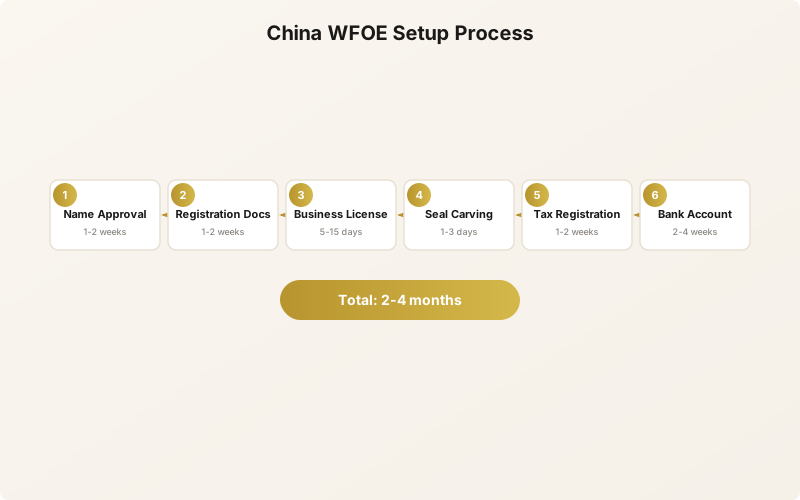
Setting up a wholly foreign-owned enterprise (WFOE) is the first step for most foreign AI companies entering China. The cost breaks down into several components.
| Cost Item | Typical Range | Notes |
|---|---|---|
| Legal fees (WFOE setup) | 30,000 – 80,000 | Varies by firm and complexity |
| Registered capital | 500,000 – 5,000,000 | Not a fee — it is your capital contribution |
| Government fees | 0 – 2,000 | Most government fees were eliminated in 2014 |
| Bank account opening | 500 – 5,000 | Depends on bank and account type |
| Seal carving | 500 – 2,000 | Company chop, financial chop, legal rep chop |
| Registered address (annual) | 12,000 – 60,000 | Virtual office or serviced address |
| Tax registration | Included in setup | Usually covered by setup service |
| Total setup cost (excl. capital) | 43,000 – 149,000 | One-time cost, 2-4 months |
The single biggest variable in setup cost is legal fees. Smaller local firms may charge as little as RMB 20,000-30,000 for a basic WFOE setup. International firms and specialised tech law firms typically charge RMB 60,000-100,000 or more, especially if the business scope is complex or requires additional licensing.
For AI companies specifically, the business scope description matters. A broad “technology development and consulting” scope is straightforward, but if your scope includes specific AI-related activities that may require special permits, the setup process becomes more complex and potentially more expensive.
Algorithm Filing and Regulatory Costs
For AI companies, regulatory filing costs are not optional — they are a core part of the cost structure. The specific filings you need depend on what your product does.
| Filing Type | Typical Cost | Timeline |
|---|---|---|
| Algorithm filing (basic) | 30,000 – 80,000 | 4-8 weeks |
| Generative AI service registration | 80,000 – 200,000 | 2-4 months |
| Deep synthesis filing | 40,000 – 100,000 | 4-10 weeks |
| Security assessment (pre-filing) | 50,000 – 150,000 | 1-3 months |
| ICP filing | 2,000 – 10,000 | 1-4 weeks |
| ICP license (if required) | 30,000 – 100,000 | 2-6 months |
Most AI startups need at least one type of algorithm filing plus ICP filing. If you are launching a generative AI product, you are looking at generative AI service registration plus the pre-filing security assessment — the highest-cost category.
It is worth noting that these are the external costs (legal and consulting fees). The internal cost of engineering and product time spent on filing preparation is often equal to or greater than the external cost. Document preparation, system configuration for compliance features, and responding to regulator questions all take significant internal resources.
IP Protection Costs
IP protection is one area where spending early saves you from much larger costs later. The cost depends on how much IP you have and what types of protection you pursue.
| IP Type | Cost per Item | Typical Quantity | Total Range |
|---|---|---|---|
| Invention patent (China) | 20,000 – 50,000 | 2-5 | 40,000 – 250,000 |
| Software copyright registration | 1,000 – 3,000 | 3-10 | 3,000 – 30,000 |
| Trademark (per class) | 3,000 – 8,000 | 3-6 classes | 9,000 – 48,000 |
| Trade secret system setup | 20,000 – 60,000 | 1 package | 20,000 – 60,000 |
| Open source compliance audit | 30,000 – 100,000 | 1 audit | 30,000 – 100,000 |
| IP strategy consulting | 20,000 – 80,000 | 1 project | 20,000 – 80,000 |
| Total first-year IP | 122,000 – 568,000 |
The wide range reflects the difference between a basic IP programme (a few trademarks and copyright registrations) and a comprehensive one (multiple patent filings, trade secret systems, open source compliance, and strategic planning). For AI companies at the seed stage, we typically recommend the middle ground: protect your brand (trademarks), register your core software copyrights, and get a basic IP strategy review — with patent filing deferred until your technology is more mature and your funding is more substantial.
Employment and HR Legal Costs
Hiring in China comes with significant legal and compliance costs beyond just salaries. The mandatory social insurance and housing fund contributions add approximately 30-40% on top of base salary.
| Item | Typical Cost | Notes |
|---|---|---|
| Employment contract templates | 5,000 – 20,000 | Customised for your company |
| Employee handbook / policies | 10,000 – 30,000 | Comprehensive policy manual |
| Social insurance registration | Included in setup | Mandatory for all employees |
| Housing fund registration | Included in setup | Mandatory in most cities |
| Equity incentive plan setup | 30,000 – 100,000 | Option pool or share incentive |
| Non-compete / confidentiality agreements | 5,000 – 15,000 | Per template set |
| Ongoing HR legal support (annual) | 20,000 – 60,000 | Advisory for employment issues |
For a startup hiring 10 people in the first year, the total HR legal cost is typically in the range of RMB 70,000 to RMB 200,000 — including both setup costs and ongoing advisory. This does not include the actual salary and benefits cost, which is much larger.
Data Compliance Costs
Data compliance is a major cost area for AI companies, given the complexity of China’s data regulations (PIPL, DSL, and sector-specific rules) and the potential penalties for non-compliance.
| Compliance Item | Typical Cost | Frequency |
|---|---|---|
| Data mapping and inventory | 30,000 – 80,000 | One-time, then annual review |
| PIPL compliance framework | 30,000 – 100,000 | One-time setup |
| Privacy policy drafting | 8,000 – 25,000 | One-time + updates |
| Cross-border data transfer (SCC path) | 30,000 – 80,000 | Per transfer activity |
| Cross-border data transfer (security assessment) | 80,000 – 200,000 | Per assessment |
| Data security risk assessment | 40,000 – 100,000 | Annual or as needed |
| PIPIA (personal info impact assessment) | 20,000 – 60,000 | Per high-risk activity |
| Ongoing compliance advisory (annual) | 50,000 – 150,000 | Annual retainer |
The total first-year data compliance cost for an AI startup is typically RMB 100,000 to RMB 350,000, depending on the volume and sensitivity of data you process and whether you need cross-border data transfers. Companies processing sensitive personal information (like biometric data or health data) will be at the higher end of the range.
Total First-Year Cost Breakdown
Putting it all together, here is what a typical AI startup can expect to spend on legal and compliance in the first year.
| Cost Category | Budget Range | % of Total |
|---|---|---|
| Entity setup | 43,000 – 149,000 | 12-18% |
| Regulatory filing | 80,000 – 250,000 | 22-30% |
| IP protection | 122,000 – 568,000 | 25-35% |
| Employment / HR | 70,000 – 200,000 | 15-20% |
| Data compliance | 100,000 – 350,000 | 20-28% |
| Total first year | 415,000 – 1,517,000 | 100% |
The median company in our data set spent approximately RMB 650,000 (about $90,000) on legal and compliance in year one. Companies with simpler models (SaaS tools without generative AI features) were at the lower end, while companies with hardware components or medical AI applications were at the higher end.
How to Optimise Your Legal Spend
Not every company needs to spend at the top of the range. Here are five strategies for getting good legal support without overspending.
Prioritise by risk, not by completeness. Do not try to build the perfect compliance system on day one. Focus on the things that are legally required for launch, then build out the rest over time. A phased approach — basic compliance at launch, intermediate at three months, comprehensive at six months — is usually the most cost-effective.
Bundle services where possible. Many law firms offer startup packages that bundle entity setup, basic contracts, and initial compliance advice for a fixed fee. These packages are often better value than buying each service separately. Ask about startup rates or packaged services before you commit to hourly billing.
Use technology and templates for routine work. Standardised documents — employment contracts, NDAs, basic policies — do not need custom legal work every time. Use templates from a reputable source and have a lawyer review them once, rather than drafting everything from scratch. Reserve legal spending for the high-stakes, high-complexity work.
Plan filing strategically. If you have multiple products or features that may require filing, think about the optimal filing sequence. Filing everything at once may be more efficient and cost-effective than filing piecemeal. But do not wait until everything is perfect — better to file your core product and add features later through change filings than to delay launch chasing perfection.
Invest in prevention. This sounds counterintuitive, but spending a bit more on good legal advice upfront usually saves money overall. A well-structured entity, clear contracts, and a solid compliance foundation prevent problems that would be much more expensive to fix later — employment disputes, regulatory penalties, IP issues, and the management time spent dealing with all of it.
What Most Startups Get Wrong
Looking at the data from 47 companies, several patterns emerge about where startups typically underestimate costs.
Underestimating regulatory filing time and cost. Many companies budget for the filing fee but not the legal and engineering time required to prepare the filing package, implement required features, and respond to regulator questions. The internal cost is often equal to or greater than the external cost.
Forgetting about ongoing compliance. Setup and filing costs are one-time, but compliance is ongoing. Annual audits, regular filing updates, employment law changes, new regulatory requirements — all of these cost money and management time. Budget for ongoing compliance from the start, not just the initial setup.
Skimping on IP protection at the beginning. Registering a few trademarks and copyrights early is relatively inexpensive, but fixing IP problems later — after someone has registered your brand name or after your trade secrets have leaked — can be extremely expensive. IP protection is an area where an ounce of prevention is worth a pound of cure.
Not budgeting for the unexpected. In China’s regulatory environment, new rules and requirements emerge regularly. You should have a contingency budget — typically 15-20% of your total legal budget — for unforeseen compliance requirements, regulatory changes, or disputes that arise.
Benchmark by Company Type
The cost structure varies significantly depending on what kind of AI company you are. Here is how different sub-sectors compare.
| Company Type | First-Year Legal Cost | Biggest Cost Driver |
|---|---|---|
| B2B SaaS / AI tools | 250,000 – 500,000 | Algorithm filing + data compliance |
| Generative AI consumer app | 400,000 – 800,000 | Generative AI registration + security assessment |
| AI hardware / robotics | 500,000 – 1,000,000 | IP protection + manufacturing legal + entity setup |
| Enterprise AI software | 300,000 – 600,000 | Data compliance + enterprise contract support |
| Medical AI / biotech | 600,000 – 1,500,000 | Regulatory approval + clinical compliance + IP |
| Autonomous driving / ADAS | 700,000 – 1,500,000 | Road testing permits + data compliance + IP |
Key Takeaways
Budget RMB 500,000-700,000 for year one if you are a typical AI SaaS or tools company. Hardware and regulated sectors should budget more.
Regulatory filing is not a side project — it is a core cost centre and timeline driver for AI companies entering China. Plan for it from day one.
IP protection pays for itself. Investing RMB 50,000-100,000 in basic IP protection early prevents problems that would cost 5-10x to fix later.
Ongoing compliance is 30-40% of the cost. Do not budget only for setup — the real cost is in maintaining compliance as you grow and as regulations evolve.
You get what you pay for, but you do not always need the most expensive option. A mid-sized boutique firm that specialises in AI and tech is often better value than a big international firm for early-stage companies.
This benchmark is for general informational purposes only and does not constitute legal advice. Actual costs vary based on specific circumstances. For a cost estimate tailored to your situation, we recommend consulting with a qualified China-focused lawyer.
Hiring Your First China Employees: Key Considerations
Your first employees in China will shape the culture, direction and trajectory of your China operation. Getting the hiring right — especially for the country lead role — is one of the most important factors in China entry success.
The China country lead needs a rare combination of skills: deep understanding of the local market, ability to work with foreign headquarters, technical credibility in your industry, and the leadership skills to build a team from scratch. Finding someone who has all four is challenging, and many companies underestimate how long this search takes.
Employment law in China also differs from what many foreign companies are used to. Employment contracts are mandatory, probation periods have strict limits, and termination is more regulated — ‘at will’ employment does not exist. Social insurance (pension, medical, unemployment, work injury, maternity) and the housing fund are mandatory contributions that add significantly to total compensation cost.
For AI companies specifically, there is also the question of where to locate. Shenzhen is the natural choice for hardware and AI companies — it has the deepest talent pool, the strongest supply chain, and the most supportive policy environment. But competition for top AI talent is intense, and salaries have risen rapidly. Budget accordingly.
Working with Chinese Partners and Distributors
Many foreign companies entering China consider working with a local partner or distributor as a way to accelerate market entry and reduce risk. Partners can provide local market knowledge, existing customer relationships, and regulatory expertise. But partnerships also come with challenges — and they rarely work out as well as expected without careful structuring and management.
The most common types of partners are: distributors (who buy your product and resell it), agents (who sell on your behalf for a commission), strategic partners (who invest in deeper collaboration), and licensing partners (who license your technology and sell their own products based on it). Each type has different implications for control, revenue share, and risk.
Key success factors for partnerships include: clear expectations from the beginning (what each side is responsible for, what the targets are, how success is measured), strong contracts (with clear terms for exclusivity, territory, pricing, IP protection, and termination), active management (partnerships need attention — they do not run themselves), and an exit strategy (what happens if it does not work out? How do you end the relationship cleanly?).
The biggest mistake companies make is treating the partnership as a shortcut that means they do not need to build their own China capability. In practice, even with a strong partner, you still need your own team on the ground to manage the relationship, protect your interests, and ensure you are learning about the market directly.
China Market Entry Timeline: What to Expect Month by Month
One of the most common questions from foreign companies is: how long does China entry actually take? The answer depends on what you mean by ’entry’ — just setting up an entity, or having a fully operational team with a launched product? Here is a realistic timeline for a typical AI or tech company.
Month 1-2: Planning and preparation. Finalise the entry strategy, choose the entity type and location, engage advisors, and start preparing documentation. If you are going the WFOE route, you need to gather various corporate documents from your home country and get them notarised and apostilled.
Month 2-4: Entity setup. Submit the WFOE application, go through the review process, and receive your business license. Then carve the official seals, open bank accounts, register for taxes, and set up social insurance and housing fund accounts.
Month 3-5: Team building. Start hiring your first employees — ideally the country or GM hire first, then they can help build the rest of the team. Set up office space, IT infrastructure, and basic operational systems.
Month 4-8: Product localisation and compliance. Adapt your product for the China market, set up the required compliance infrastructure (privacy policy, data systems, filing preparation), and start the regulatory filing process if needed.
Month 6-12: Launch and initial revenue. Soft launch your product or service, acquire your first customers, and begin generating initial revenue. Refine your go-to-market strategy based on early feedback.
This is a general timeline — some companies move faster, some slower. The most common delay factors are slow decision-making at headquarters, difficulty finding the right country lead, and underestimating the compliance work required for launch.
The Real Cost of Entering China: Beyond Setup Fees
When budgeting for China entry, foreign companies often focus on the setup fees — business license, registered capital, legal fees — and underestimate the ongoing operational costs. The setup cost is real, but it is typically the smallest part of the total cost of being in China.
The major ongoing costs fall into several categories. First, people: salaries, benefits, social insurance (which adds about 30-40% on top of base salary), and housing fund contributions. Second, office and infrastructure: rent in Shenzhen or Shanghai is comparable to major Western cities, plus IT infrastructure and compliance systems. Third, compliance: annual audit, tax filing, regulatory filings, and legal advisory. Fourth, taxes: corporate income tax (25% standard rate, though high-tech enterprises qualify for 15%), VAT (6-13% depending on activity), and withholding tax on profit repatriation.
There are also less obvious costs. The opportunity cost of management time spent on China operations is significant. The cost of mistakes — a misfiled tax return, an employment dispute, a compliance gap — can be high. And the cost of doing business slowly — taking longer to hire, longer to get approvals, longer to reach profitability — adds up.
The companies that succeed in China are the ones that budget for the full picture, not just the setup fees. They plan for at least 18-24 months of operating runway before expecting the China entity to be self-sustaining.
Protecting Your IP Before You Enter China
Intellectual property protection is often the number one concern for foreign AI and tech companies entering China. And with good reason — IP disputes are common, and the consequences can be severe. But many companies make the mistake of thinking about IP protection only after they have started operations, when the most important steps should happen before entry.
The first principle of China IP strategy is: register everything before you come. Patents, trademarks, software copyright — each needs to be registered in China to be enforceable there. China follows a first-to-file system, which means whoever files first gets the rights, regardless of who invented it first. If you wait until after you enter, you may find that someone else has already filed for your brand name or key technology.
Second, structure your contracts carefully. Your employment contracts should have clear IP assignment clauses, confidentiality provisions, and non-compete obligations (though non-competes are limited in scope and duration under Chinese law). Your supplier contracts should specify who owns the tooling, the designs, and any improvements made during the manufacturing relationship.
Third, build internal IP protection systems. Access controls, compartmentalisation of sensitive information, employee training, and regular audits all contribute to a defensible IP position. And if the worst happens — infringement or misappropriation — you need a plan for how to respond, whether through administrative channels, civil litigation, or criminal complaint.
Entity Structure Decision Tree: WFOE, JV, RO or No Entity?
One of the first and most important decisions when entering China is choosing the right legal entity structure. The options — and the tradeoffs between them — are often more nuanced than foreign companies expect.
A wholly foreign-owned enterprise (WFOE) is the most common choice for foreign tech and AI companies. It gives you full control, allows you to hire employees directly, issue RMB invoices, and conduct a wide range of business activities. The tradeoff is higher setup cost, more compliance obligations, and a longer setup timeline (typically 2-4 months).
A representative office (RO) is simpler and cheaper to set up, but it can only perform liaison activities — market research, contact facilitation, quality control oversight. It cannot generate revenue, sign contracts, or hire employees directly. ROs are suitable for the initial exploration phase but quickly become limiting as you grow.
A joint venture (JV) — partnering with a Chinese company — offers local market access and shared risk, but at the cost of control. For AI companies specifically, JVs also raise IP protection concerns that need careful contractual structuring.
Finally, some companies start without a China entity at all, serving the market cross-border through a Hong Kong or Singapore entity. This avoids China entity setup entirely but limits what you can do locally and may not work for products that require domestic licensing or filing.
Related Articles
- WFOE Setup in China: A Complete Guide for Foreign AI & Tech Companies (2026)
- Trading WFOE in China: Setup, Costs and Compliance for Import/Export Companies
- Cost of Manufacturing in China: What Foreign Hardware Startups Should Budget
- Enterprise SaaS China Entry Guide for Foreign Companies
FAQ
Q: What is the single biggest legal cost for an AI startup in China?
A: It depends on the company type, but for most AI startups, the biggest cost categories are IP protection, regulatory filing, and data compliance — usually in that order for early-stage companies. As you grow, employment-related costs and ongoing compliance become a larger share of the total.
Q: Can we reduce costs by using a cheaper law firm for setup?
A: You can, but be careful. A poorly structured entity or a mistake in the setup process can cost much more to fix later than you saved on the setup fee. For the setup itself, the difference between a cheap firm and a good mid-range firm is usually small relative to the overall cost of being in China. What matters more is getting the structure right the first time.
Q: How much should we budget for unexpected legal costs?
A: We recommend a contingency of 15-20% of your total legal and compliance budget. In China’s evolving regulatory environment, it is common for new requirements to emerge that were not on your radar when you planned your budget. Having some flexibility built in prevents these surprises from derailing your plans.
Q: Is it cheaper to start without a China entity and set up later?
A: In the short term, yes — you avoid setup costs and ongoing compliance costs. But there are trade-offs: you cannot hire employees directly, you cannot issue RMB invoices, and you may have fewer options for regulatory filings. Many companies start cross-border and set up a WFOE once they have enough China revenue or team size to justify it.
Q: How do Shenzhen costs compare to Beijing or Shanghai?
A: Legal fees are broadly comparable across the three first-tier cities, though Beijing international firms may be slightly more expensive on average. The bigger differences are in operating costs — office rent, salaries, and general cost of living — where Shenzhen is generally comparable to Shanghai and slightly less expensive than Beijing for tech talent.
Frequently Asked Questions↑ Back to article
What is the single biggest legal cost for an AI startup in China?
It depends on the company type, but for most AI startups, the biggest cost categories are IP protection, regulatory filing, and data compliance — usually in that order for early-stage companies. As you grow, employment-related costs and ongoing compliance become a larger share of the total.
Can we reduce costs by using a cheaper law firm for setup?
You can, but be careful. A poorly structured entity or a mistake in the setup process can cost much more to fix later than you saved on the setup fee. For the setup itself, the difference between a cheap firm and a good mid-range firm is usually small relative to the overall cost of being in China. What matters more is getting the structure right the first time.
How much should we budget for unexpected legal costs?
We recommend a contingency of 15-20% of your total legal and compliance budget. In China's evolving regulatory environment, it is common for new requirements to emerge that were not on your radar when you planned your budget. Having some flexibility built in prevents these surprises from derailing your plans.
Is it cheaper to start without a China entity and set up later?
In the short term, yes — you avoid setup costs and ongoing compliance costs. But there are trade-offs: you cannot hire employees directly, you cannot issue RMB invoices, and you may have fewer options for regulatory filings. Many companies start cross-border and set up a WFOE once they have enough China revenue or team size to justify it.
How do Shenzhen costs compare to Beijing or Shanghai?
Legal fees are broadly comparable across the three first-tier cities, though Beijing international firms may be slightly more expensive on average. The bigger differences are in operating costs — office rent, salaries, and general cost of living — where Shenzhen is generally comparable to Shanghai and slightly less expensive than Beijing for tech talent.
What is the total first-year legal and compliance cost for an AI startup in China?
The total first-year legal and compliance cost for a typical AI startup ranges from RMB 250,000 to RMB 850,000 — roughly $35,000 to $118,000 — depending on the business model, hiring plans, and compliance complexity. The biggest variables are whether algorithm filing is required and how quickly the company plans to hire. This benchmark is based on data from 47 AI companies that incorporated in China between 2024 and 2026, plus market rates from 12 law firms and service providers.
What are the main cost components for an AI startup entering China?
The major cost components fall into several categories: entity setup including legal fees, registered capital, and registration costs; regulatory compliance filings such as algorithm filing and ICP; IP protection including patents, trademarks, and copyrights; employment-related costs including employment contracts, social insurance setup, and hiring support; and ongoing compliance including annual audit, tax filing, and legal advisory. For most AI startups, IP protection, regulatory filing, and data compliance are typically the largest cost categories in the first year.