Key Takeaways
- Quality is built in, not inspected in. The best Chinese factories embed quality checks at every stage — IQC, IPQC, FQC, and OQC — rather than relying solely on a final inspection.
- AQL sampling is the industry standard, but it has limitations. AQL 2.5/4.0 at Level II is the baseline for consumer electronics; tighter standards apply to medical, automotive, or aerospace products.
- Golden samples are your most important quality tool. Signed, dated, and properly stored reference samples eliminate ambiguity about what “good” looks like.
- Functional testing (FCT) is non-negotiable for electronics products. Expect to invest in custom test fixtures and clearly define test procedures — do not assume the factory will figure it out.
- Third-party inspection is a safety net, not a solution. It catches obvious problems but cannot compensate for a fundamentally weak quality system at your factory.
1. Introduction: Where Product Quality Is Proven — or Lost
For hardware companies manufacturing in China, the assembly and testing phase is where your design becomes a real product — and where most quality problems either surface or get buried in a shipping container bound for your warehouse. A great design can be ruined by shoddy assembly. A mediocre design can be saved by rigorous testing. The difference between a successful product launch and a costly recall often comes down to how well you manage the assembly line, the test stations, and the final inspection process.
China’s manufacturing ecosystem offers incredible scale and speed, but quality consistency varies dramatically from factory to factory. Some facilities operate at world-class levels with automated lines, statistical process control (SPC), and trained quality engineers. Others cut corners, skip test steps to meet deadlines, and have QC teams that answer to production managers rather than independent quality departments.
This guide walks you through everything you need to know: how assembly lines are structured in Chinese factories, the four stages of quality control (IQC, IPQC, FQC, OQC), functional testing strategies (FCT, ICT, burn-in), AQL sampling, golden samples, how to set up quality systems, common pitfalls, and how to handle quality issues when they inevitably arise.
2. Assembly in Chinese Factories
Assembly Line Types
Chinese factories typically deploy three types of assembly lines, and the right choice depends on your product complexity, volume, and budget:
Manual assembly lines are the most common in China, especially for low-to-medium volume products (under 50,000 units per month). Workers stand or sit along a conveyor belt or workbench, each performing one or two assembly steps. Manual lines are flexible — they can be reconfigured for product changes in hours or days rather than weeks. A typical manual consumer electronics assembly line has 15–30 workers and can produce 500–2,000 units per 10-hour shift, depending on product complexity.
Semi-automated lines combine manual stations with automated equipment for specific high-precision or high-volume steps. For example, a smartphone assembly line might have workers placing components manually but use automated screw-driving machines, automated glue dispensers, and robotic test stations. Semi-automated lines typically cost $50,000–$300,000 to set up and make sense for volumes of 50,000–500,000 units per year.
Fully automated lines use robots and automated material handling for nearly all assembly steps. These are rare outside of very high-volume products (millions of units per year) or industries where precision requirements exceed human capability. A fully automated line can cost $1 million+ and take 3–6 months to commission.
Typical Line Layouts
Chinese factories favor several layout patterns:
- U-shaped lines are common for medium-complexity products. Workers stand inside the U, and products move around the perimeter. This layout facilitates communication, reduces walking distance, and makes line balancing easier.
- Straight lines (conveyor belt from one end of the factory to the other) are typical for high-volume, low-complexity products like phone chargers or cables.
- Cellular manufacturing groups multi-skilled workers around a single product or product family, with each cell handling complete sub-assembly. This is common for low-volume, high-mix products.
Line Balancing and Efficiency
Line balancing — ensuring each workstation takes roughly the same amount of time — is critical for efficiency. A well-balanced line in China typically achieves 80–90% line efficiency (actual output vs. theoretical maximum). Inexperienced factories often operate at 60–70% efficiency due to poor line design and frequent bottlenecks.
As a rule of thumb, a consumer electronics assembly line with 20 workers at a 60-second takt time produces about 600 units per shift. If you need 2,000 units per day, you need roughly three to four lines or a faster takt time.
3. Stages of Quality Control
Quality control in Chinese manufacturing is typically organized into four stages. Each stage catches different defects, and skipping any one of them significantly increases your risk.
IQC (Incoming Quality Control)
IQC is the first line of defense — inspecting raw materials, components, and sub-assemblies when they arrive at the factory from suppliers.
What gets inspected at IQC:
- Visual inspection: Packaging damage, obvious physical defects, correct labeling
- Dimensional inspection: Critical dimensions measured with calipers, micrometers, or coordinate measuring machines (CMM)
- Functional spot checks: Powering on components, testing basic functionality
- Certificate verification: Checking that materials come with required certificates (RoHS, REACH, UL, etc.)
Sampling plans for IQC vary. Many factories use AQL sampling for incoming materials, while critical components may require 100% inspection. The problem with IQC in many Chinese factories is that it is understaffed and under-resourced. When component shortages occur, IQC inspectors are pressured to “pass” materials quickly to keep production running.
Key advice: Specify in your quality agreement which components require IQC inspection and at what AQL level. For critical components (microcontrollers, sensors, batteries), require 100% incoming inspection or supplier-provided test data that you can audit.
IPQC (In-Process Quality Control)
IPQC happens during assembly — catching defects before the product is finished, when rework is cheaper and easier.
Key IPQC activities:
- First-piece inspection: The first unit off the line each shift or after a setup change is fully inspected to confirm the line is set up correctly
- In-line checks: QC inspectors walk the line and check units at key stations (e.g., after soldering, after enclosure assembly)
- Process monitoring: Checking that parameters like solder temperature, torque values, and glue dispensing volume are within specification
- SPC (Statistical Process Control): Plotting key quality metrics on control charts to detect trends before they become defects
The reality in many Chinese factories is that IPQC is weak or nonexistent. Production managers view IPQC as slowing down the line, and inspectors often lack the authority to stop production when they find problems.
What to do: Make IPQC a mandatory part of your production agreement. Require first-piece inspection sign-off before each production run. Define specific in-line checkpoints with documented pass/fail criteria.
FQC (Final Quality Control)
FQC is the 100% inspection of finished products before they are packed. Every unit goes through FQC.
FQC typically includes:
- 100% functional testing (FCT — more on this below)
- Appearance inspection: Checking for scratches, scuffs, misalignment, color differences
- Labeling and packaging verification: Correct labels, correct accessories, correct user manual
- Basic safety checks: Ground continuity, hi-pot testing for electrical products
FQC is usually the strongest QC stage in Chinese factories because it is the last checkpoint before the product leaves the production floor. However, the quality of FQC depends heavily on how well the test procedures are written and how well the inspectors are trained.
OQC (Outgoing Quality Control)
OQC is the final random inspection of finished, packed products before they are shipped. It is typically AQL-based and serves as a verification that FQC did its job.
OQC inspectors pull random cartons from the finished goods warehouse, open them, and inspect the products inside against the inspection criteria. If the batch passes OQC, it is released for shipment. If it fails, the entire batch goes back for re-inspection or rework.
Why You Need All Four Stages
Each stage serves a different purpose:
- IQC catches supplier problems before they enter production
- IPQC catches process problems during assembly (cheapest to fix)
- FQC catches individual unit defects before packaging
- OQC verifies overall batch quality before shipment
A factory that only does FQC and OQC is like a hospital that only checks patients at the door and at discharge — it misses most opportunities to catch problems early when they are cheapest to fix.
4. Functional Testing (FCT)
Functional Circuit Testing (FCT) is the process of verifying that an assembled product works as intended. For electronics products manufactured in China, FCT is the single most important quality gate.
What FCT Covers
A comprehensive FCT procedure typically tests:
- Power-on test: Does the unit turn on? Does it draw the correct current?
- Parameter test: Are voltage levels, frequencies, signal strengths within specification?
- Functional test: Does each feature work (buttons, displays, sensors, communication)?
- Load test: Does the product work correctly under maximum load conditions?
- Interface test: Do all ports and connectors work (USB, HDMI, Bluetooth, Wi-Fi)?
Test Fixtures and Jigs
FCT requires custom test fixtures (also called test jigs) that connect to your product’s test points or connectors and automate the testing process. A typical test fixture uses pogo pins (spring-loaded contacts) that press against test pads on the PCB, connected to a test controller or computer.
Test fixture costs in China range from $500 for a simple manual fixture to $5,000–$20,000 for a fully automated fixture with multiple test stations. Lead time is typically 1–3 weeks.
Important: You own the test fixture design. Do not let the factory design your FCT fixture in a black box. Specify what needs to be tested, review the fixture design, and validate that the test actually catches defects by deliberately inserting known faulty units.
Automated vs. Manual Testing
- Manual testing involves a worker plugging in the unit, pressing buttons, reading displays, and recording results. It is slow (1–5 minutes per unit), prone to human error, but cheap to set up.
- Automated testing uses test fixtures and software to run tests automatically in seconds. It is faster, more consistent, and provides digital test records. The upfront cost is higher but pays for itself at volumes above a few thousand units.
A good FCT procedure combines both: automated testing for electrical parameters and functional checks, plus manual inspection for appearance and user interface elements.
Designing a Good FCT Procedure
- List every function of your product and define pass/fail criteria for each
- Determine test points on your PCB that give access to critical signals
- Define test sequence and expected values for each step
- Specify test equipment (power supply, oscilloscope, signal generator, etc.)
- Validate the test by confirming it catches known defects
- Document everything in a test procedure document with photos and diagrams
What factories typically provide vs. what you need to specify:
- Factories will usually build test fixtures if you provide the design or specifications
- Factories rarely write comprehensive test procedures on their own — you need to provide or co-develop these
- Test coverage is the most commonly skimped area — if you do not specify it, expect minimal testing
5. Other Testing Methods
Beyond basic FCT, several additional testing methods are available in China depending on your product requirements.
ICT (In-Circuit Test)
ICT tests individual components on a PCB assembly — resistors, capacitors, ICs — to verify they are the correct value, properly placed, and not shorted or open. ICT uses a bed-of-nails fixture with hundreds of pogo pins contacting test points on the PCB.
ICT is useful for:
- Catching manufacturing defects like wrong components, missing components, solder bridges, and cold solder joints
- Testing complex boards where FCT alone cannot isolate component-level issues
Cost considerations: ICT fixtures are expensive ($3,000–$15,000) because they require precision-drilled pin arrays. ICT is most cost-effective for high-volume products (10,000+ units) or products with high PCB complexity.
Burn-in / Aging Test
Burn-in testing (also called aging test in China) involves running products continuously — typically at elevated temperatures — for a defined period to screen for early-life failures (infant mortality).
Typical burn-in parameters:
- Duration: 4–72 hours depending on product type and quality requirements
- Temperature: Room temperature or elevated (40–60°C is common for consumer electronics)
- Failure rate expectation: A well-designed product should see less than 1% failure during burn-in. Rates above 3% indicate design or manufacturing problems.
Burn-in adds cost — it ties up inventory, uses energy, and requires burn-in racks. For consumer electronics, 4–8 hours of burn-in is standard for mid-range products, while 24–72 hours is typical for industrial or medical devices.
Environmental Testing
China has a well-developed ecosystem of environmental testing labs, both in-house at larger factories and at third-party testing houses. Common environmental tests:
- Temperature cycling: Cycling between high and low temperatures (e.g., -40°C to +85°C) to test thermal stress resistance
- Humidity testing: 85°C / 85% RH (relative humidity) for accelerated life testing
- Vibration testing: Simulating transportation and operating vibration
- Drop test: Dropping products from defined heights onto concrete or steel surfaces
- Salt spray test: Corrosion resistance testing for outdoor products
Costs vary widely. A basic temperature/humidity chamber rental costs $50–$150 per day. Full environmental qualification testing for a new product can cost $5,000–$20,000.
Reliability Testing
Reliability testing aims to predict product lifespan and failure rates. Key concepts:
- MTBF (Mean Time Between Failures): The predicted time between failures for repairable products
- Life cycle testing: Testing moving parts (buttons, hinges, connectors) through their rated number of cycles
- Accelerated testing: Using higher stress levels (temperature, voltage, vibration) to compress testing time and extrapolate results to normal use conditions
6. AQL Sampling Explained
AQL (Acceptable Quality Limit) is the international standard (ISO 2859-1 / ANSI/ASQ Z1.4) for statistical sampling inspection. It is the universal language of quality inspection in China.
What AQL Means
AQL is defined as the worst acceptable quality level that is still considered acceptable. In practice, it means: “If my supplier’s actual defect rate is at or below the AQL, I will accept the shipment at least 95% of the time.”
Common AQL levels used in China:
- AQL 0.65 / 1.0: Used for critical defects or high-reliability products (medical, automotive, aerospace)
- AQL 2.5: Standard for major defects in consumer electronics
- AQL 4.0: Standard for minor defects in consumer electronics
- AQL 6.5: Used for cosmetic defects in low-cost products
Inspection Levels
Inspection levels determine how many units are sampled. Level II is the standard default:
| Lot Size | Level I | Level II | Level III |
|---|---|---|---|
| 50–90 | 5 | 13 | 20 |
| 91–150 | 8 | 20 | 32 |
| 151–280 | 13 | 32 | 50 |
| 281–500 | 20 | 50 | 80 |
| 501–1,200 | 32 | 80 | 125 |
| 1,201–3,200 | 50 | 125 | 200 |
| 3,201–10,000 | 80 | 200 | 315 |
| 10,001–35,000 | 125 | 315 | 500 |
For a lot of 2,000 units at Level II with AQL 2.5 major / 4.0 minor:
- Sample size: 125 units
- Accept / reject for major defects (AQL 2.5): 7 accept / 8 reject
- Accept / reject for minor defects (AQL 4.0): 10 accept / 11 reject
Common Misconceptions
Myth: AQL guarantees a maximum defect rate. Reality: AQL is a sampling risk management tool, not a guarantee. A batch with a 2.5% defect rate can still pass AQL 2.5 inspection — it just has a high probability (95%) of passing.
Myth: Lower AQL is always better. Reality: Tighter AQL means more inspection cost and more rejected batches that are actually acceptable (false rejects). Choose AQL based on the actual cost of defects vs. the cost of inspection.
How Factories Manipulate AQL Results
Be aware of these common tactics:
- “Cherry-picking”: The factory pre-inspects units and puts the best ones in the area the inspector is most likely to sample from
- Padding the lot: Mixing known-good units from a previous batch with a problematic batch
- Influencing the sample: Directing the inspector to sample from specific cartons that contain better units
- Negotiating after failure: Pressuring the inspector to “reconsider” or take a second sample from a different area
To prevent manipulation, require truly random sampling (use a random number generator to select cartons), be present for the inspection yourself or use a trusted third party, and specify in your contract that failed batches require 100% re-inspection at the factory’s cost.
7. Golden Samples and Quality Standards
A golden sample (also called a standard sample or reference sample) is a physically perfect or representative example of your product that both you and the factory agree represents the acceptable quality standard.
Why You Need Golden Samples
Golden samples eliminate the single biggest source of quality disputes in Chinese manufacturing: different interpretations of what “good” looks like.
- For the factory: It gives production workers and QC inspectors a physical reference for what they are aiming for
- For you: It gives you an objective basis for accepting or rejecting production runs
- For disputes: It provides a neutral reference point when disagreements arise
Types of Golden Samples
- Appearance golden sample: Represents the acceptable cosmetic standard — color, finish, surface quality, alignment
- Functional golden sample: Represents perfect functional performance — used as a reference for test stations
- Limit samples (boundary samples): Show the maximum acceptable level of a defect (e.g., a scratch of exactly 0.5mm length, the maximum allowed). Having both upper and lower limit samples is even better.
How to Create and Approve Golden Samples
- During the pilot production or engineering verification phase, select several units that represent the best achievable quality
- Conduct a joint review with the factory’s quality manager, production manager, and your team
- Label each sample clearly: product name, sample type (appearance/functional/limit), approval date, version number, and signatures from both parties
- Photograph each sample from multiple angles with a scale reference
- Store samples properly — in sealed bags, away from sunlight, at controlled temperature and humidity
- Keep at least two sets — one at the factory, one at your office (or with your third-party inspection partner)
Managing Sample Versions
Products evolve. When you make design changes, update your golden samples immediately. Old samples used as references for new production cause confusion and defects. Maintain a sample log that records every sample, its version, approval date, and superseding version.
8. Setting Up Quality Systems with Chinese Factories
Many hardware startups assume their Chinese factory has a robust quality system and will “just make it right.” This is almost always a mistake. You need to actively build quality into the relationship.
Quality Agreements
A quality agreement is a contractual document that defines quality expectations, inspection standards, defect classifications, and problem-resolution procedures. It should be a separate document or appendix to your manufacturing contract, not buried in fine print.
Key elements of a quality agreement:
- Defect classification table (critical / major / minor) with specific examples
- AQL levels for each defect category
- IQC, IPQC, FQC, and OQC requirements
- Testing requirements (FCT, burn-in duration, etc.)
- Corrective action procedures and timelines
- Rework and repair procedures
- Warranty and defect rate targets
- Escalation process for quality issues
Inspection Criteria Documents
Create a detailed inspection criteria document (sometimes called a QC sheet or inspection standard) that lists every inspection point, how to inspect it, and the pass/fail criteria.
Defect classification example:
| Category | Definition | Example |
|---|---|---|
| Critical | Poses safety hazard or violates regulations | No electrical isolation, toxic materials, fire risk |
| Major | Product does not function as intended | Does not power on, display not working, sensor failure |
| Minor | Cosmetic or non-functional issue | Small scratch, slight color variation, minor label misalignment |
SOPs and Work Instructions
Standard Operating Procedures (SOPs) are step-by-step work instructions for each assembly and testing station. In Chinese factories, SOPs are typically posted at each workstation with photos and diagrams.
Do not assume the factory will write good SOPs on their own. Review every SOP before production starts. Ensure they are:
- Written in clear, simple Chinese (not English)
- Illustrated with photos or diagrams at each step
- Include quality checkpoints and pass/fail criteria
- Include torque values, temperatures, time durations, and other parameters
Why Many Chinese Factories Have Weak QC
Understanding the root causes helps you address them:
- Production-first culture: In many factories, the production manager outranks the QC manager. Meeting the shipment schedule is prioritized over quality.
- High worker turnover: Assembly line workers in China often stay only 3–6 months. New workers make more mistakes and are harder to train.
- Cost pressure: Thin margins mean factories look for any way to save time and money, and testing is an easy target for cuts.
- Lack of systematic thinking: Many factories understand final inspection but not the importance of upstream quality control.
How to compensate:
- Have your own quality engineer on site during critical production runs
- Use third-party inspection for independent verification
- Build quality incentives into the contract (e.g., bonus for defect rates below target, penalty for above)
- Invest time in training the factory’s QC team yourself
- Make quality data visible — share defect rate dashboards with the factory management
9. Common Assembly and Testing Pitfalls
Poor Line Balance Causing Bottlenecks
A single slow station can drag down the entire line’s output. A 20-station line where 19 stations take 30 seconds and one takes 60 seconds produces at half speed. Always request a line balance chart from the factory before production and observe the first run to identify bottlenecks.
Inadequate Test Coverage
It is common for factories to test only the most obvious functions (does it turn on?) while missing edge cases and failure modes. Specify test coverage requirements and validate the test procedure by inserting known-defective units and confirming the test catches them.
False Fails and Test Fixture Issues
Test fixtures that are poorly designed or poorly maintained can produce false failures — good units that fail the test. This wastes time, frustrates workers, and can lead to unnecessary rework. False passes (bad units that pass) are even worse. Calibrate test equipment regularly and maintain fixtures according to a schedule.
Worker Turnover Affecting Consistency
With annual turnover rates of 200–300% in some Chinese factories, the workers assembling your product in month six may be completely different from the ones in month one. Maintain detailed SOPs, train new workers before they touch your product, and track first-pass yield as an early warning indicator.
Language Barriers in Work Instructions
If your SOPs are written in English, they might as well not exist. Ensure all work instructions, quality criteria, and defect definitions are in clear, simple Chinese. Have them reviewed by a native speaker who understands manufacturing terminology.
Cutting Corners on Testing to Meet Deadlines
When a shipment is at risk of being late, testing is the first thing to get shortened. Burn-in gets cut from 24 hours to 4 hours. FCT gets reduced from 50 test points to 10. Specify minimum testing requirements in your contract and use IPQC checks and third-party inspection to verify compliance.
Cosmetic Defects vs. Functional Defects Prioritization
Chinese factory QC teams often prioritize cosmetic defects because they are easy to see and easy to reject. Functional defects that require testing get less attention. Make sure your defect classification and inspection criteria clearly weight functional defects more heavily than cosmetic ones.
10. Third-Party Inspection
Third-party inspection companies provide independent quality verification services in China. They are especially valuable for startups that do not have their own team on the ground.
When to Use Third-Party Inspection
- During Production Inspection (DUPRO): Inspection while production is 20–50% complete. Catches problems early when they can still be fixed.
- Final Random Inspection (FRI) / Pre-Shipment Inspection (PSI): Inspection when production is 100% complete and 80%+ packed. The most common type of inspection.
- Container Loading Inspection (CLI): Supervision of the container loading process to ensure the correct quantity and quality of goods are loaded, and proper loading procedures are followed.
Major Inspection Companies in China
| Company | Origin | Strengths | Approx. Cost (per man-day) |
|---|---|---|---|
| SGS | Switzerland | Global brand, broad capabilities | $350–$450 |
| Bureau Veritas (BV) | France | Strong in consumer goods | $300–$400 |
| TUV Rheinland | Germany | Strong in safety and certification | $350–$500 |
| Intertek | UK | Strong in electronics and textiles | $300–$400 |
| Local companies (various) | China | Lower cost, faster scheduling | $180–$300 |
What Inspectors Actually Do
A typical one-day pre-shipment inspection:
- Arrive at the factory in the morning
- Verify quantity and packaging of finished goods
- Randomly select sample cartons using AQL tables
- Open cartons and inspect units against your checklist
- Perform functional tests (as specified and within time available)
- Take photos of defects and good units
- Issue an inspection report with pass/fail result
Limitations of Third-Party Inspection
- They only inspect what they can see in one day: An inspector cannot deeply test every function of every sampled unit in an 8-hour day.
- They sample statistically: A passing AQL inspection does not mean zero defects — it means the defect rate is likely below the AQL threshold.
- They are vulnerable to factory manipulation: As discussed earlier, factories may try to influence which units get inspected.
- They cannot fix systemic problems: Third-party inspection is a snapshot, not a quality system.
When You Should Have Your Own People on the Ground
Consider placing a quality engineer or operations manager on site in China if:
- You are running production volumes of 50,000+ units per year
- Your product is complex or has high reliability requirements
- You have had repeated quality issues with your factory
- You are launching a new product and need close supervision of the first production runs
- The cost of a bad batch exceeds the cost of having someone on site
11. Handling Quality Issues
Quality issues are inevitable in manufacturing. The question is not whether they will occur, but how you respond when they do.
Defect Rate Expectations
What is a “normal” defect rate? It depends on product complexity:
| Product Type | Expected First-Pass Yield | Expected Final Defect Rate |
|---|---|---|
| Simple electronics (cables, chargers) | 95–98% | 0.5–2% |
| Mid-complexity (smart home devices) | 85–95% | 2–5% |
| High-complexity (smartphones, medical) | 70–85% | 3–8% |
First-pass yield is the percentage of units that pass all tests the first time without rework. It is a better indicator of process quality than final defect rate because it captures problems that were fixed before shipment.
What to Do When You Find Defects
- Quarantine: Stop shipping and isolate affected units
- Categorize: Classify defects by type and severity (critical / major / minor)
- Quantify: Determine how many units are affected and at what stage the defect was introduced
- Containment: Implement temporary measures to prevent shipping defective units (e.g., 100% inspection of the current batch)
- Root cause analysis: Identify why the defect occurred
- Corrective action: Fix the root cause and verify the fix works
- Prevent recurrence: Update processes, SOPs, and inspection criteria to prevent similar defects
Root Cause Analysis
Two methods that work well with Chinese factories:
5 Whys: Ask “why” five times to drill down from the symptom to the root cause. For example:
- Why did the unit fail? Because the solder joint was cold.
- Why was the solder joint cold? Because the solder temperature was too low.
- Why was the temperature too low? Because the soldering iron was not calibrated.
- Why was it not calibrated? Because there is no calibration schedule.
- Why is there no schedule? Because the factory does not have a calibration procedure.
8D (Eight Disciplines): A more structured problem-solving methodology commonly used in automotive and aerospace. It includes team formation, problem description, containment, root cause analysis, corrective actions, verification, prevention, and closure.
Escalating Quality Issues with Chinese Factories
Effective escalation requires understanding Chinese business culture:
- Face matters: Do not publicly criticize workers or managers. Discuss problems privately with the appropriate level of management.
- Go up the chain: If the production manager cannot or will not fix the problem, escalate to the factory owner or general manager. Chinese hierarchy is real — top-down decisions carry weight.
- Be specific: Bring data, photos, and specific examples. Vague complaints about “quality problems” do not get action.
- Propose solutions, not just problems: Come with a specific plan for what you want the factory to do.
- Use financial leverage: Link quality performance to payment terms or future orders.
12. Cost of Quality
The cost of quality has two sides: the cost of getting it right and the cost of getting it wrong.
Cost of Good Quality
Investments in preventing defects:
- Test fixtures: $500–$20,000 depending on complexity
- QC staff: Factory QC teams add 5–15% to labor costs
- Inspection time: FCT takes 30 seconds to 5 minutes per unit
- Burn-in: 4–72 hours of energy, equipment, and inventory holding cost
- Third-party inspection: $250–$500 per man-day
- Your own quality team on site: $50,000–$150,000 per year per person
As a rough rule of thumb, building a robust quality system adds 5–10% to your total manufacturing cost.
Cost of Poor Quality
The hidden costs are much higher:
- Rework and repair: Can cost 2–10x the original assembly cost per unit
- Scrap: Wasted materials and labor for units that cannot be fixed
- Returns and warranty: Customer returns typically cost 3–5x the product value when you include shipping, processing, and replacement
- Brand damage: Negative reviews and lost customers are hard to quantify but can sink a startup
- Delays: Quality problems cause shipment delays that lead to lost revenue, penalty fees, and strained customer relationships
- Recalls: A serious quality issue requiring a product recall can cost millions and potentially put a startup out of business
Industry research consistently shows that every dollar spent on preventing defects saves $5–$10 in downstream costs. For hardware startups operating on thin margins, the math is clear: investing in quality upstream is not optional — it is essential for survival.
13. Key Takeaways
Quality must be built in at every stage. Relying on final inspection alone is the most expensive way to manage quality. IQC, IPQC, FQC, and OQC each serve an essential purpose.
Functional testing is your most important quality gate. Invest in well-designed test fixtures and comprehensive test procedures. Validate that your tests actually catch defects. Do not leave test design to the factory without your input.
Golden samples eliminate ambiguity. Create appearance, functional, and limit samples that both parties approve. Keep them well-documented and version-controlled.
AQL is a tool, not a guarantee. Understand what it does (manages sampling risk) and what it does not do (guarantee zero defects). Use AQL 2.5/4.0 at Level II as a starting point for consumer electronics.
You cannot outsource quality responsibility. Even the best Chinese factory will not care about your product’s quality as much as you do. Take an active role in defining standards, writing SOPs, training workers, and monitoring results.
Third-party inspection is a safety net. Use it, but do not rely on it as your primary quality strategy. It catches obvious problems but cannot compensate for a weak quality system.
Quality issues are inevitable — have a plan. Know what defect rates to expect, have clear procedures for containment and corrective action, and understand how to escalate effectively with Chinese factories.
Investing in quality saves money. Every dollar spent on prevention saves multiple dollars downstream. For hardware startups, the cost of poor quality far exceeds the cost of building a strong quality system.
Manufacturing in China can deliver exceptional quality at competitive prices — but only if you actively manage the assembly, testing, and inspection process. The factories that produce world-class products do so not by accident, but because their customers demand it, measure it, and systematically build it into every step of the production process.
FAQ
Q1: What is the minimum registered capital for a WFOE?
A1: China abolished the statutory minimum registered capital requirement for most industries in 2014 under the注册资本认缴登记制 (subscription system). However, companies must still specify a registered capital amount and contribution timeline in their articles of association. The practical registered capital amount should reflect the actual operational needs of the business and the industry norms. Some regulated industries still have minimum capital requirements, such as banking, insurance, securities, and certain types of consulting businesses.
Q2: How long does it typically take to set up a WFOE in China?
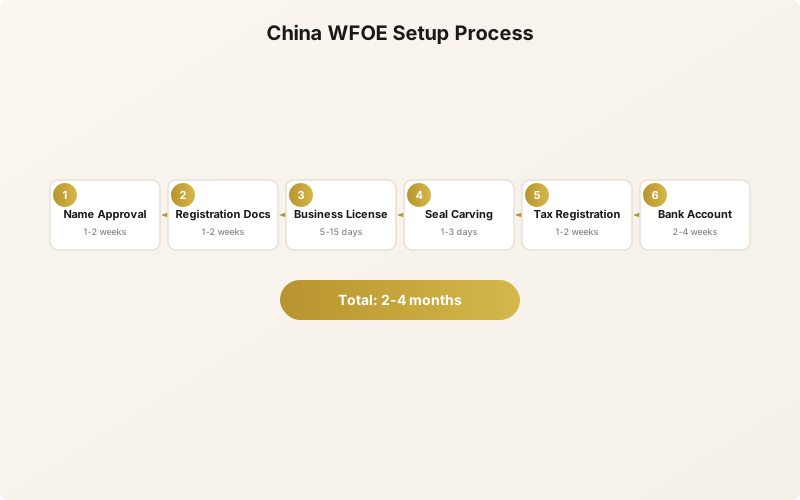
A2: The WFOE setup process typically takes 2-4 months from start to finish, depending on the industry and location. The timeline includes: name approval (1-2 weeks), preparing registration documents (1-2 weeks), business license application (5-15 business days), seal carving (1-3 days), tax registration (1-2 weeks), bank account opening (2-4 weeks), and any special industry licenses (variable timeline). Certain restricted industries may require additional approvals that can significantly extend the timeline.
Q3: What is the difference between a WFOE and a joint venture in China?
A3: A WFOE (Wholly Foreign-Owned Enterprise) is a limited liability company entirely owned by foreign investors, offering full control over operations but requiring the foreign investor to handle all aspects of market entry independently. A joint venture involves partnering with a Chinese shareholder, which can provide market access, local expertise, and government relationships but requires sharing control and profits. The choice depends on the industry (some sectors require joint ventures under the negative list), the level of local market knowledge needed, and the desired degree of operational control.
Q4: Can a foreign company hire employees in China without a local entity?
A4: Foreign companies cannot directly hire employees in China without establishing a legal entity. The common alternatives include using a PEO (Professional Employer Organization) or staffing agency for temporary or initial staffing needs, engaging independent contractors (though this carries misclassification risks), or establishing a representative office (which is limited to non-commercial activities like market research and liaison work). For ongoing business operations, establishing a WFOE or joint venture is the proper way to hire local employees directly and issue employment contracts.
Q5: What industries are restricted for foreign investment in China?
A5: China publishes a Foreign Investment Negative List that specifies industries where foreign investment is prohibited or restricted. Prohibited sectors include certain news media, compulsory education institutions, and some rare earth mining. Restricted sectors where foreign ownership is limited include telecommunications, education, healthcare, financial services, and agriculture. The negative list is periodically updated, generally becoming more open over time. Industries not on the negative list receive national treatment, meaning foreign investors enjoy the same treatment as domestic investors.
Further Reading
- Warranty, Quality Guarantee and Defect Liability in China Manufacturing — Quality control and warranty
- Product Packaging in China: A Complete Guide for Hardware Brands — Final packaging and inspection
- PCB Manufacturing in China: A Complete Guide for Hardware Companies — PCBA assembly and testing
- Battery Sourcing and Manufacturing in China: A Guide for Hardware Companies — Battery assembly and safety testing
- Supply Chain Risk Management in China: A Practical Guide for Hardware Companies — Quality risk in production
Next Steps
For hardware teams, the legal questions follow the sourcing sequence: select and vet a factory, fix tooling and payment terms, then protect the design and manage inspection, certification and export. The guides below follow that sequence.
Two service lines most often relevant at this stage:
- Which contracts does an AI company need before selling in China?
- How can a foreign AI company protect its models and code in China?
To discuss scope, timeline and fees for your own matter, Contact Us About Your China Entry. The initial consultation is free; the form prepares an email in your own mail application.
Related guides in this series
- China Hardware & Supply Chain Guide for Foreign AI Companies
- How to Select and Vet Factories in China: A Complete Sourcing Guide for Hardware Startups
- Cost of Manufacturing in China: What Foreign Hardware Startups Should Budget
Frequently Asked Questions↑ Back to article
What are the different quality inspection stages in Chinese factories?
Chinese factories typically use four main inspection stages: IQC (Incoming Quality Control) for raw materials and components, IPQC (In-Process Quality Control) for checking during assembly, FQC (Final Quality Control) for 100% finished product inspection, and OQC (Outgoing Quality Control) for random sampling before shipment. Each stage catches different types of defects and serves as a checkpoint in the production flow.
What is AQL sampling and how is it used in China?
AQL (Acceptable Quality Limit) is a statistical sampling standard used to determine whether a batch of products meets quality requirements. In China, AQL 2.5 for major defects and AQL 4.0 for minor defects are common standards for consumer electronics. Inspectors randomly sample a defined quantity of units from a batch and compare the number of defects found against the AQL acceptance number to decide whether to accept or reject the lot.
What types of functional testing do Chinese factories perform?
Chinese electronics factories commonly perform FCT (Functional Circuit Testing) to verify that assembled products work as intended — including power-on tests, parameter measurement tests, load tests, and communication tests. Many also offer ICT (In-Circuit Test) for component-level verification, burn-in/aging tests for reliability screening, and environmental testing (temperature, humidity, vibration) for products requiring higher durability standards.
How do I set quality standards with my Chinese manufacturer?
Start by creating a detailed quality inspection criteria document with defect classifications (critical, major, minor) and clear pass/fail criteria for each inspection point. Develop and approve golden samples (appearance, functional, and limit samples) that both sides sign off on. Establish SOPs (Standard Operating Procedures) for each assembly and testing step. Put a quality agreement in the contract that specifies AQL levels, defect rates, and corrective action procedures. Conduct training sessions with the factory's QC and production teams before mass production.
Should I use a third-party inspection company in China?
Third-party inspection is highly recommended for hardware startups without their own on-the-ground quality team in China. Companies like SGS, Bureau Veritas, TUV, and Intertek provide independent verification during production (DUPRO), before shipment (PSI/FRI), and during container loading (CLI). Costs typically range from $250–$450 per man-day. However, third-party inspectors only sample what they can see on the day — they cannot guarantee zero defects, and they cannot replace systematic quality control built into the production process. For high-volume or high-complexity products, having your own quality engineer on site is ideal.
What types of assembly lines do Chinese factories use?
Chinese factories typically use three assembly line types depending on volume and product complexity. Manual lines, the most common for low-to-medium volume, use workers along a conveyor performing individual steps and can be reconfigured quickly. Semi-automated lines combine manual stations with automated equipment for high-precision steps, making sense for volumes of 50,000–500,000 units per year. Fully automated lines use robots for nearly all assembly but cost $1 million or more and only make sense at very high volumes or where precision exceeds human capability.
What are golden samples and why are they important in manufacturing?
Golden samples are signed, dated reference samples that represent the agreed quality standard for a product, including appearance samples, functional samples, and limit samples showing the boundary between acceptable and unacceptable defects. They are critically important because they eliminate ambiguity about what 'good' looks like — both sides can reference the physical sample rather than arguing about written descriptions. Both the buyer and factory should sign off on golden samples before mass production begins, and they should be properly stored to prevent damage or degradation.