AIGC Applications is one of the most dynamic sectors in China’s AI industry — and one where foreign companies can find significant opportunity. But entering the Chinese market for aigc applications comes with specific regulatory requirements, market dynamics, and structural considerations that differ from other markets.
This guide covers what foreign companies need to know before entering China: why the market matters, what regulations apply, how to set up your entity, and what pitfalls to avoid.
Why AIGC Applications in China
China’s generative AI application market is the fastest-growing in the world, with hundreds of millions of users across consumer and enterprise segments. The market includes AI chatbots, AI writing tools, AI image/video generation, AI education, AI enterprise assistants, and more. Foreign AIGC companies with differentiated technology or vertical expertise can find significant opportunities, though the regulatory bar is high.
1. Massive user base
China has the world’s largest internet population and the fastest adoption of generative AI tools. Consumer AIGC apps can reach hundreds of millions of users; enterprise AIGC tools serve millions of businesses.
2. Rapid commercialisation
Chinese users and companies are fast adopters of AI tools. The speed from product launch to commercial scale is faster in China than almost any other market.
3. Ecosystem of foundation models
China has one of the most vibrant LLM ecosystems outside the US, with dozens of foundation models available. AIGC app companies can choose from multiple model providers and build on top of the ecosystem.
4. Vertical market depth
From education and healthcare to e-commerce and content creation, China’s vertical markets are large enough to support dedicated AIGC products. The depth of each vertical creates opportunities for specialised foreign players.
Key regulatory requirements for AIGC Applications
China has a comprehensive regulatory framework for AI and technology products. For aigc applications companies, the specific requirements depend on your product type, architecture, and business model — but these are the areas that most often come up:
1. Generative AI service registration
If you provide generative AI services to users in China — including chatbots, content generation tools, or AI assistants — you need to complete the Generative AI Service Registration. This requires domestic hosting, a Chinese entity, content security mechanisms, and algorithm filing.
2. Algorithm recommendation filing
If your app uses algorithmic recommendation features (content recommendations, personalised feeds, etc.), you also need to complete Algorithm Recommendation Filing in addition to generative AI registration.
3. Content moderation requirements
Generative AI services must implement content security measures including pre-generation filtering, post-generation review, and content retention. The standards for what constitutes prohibited content are broader than many foreign companies expect.
4. Training data compliance
Generative AI service providers must ensure their training data does not infringe IP rights and complies with data security laws. Foreign models trained on global datasets may face scrutiny regarding Chinese content in the training data.
5. AIGC content labelling
AI-generated content must be clearly labelled per GB 45438-2025 (AIGC Content Labelling standard). The rules are more detailed than many foreign companies expect, covering where to label, how to label, and record-keeping requirements.
Entity setup for AIGC Applications companies
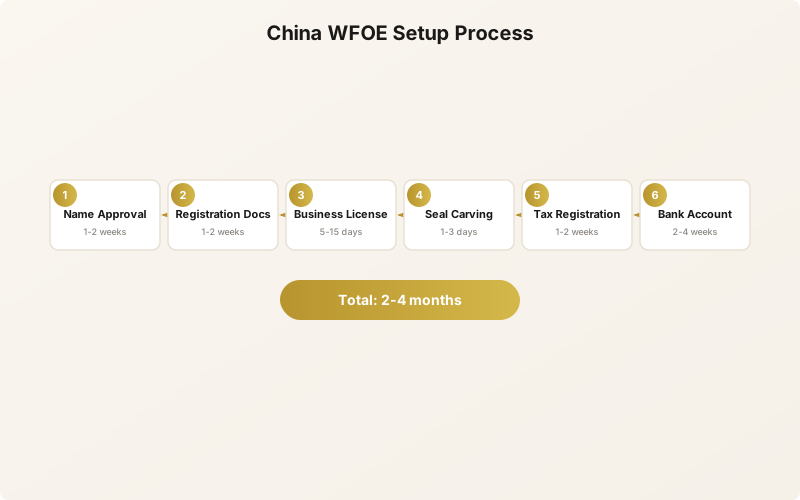
Most AIGC app companies set up a WFOE in Shenzhen or Beijing. Shenzhen is preferred for consumer-facing AI products and access to the tech ecosystem; Beijing is stronger for enterprise AI and closer to key regulators. The key challenge is not just setting up the entity — it is getting through the generative AI service registration process, which can take 4–12 weeks and requires significant preparation. Many companies underestimate how much content security infrastructure is needed.
Related: WFOE Setup in China: A Complete Guide for Foreign AI Companies
Common pitfalls — and how to avoid them
- Assuming a global SaaS model works in China — generative AI services serving Chinese users need domestic infrastructure and regulatory registration
- Underestimating content moderation requirements — Chinese content standards are different from global norms and require dedicated systems
- Thinking model licensing alone is enough — if you serve end users in China, you need your own registration even if you use a Chinese model provider
- Neglecting IPR strategy — AI output copyright, training data rights, and model IP all need China-specific attention
Next steps
If you are an AIGC company considering China, start by understanding exactly which regulatory pathways apply to your product — generative AI registration, algorithm filing, or both. Then assess your content moderation capabilities and determine whether your current global architecture can be adapted or if you need a separate China deployment.
If you would like to discuss your specific situation, contact us for a free initial consultation. We work with foreign aigc applications companies at all stages — from initial market assessment to full compliant launch.
Related resources
- China Entry Readiness Checklist — assess your readiness across 25 checkpoints
- Algorithm Filing Document Checklist — know what to prepare before you start
- Cross-Border Data Transfer Decision Tree — find the right pathway for your data
- How to Choose a Good Chinese Law Firm for AI and Tech Work — five verification criteria
Hiring Your First China Employees: Key Considerations
Your first employees in China will shape the culture, direction and trajectory of your China operation. Getting the hiring right — especially for the country lead role — is one of the most important factors in China entry success.
The China country lead needs a rare combination of skills: deep understanding of the local market, ability to work with foreign headquarters, technical credibility in your industry, and the leadership skills to build a team from scratch. Finding someone who has all four is challenging, and many companies underestimate how long this search takes.
Employment law in China also differs from what many foreign companies are used to. Employment contracts are mandatory, probation periods have strict limits, and termination is more regulated — “at will” employment does not exist. Social insurance (pension, medical, unemployment, work injury, maternity) and the housing fund are mandatory contributions that add significantly to total compensation cost.
For AI companies specifically, there is also the question of where to locate. Shenzhen is the natural choice for hardware and AI companies — it has the deepest talent pool, the strongest supply chain, and the most supportive policy environment. But competition for top AI talent is intense, and salaries have risen rapidly. Budget accordingly.
Protecting Your IP Before You Enter China
Intellectual property protection is often the number one concern for foreign AI and tech companies entering China. And with good reason — IP disputes are common, and the consequences can be severe. But many companies make the mistake of thinking about IP protection only after they have started operations, when the most important steps should happen before entry.
The first principle of China IP strategy is: register everything before you come. Patents, trademarks, software copyrights — each needs to be registered in China to be enforceable there. China follows a first-to-file system, which means whoever files first gets the rights, regardless of who invented it first. If you wait until after you enter, you may find that someone else has already filed for your brand name or key technology.
Second, structure your contracts carefully. Your employment contracts should have clear IP assignment clauses, confidentiality provisions, and non-compete obligations (though non-competes are limited in scope and duration under Chinese law). Your supplier contracts should specify who owns the tooling, the designs, and any improvements made during the manufacturing relationship.
Third, build internal IP protection systems. Access controls, compartmentalisation of sensitive information, employee training, and regular audits all contribute to a defensible IP position. And if the worst happens — infringement or misappropriation — you need a plan for how to respond, whether through administrative channels, civil litigation, or criminal complaint.
Tax Considerations for Foreign Companies in China
Tax is often one of the most complex and underestimated aspects of China entry. Foreign companies need to navigate multiple taxes — corporate income tax, VAT, individual income tax, stamp duty, and various local surcharges — plus a system of preferential policies that can significantly reduce your effective tax rate if you qualify.
Corporate income tax (CIT) is 25% for standard enterprises, but high-tech enterprises (HTEs) qualify for a 15% rate. For AI and tech companies, the HTE certification is one of the most valuable tax incentives available. The qualification criteria cover R&D investment, intellectual property ownership, and the proportion of revenue from high-tech products or services. The application process takes several months and requires careful preparation.
Value-added tax (VAT) applies to most goods and services at rates ranging from 6% (for services like consulting and technology) to 13% (for goods). Foreign companies often find China’s VAT system more complex than equivalent systems in other countries, with different rules for different activities and specific requirements for invoicing and filing.
Transfer pricing is another area that deserves attention. Transactions between your China entity and your overseas parent or affiliates need to be priced at arm’s length and properly documented. China’s tax authorities have been increasingly active on transfer pricing enforcement, especially in the tech sector. Having proper transfer pricing documentation in place from the start can save significant headaches later.
The Real Cost of Entering China: Beyond Setup Fees
When budgeting for China entry, foreign companies often focus on the setup fees — business license, registered capital, legal fees — and underestimate the ongoing operational costs. The setup cost is real, but it is typically the smallest part of the total cost of being in China.
The major ongoing costs fall into several categories. First, people: salaries, benefits, social insurance (which adds about 30-40% on top of base salary), and housing fund contributions. Second, office and infrastructure: rent in Shenzhen or Shanghai is comparable to major Western cities, plus IT infrastructure and compliance systems. Third, compliance: annual audit, tax filing, regulatory filings, and legal advisory. Fourth, taxes: corporate income tax (25% standard rate, though high-tech enterprises qualify for 15%), VAT (6-13% depending on activity), and withholding tax on profit repatriation.
There are also less obvious costs. The opportunity cost of management time spent on China operations is significant. The cost of mistakes — a misfiled tax return, an employment dispute, a compliance gap — can be high. And the cost of doing business slowly — taking longer to hire, longer to get approvals, longer to reach profitability — adds up.
The companies that succeed in China are the ones that budget for the full picture, not just the setup fees. They plan for at least 18-24 months of operating runway before expecting the China entity to be self-sustaining.
Shenzhen vs. Shanghai vs. Beijing: Where to Locate
Where you establish your China entity matters — for talent access, supply chain proximity, policy environment, and cost. The three main options for tech and AI companies are Shenzhen, Shanghai, and Beijing — each with different strengths and cultures.
Shenzhen is the hardware and manufacturing capital of China, with the deepest supply chain ecosystem in the world. It has a young, entrepreneurial culture, strong government support for tech and AI companies, and a pragmatic regulatory environment. For AI hardware, robotics, or any company that works closely with manufacturing, Shenzhen is usually the first choice. Salaries and rent are lower than Beijing or Shanghai, and the pace of business is faster.
Shanghai is China’s financial and commercial capital, with the largest concentration of multinational companies. It has a more international business environment, strong legal and financial services, and excellent global connectivity. For SaaS, enterprise software, or companies focused on serving multinational clients in China, Shanghai is a strong choice. It is also the most ‘international’ of the three cities, which can make it easier for expat employees.
Beijing has the deepest AI research talent pool, with top universities and research institutions, plus the headquarters of many of China’s largest internet companies. It is also where most national regulators are based, which can be an advantage for companies with heavy regulatory engagement. The downside is higher cost, more bureaucracy, and a slower, more relationship-driven business culture.
The right choice depends on your industry, your talent needs, your supply chain requirements, and your personal preference. Many companies start with one city and expand to others as they grow.
Visa, Work Permits, and Relocation for Foreign Staff
If you are sending foreign employees to China to build your operation, you need to navigate the visa and work permit system. The process has become more streamlined in recent years but still requires careful planning and documentation.
The standard path for foreign workers in China is: first, obtain a work permit notification from the local foreign experts bureau (or equivalent), then apply for a Z visa (work visa) at a Chinese embassy or consulate in your home country, travel to China, then complete the work permit and residence permit process after arrival. The whole process typically takes 2-4 months from start to finish.
Eligibility for a work permit is based on a points system that considers factors like education, work experience, salary, age, and Chinese language ability. There are three tiers (A, B, C) with different requirements and benefits. Tier A (high-end talent) gets the fastest processing and the most benefits; Tier C (unskilled workers) is restricted. For AI and tech professionals, most qualify for Tier A or B.
There are also special programmes for high-end talent — like the Shenzhen Peacock Plan — that provide faster processing, preferential treatment, and sometimes financial incentives. If you qualify, these programmes are worth pursuing as they can significantly speed up the process and reduce the administrative burden.
Relocation support — housing, schooling for children, healthcare access, cultural adaptation — is also important. Employees who are well-supported in their relocation are more productive and more likely to stay long-term. Budgeting for this support is an investment, not a cost.
Working with Chinese Partners and Distributors
Many foreign companies entering China consider working with a local partner or distributor as a way to accelerate market entry and reduce risk. Partners can provide local market knowledge, existing customer relationships, and regulatory expertise. But partnerships also come with challenges — and they rarely work out as well as expected without careful structuring and management.
The most common types of partners are: distributors (who buy your product and resell it), agents (who sell on your behalf for a commission), strategic partners (who invest in deeper collaboration), and licensing partners (who license your technology and sell their own products based on it). Each type has different implications for control, revenue share, and risk.
Key success factors for partnerships include: clear expectations from the beginning (what each side is responsible for, what the targets are, how success is measured), strong contracts (with clear terms for exclusivity, territory, pricing, IP protection, and termination), active management (partnerships need attention — they do not run themselves), and an exit strategy (what happens if it does not work out? How do you end the relationship cleanly?).
The biggest mistake companies make is treating the partnership as a shortcut that means they do not need to build their own China capability. In practice, even with a strong partner, you still need your own team on the ground to manage the relationship, protect your interests, and ensure you are learning about the market directly.
China Market Entry Timeline: What to Expect Month by Month
One of the most common questions from foreign companies is: how long does China entry actually take? The answer depends on what you mean by ’entry’ — just setting up an entity, or having a fully operational team with a launched product? Here is a realistic timeline for a typical AI or tech company.
Month 1-2: Planning and preparation. Finalise the entry strategy, choose the entity type and location, engage advisors, and start preparing documentation. If you are going the WFOE route, you need to gather various corporate documents from your home country and get them notarised and apostilled.
Month 2-4: Entity setup. Submit the WFOE application, go through the review process, and receive your business license. Then carve the official seals, open bank accounts, register for taxes, and set up social insurance and housing fund accounts.
Month 3-5: Team building. Start hiring your first employees — ideally the country or GM hire first, then they can help build the rest of the team. Set up office space, IT infrastructure, and basic operational systems.
Month 4-8: Product localisation and compliance. Adapt your product for the China market, set up the required compliance infrastructure (privacy policy, data systems, filing preparation), and start the regulatory filing process if needed.
Month 6-12: Launch and initial revenue. Soft launch your product or service, acquire your first customers, and begin generating initial revenue. Refine your go-to-market strategy based on early feedback.
This is a general timeline — some companies move faster, some slower. The most common delay factors are slow decision-making at headquarters, difficulty finding the right country lead, and underestimating the compliance work required for launch.
Entity Structure Decision Tree: WFOE, JV, RO or No Entity?
One of the first and most important decisions when entering China is choosing the right legal entity structure. The options — and the tradeoffs between them — are often more nuanced than foreign companies expect.
A wholly foreign-owned enterprise (WFOE) is the most common choice for foreign tech and AI companies. It gives you full control, allows you to hire employees directly, issue RMB invoices, and conduct a wide range of business activities. The tradeoff is higher setup cost, more compliance obligations, and a longer setup timeline (typically 2-4 months).
A representative office (RO) is simpler and cheaper to set up, but it can only perform liaison activities — market research, contact facilitation, quality control oversight. It cannot generate revenue, sign contracts, or hire employees directly. ROs are suitable for the initial exploration phase but quickly become limiting as you grow.
A joint venture (JV) — partnering with a Chinese company — offers local market access and shared risk, but at the cost of control. For AI companies specifically, JVs also raise IP protection concerns that need careful contractual structuring.
Finally, some companies start without a China entity at all, serving the market cross-border through a Hong Kong or Singapore entity. This avoids China entity setup entirely but limits what you can do locally and may not work for products that require domestic licensing or filing.
Related Articles
- Enterprise SaaS China Entry Guide for Foreign Companies
- Why Enter the China AI Market? Opportunities, Ecosystem, and What Foreign Companies Need to Know
- Autonomous Driving & NEV China Entry Guide
- China AI Startup Legal Cost Benchmark 2026
FAQ
Q: How long does it take to set up a WFOE in China?
A: A typical WFOE setup takes two to four months from start to finish, assuming you have all the required documents ready. The timeline can be longer if your business scope requires special permits or licenses, or if there are complications with the application. Shenzhen and other first-tier cities generally have more efficient processes than smaller cities.
Q: How much registered capital do we need?
A: China no longer has a minimum registered capital requirement for most types of companies — the amount is up to you. But registered capital is not meaningless. It represents the shareholders’ liability limit, and it affects how your company is perceived by banks, partners, and regulators. For a typical AI or tech WFOE, registered capital of RMB 1-5 million is common, but the right amount depends on your business plan, capital needs, and risk tolerance.
Q: Can we hire employees before the WFOE is set up?
A: Technically, no — only a properly registered entity can employ people in China. In practice, many companies use a third-party employment agency (劳务派遣 or HR service provider) during the setup phase to get people on the ground quickly. Once the WFOE is established, you then transfer the employees to your own payroll. This is a common and legitimate approach, but you should use a reputable agency and understand the legal relationship.
Q: What are the main tax incentives for AI companies?
A: The High-Tech Enterprise (HTE) certification is the most valuable tax incentive for AI and tech companies — it reduces the corporate income tax rate from 25% to 15%. There are also incentives for R&D (super-deductions for R&D expenses), software enterprises (VAT refunds and tax holidays), and specific regional incentives (Shenzhen has several programs for AI and tech companies). The availability and details of incentives change periodically, so you should get current advice based on your specific situation.
Q: Do we need a physical office address to register?
A: Yes, you need a registered business address to set up a WFOE. It cannot be a residential address in most cases — it needs to be a commercial address. Many companies use a serviced office or business incubator address for registration, especially in the early stages. Some districts also allow virtual office registration for certain types of companies. The specific requirements depend on the district and the type of business.
Related guides in this series
- China Algorithm Filing: A Complete Guide for Foreign Companies (2026)
- Algorithm Filing in China: A Complete Guide to the Five Steps and Four Core Document Sets
- Algorithm Filing and Large-Model Filing: What Separates Them, and the Order in Which to Decide
Frequently Asked Questions↑ Back to article
Do aigc applications companies need a Chinese entity to enter China?
It depends on your business model. If you are only selling hardware components or software licenses cross-border, you may not need a local entity. But if you are providing services to users in China, handling Chinese user data, or having a physical presence — you typically need a domestic entity. We assess your specific situation and advise on the right structure.
How long does it take to launch an aigc applications product in China?
Timeline varies significantly by product type. Entity setup takes 6–8 weeks. Licensing and compliance add 2 weeks to 6+ months depending on your product category and regulatory requirements. Budget 3–9 months for a full compliant launch, depending on what certifications and filings you need.
What are the biggest compliance risks for foreign aigc applications companies in China?
The biggest risks vary by sub-sector but generally include: data compliance (data localisation and cross-border transfer), product safety and standard compliance (especially for physical products), algorithm and AI regulation, and licensing requirements. The specific risks depend on your product architecture and business model.
Do I need an ICP filing for an AI app used in China?
If your app has a website or web-based component targeting Chinese users, yes — you need ICP filing (ICP beian). For apps distributed through Chinese app stores, you also need ICP filing and potentially other licenses depending on the app's functions. AIGC apps that generate content may also need algorithm filing and content regulation compliance.
What are the data security requirements for AI apps in China?
China has comprehensive data security laws. Key requirements include: (1) data classification and grading, (2) personal information protection (similar to GDPR but with China-specific requirements), (3) important data protection, (4) data security assessment for certain types of data processing, (5) data export security assessment for cross-border data transfers, and (6) cybersecurity compliance. For AIGC apps, training data sourcing and user data protection are both critical.
What is the generative AI service registration requirement in China?
If you provide generative AI services to users in China — including chatbots, content generation tools, or AI assistants — you must complete the Generative AI Service Registration administered by the CAC. This requires domestic hosting, a Chinese entity as the filing party, content security mechanisms including pre-generation filtering and post-generation review, and algorithm filing. The registration process typically takes 4–12 weeks and requires significant preparation, particularly for content moderation infrastructure.
What content moderation requirements apply to AIGC apps in China?
Generative AI services in China must implement comprehensive content security measures, including pre-generation filtering to prevent the model from generating prohibited content, post-generation review to catch problematic outputs, and content retention for regulatory inspection. The standards for what constitutes prohibited content are broader than many foreign companies expect, covering political, social, and cultural sensitivities specific to China. Many companies underestimate how much content security infrastructure is needed to pass the registration review.